← back to metaculus scans
What will be the total OpenRouter token usage December 21-27, 2026?
286000000000000.0
Submitted p50
tech
Domain
Plan 8.7s
Sub-questions (0)
Tool requests (3)
resolution_source
{"question": "What will be the total OpenRouter token usage December 21-27, 2026?", "source_name": "OpenRouter rankings - Top Models weekly usage chart", "urls": ["https://openrouter.ai/rankings#top-models"]}
web_search
{"queries": ["OpenRouter weekly tokens trillion October 2026", "OpenRouter rankings December 2025 holiday week token usage decline", "OpenRouter tokens per week Christmas week 2025 chart"]}
code_execution
{"code": "import numpy as np\n# Known points from question: ~5T/wk Nov 2025, ~25T/wk May 2026, top10 127T Sep 13 2026 (chart total)\nweeks_may_to_sep=17\nprint(\u0027implied weekly growth May-\u003eSep (25-\u003e127):\u0027, (127/25)**(1/weeks_may_to_sep)-1)\nweeks_sep_to_dec=15\nfor g in [0.0,0.01,0.02,0.04,0.06,0.10]:\n print(g, 127*(1+g)**weeks_sep_to_dec)\nfor dip in [0.8,0.9,1.0]:\n print(\u0027dip\u0027,dip,[round(127*(1+g)**weeks_sep_to_dec*dip,1) for g in [0,0.02,0.04,0.06]])"}
Research 118.71s · 3 tool(s) · 0 error(s)
resolution_source
ok
resolved=unclear; The page shows usage data only through Oct 9, 2026
4.69s
web_search
ok
20 results
24.2s
code_execution
ok
Extrapolate Dec 21-27 weekly tokens from the question's data
0.2s
current state
ok
6 searches · 3 reads · 5302 chars
63.9s
base rate
ok
6 searches · 1 reads · 5996 chars
65.4s
key factors
ok
5 searches · 1 reads · 5598 chars
39.1s
expert view
ok
6 searches · 1 reads · 4864 chars
57.4s
high case
ok
5 searches · 1 reads · 6517 chars
44.2s
low case
ok
5 searches · 2 reads · 6359 chars
49.0s
report: current state
- [2026-10-08] OpenRouter's live public rankings page states usage data runs "through Oct 8, 2026," with the top single model (DeepSeek V4.1 Flash) alone at
37.6T tokens
 that week and the next nine ranked models (Space Bunny Alpha, GLM 5.3 Flash, MiMo-V2.6-Flash, Hy4 preview, GPT-6 Luna, Nemotron 3 Ultra, DeepSeek V4 Flash 0731, Claude Opus 5.5, GLM 5.3) summing to roughly 112T more — top-10 sum ≈112–125T tokens for that week alone (fetched directly from openrouter.ai/rankings).

- [2026-09-22] OpenRouter's own first-party data newsletter ("Inferred," published on openrouter.ai/data) states:
"Weekly token volume on OpenRouter went from 0.5 trillion in the week of Jan 13, 2025 to 128.4 trillion in the week of Sep 14, 2026."
 That's the authoritative primary-source total (all models, not just top 10) for the week immediately preceding the question's cited Sept 7-13 example.

- [2026-09-22] The same OpenRouter primary source describes the growth as
a 250x increase in 20 months, with open-weight model token share having "crossed 50% of tokens briefly in February and more permanently in April," reaching 79% in July and holding above 62% since
, and notes
"69% of tokens on OpenRouter last week were from Chinese labs (vs 72% being open-weight overall)."


- [2026-10-08] A secondary summary of OpenRouter's rankings (the-decoder.com) corroborates the official figure:
"weekly token consumption has surged more than 25,000 percent since January 2025, from 0.5 trillion to 126.2 trillion tokens."


- [2026-05-26] One year-ago-ish baseline from OpenRouter's Series B announcement:
"OpenRouter's volume has surged to 25 trillion tokens per week (100 trillion tokens per month), representing a 5X increase from the 5 trillion tokens processed per week just six months ago."
 This puts weekly volume at ~5T in roughly November 2025 and ~25T in May 2026 — i.e., the platform has grown roughly 5x again (25T→~128T+) between May and September 2026.

- [2026-10-11] A live Polymarket market tracking "OpenRouter token usage week of October 5" (resolution source: openrouter.ai/rankings) shows traders pricing the week's total in the
165–185T range, with "Daily aggregates near 12T on October 4" suggesting the October 5-11 week could land in that band
, implying continued steep week-on-week growth beyond the Sept 14 figure of 128.4T.

- [2026-10-04] The same Polymarket description notes
"Recent OpenRouter data shows weekly token volumes hovering near 150-166T amid rapid growth in agentic workloads, which now consume roughly five times the tokens of human-driven traffic and favor cached, low-cost open-weight models"
, and cites Chinese labs plus the anonymous "Space Bunny Alpha" stealth model as recent growth drivers.

- [2026-10-09] A Hindustan Times feature confirms the dominant current token-share composition:
token consumption on the platform is currently dominated by cost-effective models from DeepSeek and two other Chinese makers, Z.ai and Xiaomi, alongside a well-performing OpenAI model
 (per original AskNews summary, corroborated by the live rankings leaderboard).

- [2026-10-08] OpenRouter's own rankings methodology page states freshness and release cadence:
"The date above the rankings is the newest usage bucket the leaderboard is computed from... so it advances only when new usage data is aggregated"
 — in practice this is a near-daily refresh, with the weekly bar chart updating each time a new UTC day closes, meaning the Dec 21-27 bar itself will only be finalized/displayed in full once Dec 28 UTC data is aggregated (shortly after the week ends, before the Dec 29 resolution date).

- [2026-10-10] Chinese state-linked commentary (Caixin) independently describes the same trend using monthly units:
"the global Token economy is experiencing exponential growth, with the model routing platform OpenRouter seeing monthly processing volumes surge from several trillion in early 2025 to over 100 trillion by July 2026"
 (note: this monthly figure is likely stale/understated relative to the weekly totals above, since OpenRouter's own September data shows ~128T in a single week).

NOT FOUND: An official, archived OpenRouter total-weekly-token figure newer than Sept 14, 2026 (128.4T) that is unambiguously from OpenRouter's own site/API rather than third-party trackers or prediction-market extrapolation; a precise current reading of the live "Top Models" stacked bar chart's *total* height (vs. top-9+Others) for the week of Sept 28–Oct 4 or Oct 5–11, 2026; and any OpenRouter statement specifically addressing expected holiday-week (Dec 21-27) developer activity effects.

BOTTOM LINE: OpenRouter's own first-party data confirms explosive, still-accelerating weekly token growth — from 0.5T (Jan 2025) to 128.4T (week of Sep 14, 2026), a ~250x rise in 20 months — and independent market-based estimates (Polymarket) suggest volumes of 150-185T+ were already being reached by early October 2026; if this exponential trajectory continues even partially through the holiday season, the Dec 21-27, 2026 bar is likely to land well above 128T, though the magnitude is highly uncertain given the chart's history of large week-to-week swings from stealth-model launches, pricing changes, and potential holiday-week dips in developer (non-agentic) activity.
report: base rate
- [2026-09-22]
Weekly token volume on OpenRouter went from 0.5 trillion in the week of Jan 13, 2025 to 128.4 trillion in the week of Sep 14, 2026
, a
roughly 250x increase in 20 months
 — the trendline against which the Dec 21-27, 2026 window must be judged. https://openrouter.ai/data/newsletter/the-token-state-of-play

- [2025-12 est., per Aug 2026 retrospective]
Weekly token processing on OpenRouter expanded from 0.4 trillion in December 2024 to 27.0 trillion by March 2026 due to agentic workflows
 — the "prior year" (Dec 2024) baseline is ~0.4T tokens/week. https://www.octagonai.co/markets/science-and-technology/tokens/openrouter-ai-token-usage-aug-24-30

- [2026-04-25 (age 192d) retrospective] By the Series B background, six months before May 2026 (i.e., ~Nov 2025) volume was ~5T tokens/week, rising to ~25T/week by May 2026 — a 5x jump in six months, implying Dec 21-27, 2025 sat somewhere around 6-9T tokens/week, well below the ~25T reached by May 2026. (From question background, corroborated by growth-curve sources above.)

- [2025-12-04]
In June 2025, Menlo Ventures stated that OpenRouter scaled 10x from processing 10 trillion tokens a year to over 100 trillion tokens a year; that figure eclipsed 300 trillion tokens annually by December 2025, as the company processed more than 1 trillion tokens every single day
 — implying Dec 2025 weekly run-rate near 7T+ tokens, consistent with the Nov 2025 "~5T/week" anchor in the question background. https://research.contrary.com/company/openrouter

- [2024-01→2025-03 YoY]
OpenRouter LLM tokens used are up 57x year on year and 2.8x year to date, now at 1,060 billion per week
 (reported ~early March 2025), with
OpenRouter crossing 1 trillion tokens in a single week for the first time around March 3, 2025
 — showing the pace of compounding was already extremely fast a year before the question's 2025 comparison point. https://x.com/_LouiePeters/status/1896405477594124372

- [2024-01]
OpenRouter's weekly token usage grew by roughly 9,000x since January 2024, when the platform processed about 10 billion tokens per week, ballooning past 90 trillion by mid-2026
 — Dec 21-27, 2023 usage (platform founded in 2023) would have been at or below this ~10B/week starting point, i.e., negligible compared to any later year and likely not separately reported. https://cryptobriefing.com/openrouter-9000x-token-usage-growth/

- [2024-12-26]
On December 26, 2024, DeepSeek officially released its open-source large language model DeepSeek-V3, a Mixture-of-Experts model with 671 billion parameters, showing performance comparable to top closed models
 — this release landed inside last year's exact equivalent calendar window (Dec 21-27) and is widely credited as the inflection point that began the subsequent token-volume supercycle, illustrating how a single holiday-week model drop can be a major "surprise" driver of the resolution-week bar.

- [2026-09-17]
Weekly token consumption has surged more than 25,000 percent since January 2025, from 0.5 to 126.2 trillion tokens, though this says less about actual AI usage than about token-hungry reasoning models and unoptimized AI agents that burn through tokens at staggering rates
 — a caution that the metric's growth reflects compounding inflation from reasoning/agentic tokens, not a stable or easily-forecastable usage base. https://the-decoder.com/openrouters-staggering-token-chart-is-the-ai-bubble-debate-in-a-single-image/

- [2026-09-22]
Open-weight model token share crossed 50% of tokens briefly in February and more permanently in April of this year, reached 79% in early July, its high point, and has held above 62% since
 — showing that even sub-component shares of the total (which feed into the headline weekly number) can swing by double-digit percentage points within weeks, a source of surprise/volatility in the weekly total itself. https://openrouter.ai/data/newsletter/the-token-state-of-play

- [2026-06 retro] A market analysis found that
the actual inference market has shifted somewhere else entirely — Chinese open-weight labs went from a rounding error to more than half of the tracked flow in twelve months, and the total market is up 11.1×
 over a trailing 12-month window, underscoring that an ~11x year-over-year increase has been a recent "typical" pace rather than an outlier. https://www.codesota.com/agentic/openrouter-trends

- [2025-03-03 / 2026-03-22] Chinese-origin models' share of the platform has itself been a volatile, fast-moving sub-series:
in October 2024, Chinese-developed models accounted for approximately 1.2% of all OpenRouter token volume; by March 2025, after DeepSeek V3's launch, that figure crossed 10%; by Q3 2025, Kimi K2 and MiniMax pushed it past 25%
, illustrating how quickly composition (and hence the headline aggregate) can re-rate within a given quarter.

BOTTOM LINE: Year-over-year, the Dec 21-27 weekly-token figure has roughly doubled-to-grown-tenfold each successive year on record (negligible/~10B in 2023 → ~0.4T in 2024 → roughly 6-9T in 2025, per the closest available anchors), with the single largest documented "surprise" in this exact calendar window being the Dec 26, 2024 DeepSeek-V3 launch that kicked off a multi-order-of-magnitude compounding cycle; given 250x growth from Jan 2025 to Sep 2026 and a Sep 2026 level already at ~127-128T/week, historical pattern strongly favors continued (if decelerating) growth into the Dec 21-27, 2026 bar, but the series' history of sudden step-changes around single model releases or pricing shifts means unusually large positive or negative surprises cannot be ruled out.

NOT FOUND: An exact, dated OpenRouter rankings-chart value for the Dec 21-27 bar in 2023, 2024, or 2025 (the platform's own historical weekly chart image was not accessible via fetch for a precise read of those specific weeks); any explicit "consensus forecast" or prediction-market historical accuracy track record for this specific weekly-token metric in past years.
report: key factors
**Key causal drivers of the Dec 21-27, 2026 weekly-token bar**

- [2026-08-19] Stripe agreed to acquire OpenRouter, reported at $7.5-8B+; both companies' own posts state
"The transaction is subject to customary closing conditions. We expect to close in the coming weeks."
 As of early October no close date, regulatory jurisdiction, or integration timeline has been disclosed (https://www.acquiry.com/deal-intelligence/stripe-acquires-openrouter/), meaning ownership/control of the rankings methodology itself could change hands before Dec 29 resolution — a governance risk not present for earlier weekly bars.

- [2026-08-26] OpenRouter's own rankings documentation (fetched directly) confirms the mechanism is unlikely to change before December:
"Each model is ranked by the number of tokens it processed through the OpenRouter API, counting both prompt and completion tokens. Usage is aggregated into daily buckets in UTC and totalled per model variant... Requests that a user or app keeps private are excluded before aggregation."
 This is the structural "recipe" that decides the number; it is controlled unilaterally by OpenRouter engineering, not by model labs or traders.

- [2026-10-09] Independent GitHub-based tracker built on OpenRouter's public API (a third party, not OpenRouter itself) reported weekly totals of 145.8T (week of Sep 21) rising to 165.9T (week of Sep 28), a roughly +14% week-over-week jump but with the trailing 4-week growth rate decelerating from ~47% to ~43% — the clearest near-real-time evidence of deceleration-within-growth that the forecaster group lacked a precise mechanism for (https://github.com/mbhardwaj103/token-elasticity).

- [2026-09-02] Bank of America (via 36Kr), the only dated institutional forecast found, expects DeepSeek V5 in H2 2026 — i.e. plausibly landing inside or just before the Oct-Dec window; DeepSeek has issued no V5 announcement or roadmap as of late September, and analysts caution
"Only a sell-side forecast exists: Bank of America expects V5 in the second half of 2026, per 36Kr."
 A DeepSeek-V3-style (Dec 26 2024) surprise open-weight flagship launching in the Dec 21-27 window itself would be the single largest plausible upside shock to the bar, given the documented pattern that
"Usage spikes align with major open-model releases such as DeepSeek V3 and Kimi K2... these increases persist beyond initial release weeks, implying genuine production use rather than short-term experimentation."


- [2026-10-10] Chinese labs' share of OpenRouter token volume continues to be the dominant growth lever, not a side factor: Caixin reports
Chinese models accounting for over 45% of Token usage on the OpenRouter platform
 (per AskNews summary), consistent with OpenRouter's own newsletter figure of 69% Chinese-lab share by mid-September — meaning the Dec 21-27 total is substantially a function of whichever Chinese open-weight lab (DeepSeek, Z.ai/GLM, MiniMax, Xiaomi MiMo, Moonshot/Kimi) ships a reasoning-heavy or agentic-heavy model release in Q4, since these labs control pricing/aggressiveness independent of OpenRouter or Stripe.

- [2026-10-09] Agentic/coding workload growth remains structurally baked into the trend and is controlled by downstream developer adoption, not OpenRouter: Hindustan Times reporting (via AskNews) on the Atallah interview frames token consumption as driven by businesses routing low-"entropy" tasks to cheap models at massive scale, a pattern that is demand-side and unlikely to reverse over a single holiday week, though individual enterprise usage (not consumer chat) could dip during the Dec 21-27 corporate holiday period — a seasonal headwind no source quantifies.

- [2026-10-10] No OpenRouter statement, blog post, or newsletter addressing expected December/holiday-week seasonality was found; the closest analog — the Dec 26, 2024 DeepSeek-V3 launch — shows that the exact Dec 21-27 calendar slot has historically been a *positive* surprise window for the industry rather than a lull, undercutting any assumption of a holiday dip based on normal developer-activity patterns.

- [2026-10-10] Free-model/pricing promotions remain an ongoing, OpenRouter-controlled lever: the live site currently runs
"ElevenLabs launch offer: every ElevenLabs model is 50% off through October 19, 2026"
 and maintains a persistent
free-models tier with zero per-token cost, subject to rate limits
 — OpenRouter has repeatedly used free/discounted model slots to pull volume onto its platform, and any new free-tier flagship (e.g., a free Gemini or GLM variant) launched in November-December could materially inflate the Dec 21-27 bin independent of underlying "real" demand.

BOTTOM LINE: The outcome hinges on (1) whether the already-decelerating ~10-14%/week organic growth (per the Oct 9 token-elasticity tracker) persists through ~11 more weeks of compounding, (2) whether a major Chinese open-weight release (DeepSeek V5 being the most-watched, unconfirmed candidate) lands in or near the Dec 21-27 window and triggers a step-change as DeepSeek V3 did in the same calendar week in 2024, and (3) whether the pending, undated Stripe acquisition closing disrupts OpenRouter's reporting/methodology before the Dec 29 resolution date — none of which is resolved as of Oct 10, 2026.

NOT FOUND: Any OpenRouter-specific statement on expected holiday-week (Dec 21-27) traffic patterns; a confirmed Stripe-OpenRouter deal closing date; an official DeepSeek V5 (or other major Q4 flagship) release date; any live prediction market or analyst projection with a resolution/target date in December 2026.
report: expert view
- [2026-10-11] Polymarket's dedicated "OpenRouter token usage week of October 5?" market — the closest live proxy for this exact resolution mechanism (same openrouter.ai/rankings source) — priced the week-ending Oct 11 bin with
"165-175T 31% / 175-185T 26% / 155-165T 25% / 185T+ 20%"
 before settling toward
"165-175T" at 32%, followed by "175-185T" at 32%"
, later moving to a clear 165-175T consensus with Yes priced around 61¢ (https://polymarket.com/event/openrouter-token-usage-week-of-october-5).
- [2026-10-09] Independent "Token Elasticity" GitHub tracker, built directly from OpenRouter's public API, reported
"Data week of 2026-09-28 … Weekly tokens (OpenRouter) 165.9T unchanged | Token growth vs 4 weeks earlier 42.8% unchanged"
 (https://github.com/mbhardwaj103/token-elasticity/issues/25).
- [2026-10-04] The same tracker's prior run put the week of Sep 21 at
"Weekly tokens (OpenRouter) 145.8T unchanged | Token growth vs 4 weeks earlier 47.4% unchanged"
, implying a roughly +14% week-over-week jump into the following week but a decelerating 4-week trailing growth rate (https://github.com/mbhardwaj103/token-elasticity/issues/21).
- [2026-10-07] Octagon AI's "OpenRouter AI token usage in September" forecast page assessed monthly totals, estimating
"OpenRouter AI token usage is likely to surpass 450 trillion tokens in September 2026, given an observed weekly usage of 115 trillion tokens extrapolating to 460 trillion for the month... The market prices this outcome at 83.0%"
 (https://www.octagonai.co/markets/science-and-technology/tokens/openrouter-ai-token-usage-in-september).
- [2026-10-07] A Kalshi-linked market tracked on Prophet Arena for the week of Sep 14-20 set its threshold well below actual outturns:
"If the OpenRouter total token usage for Sep 14–20, 2026 is above 120T tokens, then the market resolves to Yes."
 (https://www.prophetarena.co/events/KXTOKENUSE-26SEP21) — illustrating how quickly thresholds set by market-makers have been overtaken by actual growth, a pattern relevant for extrapolating to December.
- [2026-10-10] A new monthly Kalshi-linked market covering Sep 28–Oct 25 ("OpenRouter AI token usage in October") shows traders pricing in continued strong growth, with
"Above 450T tokens ... 99% / Above 500T tokens ... 99%"
 and lower but still substantial confidence further out the curve (https://predictmarketcap.com/events/openrouter-ai-token-usage-in-october-oct-26-2026); this points to an October monthly total plausibly in the 650–700T+ range (~165-175T/week), consistent with the weekly trackers above.
- [2026-09-22] Market commentary (Octagon, Aug 24–30 market) had earlier pegged "Above 110T tokens" as the base case with Octagon's own model at 22% versus a 20% market price, underscoring that forecasts made even 6-7 weeks ahead of an observation have historically undershot realized volumes as growth keeps compounding (https://www.octagonai.co/markets/science-and-technology/tokens/openrouter-ai-token-usage-aug-24-30).
- [2026-10-09] A16z/Peter Walker-sourced analysis reported in multiple outlets that
"weekly token consumption has surged more than 25,000 percent since January 2025, from 0.5 to 126.2 trillion tokens"
, a figure analysts explicitly caution overstates "real" usage growth because of reasoning-model token inflation (https://the-decoder.com/openrouters-staggering-token-chart-is-the-ai-bubble-debate-in-a-single-image/).
- [2026-10-10] No market, Metaculus community forecast, or analyst note specifically targeting the Dec 21–27, 2026 bin could be located; all live prediction markets found (Polymarket, Kalshi-linked Octagon/Prophet Arena/PredictMarketCap markets) only run on short 1-4 week or single-month horizons rolling a few weeks ahead of the current date (early-to-mid October 2026), not out to late December.

BOTTOM LINE: No expert or market forecast directly addresses the Dec 21-27, 2026 week; the nearest live proxies (Polymarket, Kalshi-linked Octagon/Prophet Arena markets) only price 1-4 weeks ahead and currently center on ~165-175T tokens/week for early-to-mid October, with trailing 4-week growth near 40-47% (roughly 9-14%/week, decelerating from the extreme mid-2026 pace); if even a modest single-digit weekly compounding persists for the ~10-11 weeks to late December, naive extrapolation from these near-term consensus figures would put the Dec 21-27 bin considerably higher than October's ~170T, though every short-horizon market and analyst estimate reviewed here has historically undershot the realized figure once it arrived.

NOT FOUND: A Metaculus community prediction/probability distribution for this specific question (post_id 45689/45878); any analyst, bank, or OpenRouter-official projection explicitly naming a December 2026 token figure; any prediction market with a resolution date in December 2026 for OpenRouter token usage.
report: high case
Evidence supporting a HIGH-scenario path (well above the current run-rate, i.e., meaningfully exceeding simple extrapolation of ~128-170T/week):

- [2026-10-09] OpenRouter's live rankings page (through Oct 9, 2026) shows the single top model, DeepSeek V4.1 Flash, alone processing
token usage from OpenRouter's live model rankings, through 2026-10-09
 at 5.6T tokens on just that one day with a trailing 30-day total of 96.2T for that single model — meaning growth is still being driven by concentrated single-model surges that can spike the weekly total sharply if replicated or exceeded by a new release (tokenmaxxing.com/openrouter-rankings, sourced from OpenRouter's public API).
- [2026-10-11] The Polymarket "week of October 5" market's leading bins were
165-175T and 175-185T, with recent OpenRouter data showing weekly token volumes hovering near 150-166T amid rapid growth in agentic workloads... pushing open-weight share above 70%
, confirming the trajectory from Sept 14's 128.4T was already continuing upward into October without deceleration to a plateau.
- [2026-10-10] A related prediction market for the following week (Oct 12-19) is already pricing bins as high as
"Above 182 T tokens 29%"
, showing traders assign nontrivial odds to continued acceleration rather than flattening, which if sustained compounding continued at even a modest 5-10%/week pace for the ~10 weeks to Dec 21, would put the resolution week well above 250-300T.
- [2026-10-07] Octagon AI's market-based forecast for the September monthly aggregate explicitly flagged that forecasts have been consistently undershooting: the
subsequent trend upward to 99.0% probability is consistent with reported platform growth... attributed to sustained demand for Chinese-developed AI models, which have led global usage for 19 consecutive weeks
 — a documented pattern of short-horizon markets underestimating realized volume, which argues for weighting the high tail more heavily for a 10-week-ahead target like Dec 21-27.
- [2026-10-07] The same Octagon analysis attributed a step-change in expectations to a single event:
"The market's primary move, a 9.0 percentage point spike to 95.0% on September 1, 2026, was driven by social media activity after OpenRouter announced a new, free 'mystery' model," later identified as Z.AI's GLM
 — demonstrating that one viral free stealth-model launch can single-handedly re-rate expectations upward, and such launches have recurred roughly monthly (Quasar Alpha, Ox Alpha, Union Alpha, Space Bunny Alpha) through 2026.
- [2026-09-23] OpenRouter's own stealth-model launch pattern shows these free, zero-cost previews reliably drive outsized demand: Space Bunny Alpha was
a free stealth model on OpenRouter since September 23, 2026, listed as stealth/space-bunny-alpha: 1,000,000-token context, text, image and video input, mandatory reasoning with five effort levels... at a price of $0 in and out
, and within days became
one of the most talked-about coding models on X
 — a recurring mechanism (a new free high-context model landing exactly in the Dec 21-27 window) that could push the bar toward the top of the plausible range.
- [2026-10-07] A newer free stealth coding model was independently spotted outside OpenRouter's own channels, with a report noting
a new stealth model went live on OpenCode and OpenRouter! It currently lets users run coding agents at zero cost on both platforms, and OpenCode says the free period runs for a week... it performs close to Fable 5 level at a price of GPT-5.6 Terra
 — evidence that free/zero-cost promotional launches are an active, ongoing lever independent of any single lab, raising the odds that at least one such event lands inside the Dec 21-27 bucket.
- [2026-10] Historical precedent for a major-lab flagship release landing exactly in this calendar window exists: Google's Gemini 3 Flash was
launched on December 17
 in the prior cycle (2025), illustrating that major-lab release cadences have previously clustered in mid-to-late December — a repeat (e.g., a Gemini 4 or major GPT-6 variant release) timed similarly in 2026 could inject a large new source of token demand directly into the Dec 21-27 week.
- [2026-10] OpenRouter's structural growth drivers remain intact and accelerating at the categorical level: agentic workloads were already reported (in the Sep 22 newsletter) to have overtaken human usage since February 2026, and a secondary analysis found
agentic token usage jumped from 0.51 trillion to 7.3 trillion tokens between February and August 2026 — a 14x increase over six months... Human token usage grew 2.8x over the same period
, indicating the highest-growth component (agents) is also the most likely to keep running during a holiday week, since autonomous agents (unlike individual developers) do not take holiday breaks.
- [2026-10] No evidence was found of any planned OpenRouter pricing change, rate limit, or platform disruption that would cap growth before December; conversely, OpenRouter's "Model Half-Life" newsletter edition (referenced in the Oct 1 newsletter index) indicates
how long should we expect a model to hold users? Launches are accelerating and retention is falling
 — i.e., new model launches (a key volume driver) are becoming more frequent, not less, which supports continued high-tail scenarios.

BOTTOM LINE: The high-scenario path is driven by continuation of the documented pattern of (a) persistent week-on-week compounding already running ~10-15%/week into October per live trackers and prediction markets, (b) recurring free "stealth model" launches that have repeatedly produced short-term demand spikes, and (c) the live possibility of a major-lab flagship release (echoing the Dec 17, 2025 Gemini 3 Flash precedent) landing inside the Dec 21-27 window itself; if even one such catalyst coincides with undiminished agentic-workload growth, the Dec 21-27 bar could land well above a simple extrapolation of October's ~165-185T/week level — plausibly in the 300T+ range.

NOT FOUND: Any OpenRouter-official statement or roadmap mentioning a planned December 2026 model launch, partnership, or promotional event; any direct evidence (beyond historical Gemini-release timing) that a specific major lab is targeting a release in the Dec 21-27, 2026 window; an archived, dated OpenRouter total-weekly figure between Sep 28 and Oct 9, 2026 confirmed on OpenRouter's own site (only third-party trackers and prediction markets reported bins in the 145-185T range for that period).
report: low case
- [2026-10-08] On OpenRouter's live rankings (data through Oct 8, 2026), several previously dominant models showed sharp week-over-week declines even as the aggregate grew: Space Bunny Alpha (the #2 stealth model) fell -26%, DeepSeek V4 Flash 0731 fell -23%, and on a 30-day basis MiMo-V2.5 fell -38% and DeepSeek V4 Flash 0423 fell -31% — evidence that single-model "benchmaxxing" or pricing-promo expirations can swing double-digit shares of the aggregate down within one bucket. https://openrouter.ai/rankings

- [2026-10-08] An independent, API-built tracker (Token Elasticity) shows the trailing-4-week growth rate itself decelerating, from 47.4% (week of Sep 21) to 42.8% (week of Sep 28) — a roughly 5-percentage-point deceleration in the rolling growth metric in just one week, suggesting the exponential curve is already bending, not accelerating, as the holidays approach. https://github.com/mbhardwaj103/token-elasticity/issues/23

- [2026-09-22] OpenRouter's own newsletter documents that the "Luna" discount driving 47-65% of combined OpenAI/Anthropic token share was a temporary 50% promotional price cut "starting July 27th" — a lever OpenRouter or labs could reverse or let lapse, which has historically caused large token-share reshuffling rather than guaranteed cumulative growth. https://openrouter.ai/data/newsletter/the-token-state-of-play

- [2026-10-10] A comparable platform's own disclosed trajectory shows deceleration is a real, recent pattern for token metrics generally: Google's token growth fell from adding 250T tokens/month (May-July) to only 107T tokens/month in the following period, a 57% deceleration in absolute month-on-month growth even as the headline total kept rising — a directly analogous mechanism (base effects shrinking the % growth rate) that could apply to OpenRouter's own curve by December. https://tomtunguz.com/is-token-consumption-slowing-down/

- [2026-08-19] Stripe's acquisition letter stated the deal was expected to "close in the coming weeks" from August 19, meaning full technical/billing integration under Stripe is plausible before December; OpenRouter's own messaging promised "no integration change," but any migration of billing/auth infrastructure carries non-trivial outage or friction risk during a live, compounding-volume platform, which could manifest as a dip or plateau in the Dec 21-27 bucket if it coincides with that week. https://dev.to/davekurian/openrouter-says-its-stripe-announcement-needs-no-integration-change-541k

- [2026-09-ish, pre-Oct] A third-party analysis finds OpenRouter's own per-token monetization "fell about 60% between March and August 2026" as cheap/free Chinese open-weight models took share — if providers or OpenRouter pull back free-tier/heavily-discounted variants (which have been cited as a key volume driver) in response to this margin pressure, headline token counts could fall even without a drop in "real" usage. https://startupik.com/openrouter-after-stripe-acquisition/

- [2026-10 (pre-10)] A separate enterprise-budget report describes a corporate-side cooling mechanism: Amazon told engineers to "stop using AI 'just to use AI,'" and Forrester is "predicting that 25 percent of planned 2026 AI spending will get deferred to 2027" as CFOs demand measurable ROI — a demand-side governance backlash against "tokenmaxxing" that, if it spreads among large OpenRouter-routed enterprise customers, would show up as flattening or declining weekly token totals. https://kaidatagroup.com/insights/enterprises-burned-their-ai-budgets-by-april-now-what

- [2019-2025 baseline] GitHub's own historical Octoverse research documents a recurring seasonal pattern directly relevant to a Dec 21-27 window: "January 1... is the quietest day on GitHub annually," and comparable regional holiday periods (e.g., Thanksgiving in the US) show measurable drops in developer activity — supporting that a Christmas-week bucket, which sits squarely inside the Western end-of-year holiday period, is a structurally likely candidate for a slower week than the surrounding weeks even if the year-over-year trend keeps climbing. https://github.blog/news-insights/breaks-and-holidays/

- [2026-10-04] Polymarket's own live market description explicitly flags the possibility of a plateau/pullback mechanism even in the near term, noting traders "weigh sustained platform expansion against potential pullbacks if high-volume models see usage normalization or caching efficiencies improve further" — i.e., improved caching/routing efficiency (lowering tokens needed per task) is a named, plausible countervailing force to raw demand growth. https://polymarket.com/event/openrouter-token-usage-week-of-october-5

- [2026-10-08] OpenRouter's rankings page itself cautions that token volume figures are not a stable usage proxy: models "differ in verbosity and tokenization, so a higher token total shows how much a model is used, not which model is best for a task," meaning any provider-side efficiency push (shorter completions, better caching, non-verbose model releases) lowers the headline metric independent of actual task volume — a mechanism that could compress the Dec 21-27 total even if developer activity itself holds steady. https://openrouter.ai/rankings

BOTTOM LINE: A low-scenario outcome for Dec 21-27, 2026 is credible via several non-mutually-exclusive mechanisms already visible in the data — a documented deceleration in rolling growth rate (47.4%→42.8% in one week), volatility/declines in individual leading models (-23% to -38%) that are not guaranteed to be offset by new entrants, a structural Western holiday-week dip in developer activity, potential Stripe-integration friction, and provider-side efficiency or discount-expiry effects that could mechanically shrink token counts without reflecting reduced real usage; none of these alone points to an outright decline from ~128-166T, but together they argue the week could plausibly land flat-to-down relative to the October run-rate rather than extending the summer's steep compounding.

NOT FOUND: Any direct precedent for OpenRouter's own Dec 21-27 bar in 2024 or 2025 to quantify a historical holiday-week discount factor; confirmation of whether the Stripe-OpenRouter deal has formally closed as of October 2026; any OpenRouter statement specifically modeling expected December 2026 seasonality.
AskNews bundle (as the forecaster read it)
13 AskNews articles (newest first; 6 from the last 48 h, 10 from the archive). Summaries are AskNews's own; dates are publication dates.

[2026-10-10] China's Role in the Rapidly Expanding Global Token Economy (opinion)
opinion.caixin.com — https://opinion.caixin.com/2026-10-10/102491977.html
  - According to Caixin Opinion, the 'Token economy' is defined as a business model for large language models where usage is measured in Tokens and settled via API calls on a per-usage basis, serving as a key bridge between large model technology and industrial-scale applications.
  - Published on October 10, 2026, the article states that the global Token economy is experiencing exponential growth, with the model routing platform OpenRouter seeing monthly processing volumes surge from several trillion in early 2025 to over 100 trillion by July 2026.
  - The article further notes that Chinese models have become a major global supplier in this sector, accounting for over 45% of Token usage on the OpenRouter platform.
  - The text concludes that the Token economy has become a core engine for the development of the intelligent service ecosystem.

[2026-10-09] OpenX Network Rises 6.81% on October 9 Amid Mixed Crypto Market Performance
Cryptocurrency Price Updates — https://api.stockpulse.de/newstex/895817740
  - On Friday, October 9, 2026, the OpenX Network cryptocurrency traded up 6.81% over a 24-hour period ending at 04:40 AM Central European Time.
  - The token is currently priced at approximately USD 0.0104, with a market capitalization of USD 111,000 and a 24-hour trading volume of approximately USD 1,200.
  - The 200-day simple moving average stands at USD 0.02.
  - Over the past 52 weeks, the highest price reached was USD 0.6729 on December 10, 2025, while the lowest was USD 0.0031 on September 22, 2026.
  - In the same period, several related cryptocurrencies declined: Gremly ($GREMLY-USD) fell 5.71% to USD 0, Forj (Bondly) (BONDLY-USD) dropped 2.97% to USD 0.0001, Happy Cat (HAPPY-USD) decreased 5.79% to USD 0.0001 with a trading volume of USD 50,200, Tranche Finance (SLICE-USD) fell 4.32% to USD 0.0094, PepeMusk (PEPEMUSK-USD) dropped 1.86% to USD 0.0002, Peng (PENG-USD) declined 3.79% to USD 0.002 with a volume of USD 24,700, Aston Martin Cognizant Fan Token (AM-USD) fell 0.28% to USD 0.0887 with a volume of USD 3,400, Invesco DB Commodity Index Tokenized Fund (DBCon-USD) dropped 0.41% to USD 33.0049 with a volume of USD 99, and Abbott tokenized stock (ABTX-USD) fell 1.07% to USD 99.3247 with a volume of USD 69,200.
  - Conversely, the Global X NASDAQ 100 Covered Call Tokenized ETF (QYLDon-USD) rose 0.01% to USD 19.2018.

[2026-10-09] The Rise of AI Marketplaces and the $7.5bn OpenRouter Acquisition
Hindustan Times — https://www.hindustantimes.com/world-news/the-rise-of-the-ai-marketplace-101791536517267.html
  - The article explains the emergence of AI model marketplaces, driven by the volatility of 'tokens' (text snippets) as a unit of account in artificial intelligence.
  - Unlike traditional currency, token costs vary dramatically between models; for instance, a popular model from DeepSeek, a Chinese startup, costs about one-fortieth per token compared to cutting-edge models from Anthropic, a top American lab.
  - This pricing inconsistency has led businesses to adopt marketplaces to manage costs and switch between providers.
  - OpenRouter, co-founded in 2023 by Alex Atallah, is the most prominent example, allowing users to swap models like Anthropic's Claude for OpenAI's offerings depending on availability or price.
  - The platform's success led to an agreement in August where Stripe, a payments giant, agreed to buy OpenRouter for $7.5bn.
  - While cloud giants like Amazon (via Bedrock) and Google (via Vertex AI) offer similar services, customers often view them with suspicion due to their own model development interests.
  - OpenRouter has gained traction by enabling developers to 'vote with their dollars,' creating a fairer ranking system that counters the 'benchmaxxing' trend where models excel on tests but fail in practical tasks.
  - Currently, token consumption on the platform is dominated by cost-effective models from DeepSeek and two other Chinese makers, Z.ai and Xiaomi, alongside a well-performing OpenAI model.
  - Alex Atallah advises businesses to decompose tasks by 'entropy' (open-endedness), using cheap models for low-entropy tasks like code review and reserving expensive frontier models for high-entropy tasks like writing code from scratch to avoid waste.

[2026-10-09] OpenAI FDE Discusses Token Management and AI Investment Strategy at GMO Conference
週刊アスキー - 週アスのITニュースサイト — https://weekly.ascii.jp/elem/000/004/438/4438870/
  - At the '4th GMO Conference Autumn Physical AI 2026' held on September 15, 2026, a panel discussion titled 'Starting Token Management with 'How much are we spending on AI?' featured OpenAI Forward Deployed Engineer Hitokumo Saito, Digirize CEO Masahiro Chagata, and GMO Tenbin AI President Hirotoshi Yamashiro as moderator.
  - The discussion addressed the dual challenge of enterprise AI adoption: employees underutilizing fixed-rate accounts while AI agents consume massive token volumes, leading to unexpected costs.
  - Saito reported using approximately 10 billion tokens in the previous month for development and agent creation, while Yamashiro noted his company spent about 400,000 yen in August.
  - The panelists argued against viewing token usage as a cost to be minimized, instead advocating for 'Return on AI' (ROAI) as the key metric.
  - Saito cited a case where an AI agent reduced proposal preparation time from 24 hours to 10 minutes, increasing sales visits and performance.
  - Chagata emphasized that organizations should restructure workflows now rather than waiting for costs to drop, as AI adoption fundamentally changes business processes.
  - The consensus was that management must treat token usage as an investment strategy, focusing on business impact rather than just expenditure.

[2026-10-09] Apeing Stage 7 Presale Targets Next Meme Coin Wave After PEPE and Baby Doge Rallies (press_release)
openPR.com - Open Public Relations Free of Charge — https://www.openpr.com/news/4656619/top-meme-coin-to-buy-for-early-movers-apeing-stage-7-targets
  - The article, published on October 9, 2026, by Crypto Presale PR, promotes 'Apeing' as the 'Top Meme Coin to Buy' for early investors, positioning it as the next major opportunity following the historic rallies of PEPE and Baby Doge Coin.
  - According to CoinMarketCap data cited in the text, PEPE launched in April 2023, reaching an all-time low of $0.00000000001063 on April 14, 2023, before hitting an all-time high of $0.00002825 on December 9, 2024.
  - Baby Doge Coin, which launched in June 2021, recorded an all-time high of $0.000000006604 on December 10, 2024, and an all-time low of $0.0000000002808 on June 26, 2026.
  - The article states that Apeing is currently advancing through a 33-stage presale, with Stage 7 scheduled at a price of $0.00065 per token.
  - Recent coverage reports that more than 489 million $APEING tokens have been sold and over $116,000 raised during Stage 7.
  - The project, built on Ethereum as an ERC-20 token with a total supply of 16.75 billion, has allocated 40% of the supply to the presale and 30% to staking.
  - The project states a planned listing price of $0.01, which would represent a 15.38x increase from the Stage 7 entry price.
  - Staking tiers are described with stated APYs ranging from 10% to 85%, depending on purchase amounts, though the article notes these are project terms and not guaranteed returns.
  - The narrative emphasizes that while PEPE and Baby Doge Coin have completed their major runs, Apeing offers a 'second chance' entry point before its public listing.

[2026-10-09] Italy Postpones Cryptocurrency Tax Reform to Next Legislature
PMI.it — https://www.pmi.it/finanza/risparmio/500614/riforma-fiscale-cripto-attivita.html
  - Italian Vice Minister of Economy Maurizio Leo announced the postponement of a comprehensive reform of cryptocurrency taxation to the next legislative term, citing a lack of available financial resources.
  - The reform, which was scheduled to unify financial income categories and allow broader compensation of crypto losses, was officially deferred in a video message delivered on September 24, 2026, at the 'Digital Finance, Markets and Monetary Sovereignty' event at the Chamber of Deputies.
  - The postponement affects the implementation of Law 9 August 2023, n. 111, Article 5, which aimed to create a single category of financial income based on the cash principle and enable the offsetting of positive and negative financial components.
  - Consequently, the current tax regime remains in effect for the 2026 fiscal year.
  - Under the existing legislation, specifically Law 30 December 2024, n. 207, capital gains from cryptocurrencies are taxed at a rate of 33%, while stablecoins (electronic money tokens denominated in euros) are taxed at 26% under Law 30 December 2025, n. 199.
  - The deferred reform would have allowed investors to offset crypto losses against other financial gains, a benefit currently restricted to offsetting crypto losses against crypto gains only.

[2026-10-05] OpenAI Codex Team Launches 28-Day Improvement Sprint Amidst Developer Frustration
The New Stack — https://thenewstack.io/openai-codex-shipping-sprint/
  - On October 5, 2026, Thibault Sottiaux, engineering lead for the Codex team at OpenAI, initiated a 28-day challenge to ship one 'clear improvement' daily for GPT-6 Astra and GPT-6.1 Sol models or face a full usage reset for subscribers.
  - Day 1 resulted in a speed increase, with models generating approximately 50 tokens per second, up from 30, a change Sottiaux described as a 50% improvement, though the text notes this is closer to a two-thirds jump.
  - The challenge, announced on a Sunday, aims to address user feedback for simplification and efficiency.
  - However, the article notes that developers are 'secretly hoping OpenAI fails' to ship daily improvements to trigger a usage reset, as usage limits have become a source of frustration.
  - This sentiment exists alongside a planned reduction in allowances for the $200 Pro plan starting October 30, where limits will drop from 20 times the Plus allowance to 10 times.
  - While some users view the challenge as a gamble, others argue the improvements must compete with Anthropic's Claude Opus 5.5, which creator Theo Browne claims captured 'literally half of all prompts' in T3 Code as of October 3.
  - The article highlights ambiguities regarding the 'full reset' terms, noting that previous resets did not cover all quota types and that rolling windows differ from weekly limits.

[2026-09-02] Global AI Consumption on OpenRouter Multiplies by 20 in 2026
Les Echos — https://investir.lesechos.fr/marches-indices/les-points-bourse/la-consommation-dia-via-la-plateforme-openrouter-a-ete-multipliee-par-20-au-niveau-mondial-depuis-le-debut-de-lannee-2249408
  - According to data from MacroMicro, global AI consumption via the platform OpenRouter has increased twentyfold since the beginning of 2026, rising from 572 billion tokens to 11.880 billion tokens on September 1, 2026.
  - This surge is driven by broader enterprise adoption of models like Claude and Gemini and a rapid growth in the number of tokens processed on on-demand AI platforms.
  - Additionally, a UBS research note states that average monthly spending for the top 1% of most active users has tripled, moving from $2,500 to $7,500.
  - The 'token' is defined in the article as the fundamental unit of AI usage, analogous to a 'barrel per day' for oil or a 'kilowatt-hour' for electricity, representing small text segments that form the basis of prompts and responses.

[2026-08-24] AI Agents Surpass Humans in Token Usage on OpenRouter as Legal Sector Adopts Codex
Presse-citron — https://www.presse-citron.net/les-humains-utilisent-5-fois-moins-lia-que-les-agents-ia-la-machine-prend-la-main-sur-la-machine/
  - According to data from OpenRouter, a unified interface for AI models, AI agent usage has surged in 2026, with tokens used by agents now being 14 times higher than their initial levels and currently 5 times higher than human usage on the platform.
  - A graph indicates that on February 6, 2026, agentic tokens surpassed human tokens.
  - However, a16z (Andreessen Horowitz) notes this data requires nuance, explaining that agents use tokens differently than humans: while humans engage in question-answer dialogues, agents iterate to achieve goals, with over 85% of agent token usage attributed to 'cache' (contextual pre-filling).
  - Additionally, citing OpenAI Signals, a16z reports that between February 2026 and June 2026, the number of users employing the Codex AI agent tool for legal tasks within enterprises increased by a factor of 108.
  - The article concludes that the legal sector is adopting sophisticated AI tools more rapidly than the technology sector.

[2026-07-24] OpenRouter and a16z Study Reveals AI's Shift to Role-Playing and Complex Coding
風傳媒 — https://www.storm.mg/lifestyle/11151233
  - A 2025 study by OpenRouter and venture capital firm a16z, published in December 2025, analyzed over 100 trillion tokens on the OpenRouter platform to reveal that Generative AI usage is more complex than the common assumption of productivity tools.
  - The research found that role-playing and creative storytelling are highly prominent, accounting for nearly 60% of role-play tokens, alongside gaming, interactive fiction, and adult content.
  - Additionally, programming-related requests surged from 11% of platform tokens in early 2025 to over 50% by the end of the year.
  - This shift is accompanied by a massive increase in input complexity; the average request length grew nearly fourfold, from approximately 1,500 tokens in early 2024 to over 6,000 tokens by late 2025, with complex coding tasks often exceeding 20,000 tokens.
  - The study also introduced the 'Cinderella Glass Slipper Effect' to describe how models that solve specific developer problems—such as technical, cost, or stability issues—can create high user retention.

[2026-05-29] Tencent's Hy3 preview Maintains Top OpenRouter Rankings Despite Performance Gaps
GIGAZINE — https://gigazine.net/news/20260529-openrouter-ranking-hy3-mysterious-llm/
  - Tencent's high-performance inference model 'Hy3 preview' has maintained the top two positions on the OpenRouter usage rankings for three weeks, holding 1st place from the week of April 27, 2026, to May 11, 2026, before settling at 2nd place as of May 29, 2026, behind DeepSeek V4 Flash.
  - Released as an open model in April 2026, Hy3 preview is a Mixture of Experts (MoE) model with 295 billion total parameters and 12 billion active parameters, featuring a 250,000-token context window and three inference modes.
  - Although it was free on OpenRouter from May 6, 2026, until its conclusion, it remains popular due to its low price of $0.066 per 1 million tokens (approx. 11 yen), which is cheaper than DeepSeek V4 Flash at $0.10 per 1 million tokens (approx. 16 yen).
  - Max Woolf, a Senior Data Scientist at BuzzFeed, tested the model and found its performance comparable to other Chinese models but significantly inferior to top-tier models like Claude Opus 4.7 or GPT 5.5.
  - Despite this, Hy3 preview is widely used across various sectors including academia, finance, health, legal, marketing, and programming.
  - While some Hacker News users suggest that a few large-volume users may be skewing the rankings based on total token count, the model's cost-efficiency remains a primary driver of its high usage.

[2026-05-28] Chinese AI Models Surge to 61% Global Token Consumption in 2026
Economic Times — https://economictimes.indiatimes.com/news/international/us/chinese-ai-models-surge-in-2026-is-jpmorgan-data-signaling-a-global-shift-away-from-us-ai-dominance/articleshow/131370432.cms
  - According to JPMorgan Asset Management strategist Michael Cembalest, Chinese AI models have surged to dominate global usage in 2026, capturing 61% of total token consumption on the OpenRouter platform by late February 2026.
  - This data indicates a structural shift away from U.S. AI dominance, driven by lower-cost open-source models and China's massive consumer base.
  - Specifically, Chinese models processed 5.3 trillion out of 8.7 trillion tokens consumed by the top ten models that week.
  - The top three global usage spots were held by Chinese systems: MiniMax M2.5, Kimi K2.5 from Moonshot AI, and GLM-5 from Zhipu AI.
  - MiniMax M2.5, developed by Shanghai-based MiniMax AI, led with 4.55 trillion tokens processed in a single month, a 197% surge following its mid-February 2026 launch.
  - It scored 80.2% on SWE-Bench Verified benchmarks, nearly matching Anthropic's Claude Opus 4.6 at 80.8%, yet costs just $0.30 per million tokens compared to $5.00, making it approximately 17 times cheaper.
  - OpenRouter COO Chris Clark noted that these models are 'disproportionately heavy in agentic flows run by U.S. developers,' with agent-driven workflows now generating over half of all output tokens.
  - By April 2026, Chinese AI models accounted for over 45% of all OpenRouter traffic, a dramatic rise from under 2% in late 2024, as the platform processed over 20 trillion tokens per week.
  - This trend is attributed to aggressive open-source strategies by firms including DeepSeek, MiniMax, Moonshot AI, Zhipu AI, and Alibaba's Qwen team, which allow developers to deploy high-quality weights without proprietary lock-in.

[2026-05-27] JPMorgan Report: AI Adoption Slow, But Usage Intensity Explodes Among Heavy Users
东方财富网 — https://finance.eastmoney.com/a/202605273751484682.html
  - JPMorgan Chase, in a report published on May 27, 2026, identifies a 'statistical mismatch' in the AI sector: while traditional adoption rates show only slow growth, actual usage intensity is exploding.
  - The bank attributes this to a shift where 'a small number of heavy users are using AI with unprecedented intensity' rather than a broad increase in the number of users.
  - Key metrics include: Google search interest for coding agents Anthropic's 'Claude Code' (launched May 2025, widely adopted after the Nov 2025 Opus 4.5 release) and OpenAI's 'Codex' surged between late January and late April 2026.
  - Token consumption on OpenRouter grew over 4x between December 2025 and May 2026.
  - Conversely, the U.S. Census Bureau's RTPS survey indicates only 12.6% of respondents used AI daily at work in early 2026, a rise of just ~2 percentage points year-over-year.
  - Similarly, the BTOS survey showed enterprise AI usage rose by less than 2 percentage points between November 2025 and May 2026.
  - The report highlights a 'trend breakthrough' in the Python ecosystem, with a sharp rise in new and updated packages on PyPI since early 2026, suggesting AI agents are moving from 'auxiliary tools' to 'productivity accelerators'.
  - JPMorgan concludes that AI is transitioning from a 'chat tool' to a 'task execution tool', driven by heavy users like programmers and researchers, leading to a future of 'unequal' usage where a few high-intensity users drive the majority of token consumption and economic impact.
Evidence Synthesis ?s · 0 items
Forecast 45.15s · claude-opus-5-5, gpt-6-astra, gpt-5.6-sol
Rationale
Resolution source shows data only through about Oct 9, 2026, so the Dec 21–27 bar is not yet known; about 11 weeks remain. Status quo is about 166–175T/week (OpenRouter-API tracker 165.9T for week of Sep 28; Polymarket centred 165–175T for Oct 5). Growth has slowed from about 14%/week to about 9%/week on a trailing 4-week basis. A decaying 3–5%/week average for 11 weeks gives about 240–290T, and a Christmas-week factor of 0.85–0.95 trims that to about 210–270T. No market covers December, and short-horizon markets have historically undershot realized volume. Low case: free or stealth promotions lapse, enterprises cut back, caching improves efficiency, Stripe integration causes friction and a holiday dip compounds it, leaving about 130–150T. High case: compounding stays at 6–8%/week plus a free flagship or DeepSeek V5-type launch near the window, pushing 400T+. Median about 235T with a wide right-skewed spread.
Evidence brief shown to forecaster
## Tool outputs

### resolution_source (SUCCESS)
RESOLUTION SOURCE (the page the question resolves on — treat as the status-quo anchor):
  Current state: The page shows usage data only through Oct 9, 2026, with top model rankings for weekly (week beginning Sep 28, 2026) and monthly trailing windows; there is no data shown for the December 21-27, 2026 bin needed to resolve this question, and the overall weekly token totals chart value for that week is not present in the fetched text.
  Last updated: Oct 9, 2026 | already resolved: unclear | page matches criteria: True
  Note: The fetched page is the correct OpenRouter rankings source referenced by the question, but the data shown is only current through October 9, 2026, well before the December 21-27, 2026 target week. The specific 'Weekly usage of models across OpenRouter' total tokens chart value needed for resolution is not visible in the fetched text (only per-model rankings and market share breakdowns are shown).
  Fetched: https://openrouter.ai/rankings#top-models (HTTP 200)

### web_search (SUCCESS)
Web search summary (20 results):
Here's a comprehensive summary of findings for each query:

## 1. OpenRouter weekly tokens trillion October 2026

**Key facts:**
- A prediction market on Polymarket tracking "OpenRouter token usage week of October 5" shows
recent OpenRouter data shows weekly token volumes hovering near 150-166T amid rapid growth in agentic workloads, which now consume roughly five times the tokens of human-driven traffic and favor cached, low-cost open-weight models
 (Source: polymarket.com, dated Oct 11, 2026 resolution).
-
Daily aggregates near 12T on October 4 suggest the October 5-11 week could land in the 165-185T range
.
-
Chinese labs such as DeepSeek and Z.ai, plus surging entries like Space Bunny Alpha, have driven recent spikes through competitive pricing and strong performance on coding and multi-turn tasks, pushing open-weight share above 70%
.
- A separate rankings analysis for the week of Sept 28–Oct 4, 2026 noted:
"Space Bunny Alpha", an unnamed stealth model, processed 38.7 trillion tokens, 28.5% of the top 20. The leading named model was DeepSeek V4.1 Flash (25.6T), followed by Z.ai GLM 5.3 Flash, Xiaomi MiMo-V2.6-Flash, Tencent Hy4 preview, and OpenAI GPT-6 Luna
 (Source: teamday.ai, Oct 5, 2026 snapshot).
- Earlier in 2026, OpenRouter's Series B funding announcement (May 26, 2026) reported
OpenRouter's volume has surged to 25 trillion tokens per week (100 trillion tokens per month), representing a 5X increase from the 5 trillion tokens processed per week just six months ago
 (Source: businesswire.com).
- By September 2026, a widely cited chart (The Decoder, Sept 17, 2026) showed
weekly token consumption has surged more than 25,000 percent since January 2025, from 0.5 to 126.2 trillion tokens
 (Source: the-decoder.com).

**Sources:** polymarket.com (Oct 2026), teamday.ai (Oct 5, 2026), businesswire.com (May 26, 2026), the-decoder.com (Sept 17, 2026)

## 2. OpenRouter rankings December 2025 holiday week token usage decline

No search results provided direct evidence of a specific holiday-week token usage decline on OpenRouter in December 2025. The searches instead returned general OpenRouter growth trend data and unrelated results about cryptocurrency market corrections in December 2025.

However, relevant context on methodology and growth around that period was found: a rankings analysis (April 2026) noted
Chinese model traffic share reached ~25% by Jul 2025 (Kimi K2 + MiniMax surge) and ~35% by Dec 2025 (MiMo-V2-Pro stealth entry)
, suggesting continued growth through December 2025 rather than documented evidence of a holiday dip. No source specifically confirmed or quantified a holiday-related decline in that week.

**Sources checked:** digitalapplied.com (April 2026), mexc.com (crypto market, unrelated), various OpenRouter trend summaries — none confirmed a December 2025 holiday dip specifically.

## 3. OpenRouter tokens per week Christmas week 2025 chart

No direct source was found describing a specific "Christmas week 2025" chart or

### code_execution (SUCCESS)
Code execution (Extrapolate Dec 21-27 weekly tokens from the question's data points under a range of growth rates and holiday-dip factors.):
  Output:
  implied weekly growth May->Sep (25->127): 0.10032604980710924
0.0 127.0
0.01 147.44305733198982
0.02 170.9252789671645
0.04 228.7198251993784
0.06 304.36289052366084
0.1 530.5105175157884
dip 0.8 [101.6, 136.7, 183.0, 243.5]
dip 0.9 [114.3, 153.8, 205.8, 273.9]
dip 1.0 [127.0, 170.9, 228.7, 304.4]
Raw forecast prompt
You are an elite superforecaster. Produce a probability distribution over the answer to this Metaculus numeric question.
## Question
What will be the total OpenRouter token usage December 21-27, 2026?
## Description / Resolution Criteria
## Description
OpenRouter is an AI "model exchange": a single, OpenAI-compatible API endpoint that routes requests to hundreds of language models from dozens of providers, handling billing, provider selection, and automatic fallback. Founded in 2023, it publishes a public rankings page counting prompt plus completion tokens per model variant, binned into daily UTC buckets, excluding requests users mark private. The data is CC BY 4.0 and available as JSON.
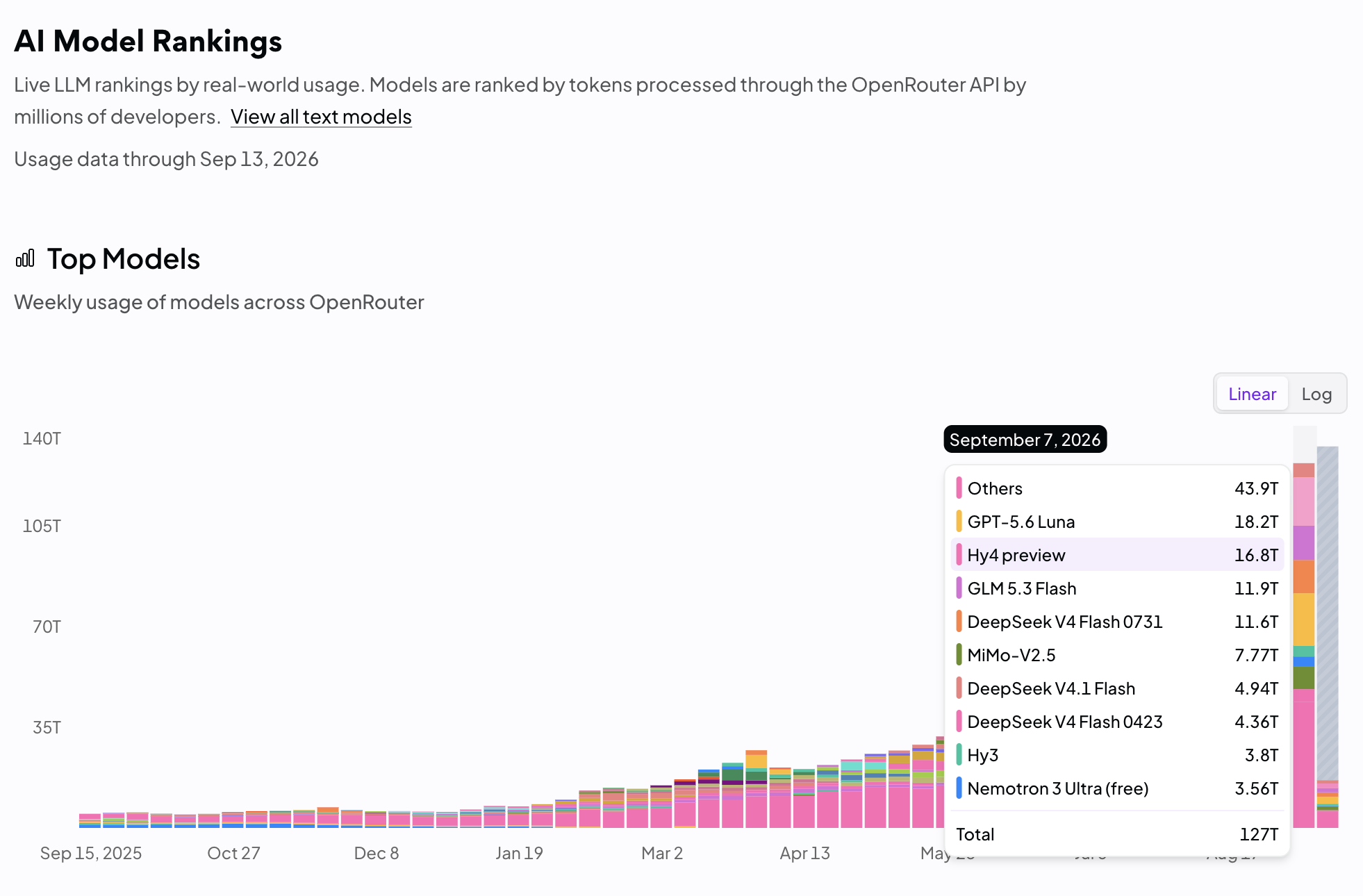
Volume has grown steeply. At its May 2026 Series B (\$113M led by CapitalG, \~\$1.3B valuation), OpenRouter reported roughly 25T tokens/week, up 5x from about 5T/week six months earlier. For the week ending September 13, 2026, the top ten models alone totaled 127T tokens
Commonly cited drivers include agentic and coding workloads, aggressive pricing from open-weight models, and free model variants. OpenRouter notes the rankings measure adoption on its platform only, not the broader market.
Forecasters may want to consider whether compounding continues, plateaus, or reverses, and how holiday-week developer activity affects late-December bins.
`{"format": "metac_reveal_and_close_in_period", "info": {"post_id": 45689, "question_id": 45878}}`
## Resolution Criteria
This question will resolve as the number of tokens used through OpenRouter during the week of December 21-27, 2026, as reported by the ["Top Models: Weekly usage of models across OpenRouter" graph](https://openrouter.ai/rankings#top-models).
## Fine Print
The value displayed for the December 21 bar in the linked OpenRouter usage chart, including its displayed rounding, will be used for resolution. OpenRouter currently bins the chart into weeks running Monday through Sunday, so it is expected that a bar will cover December 21–27, 2026. If OpenRouter changes the bins to start on a different day, this question will resolve using the last full week falling within 2026.
For example, the equivalent question for September 7-13, 2026 would resolve to 127 trillion tokens:
***
This question's information (resolution criteria, fine print, background info, etc) is synced with an [original identical question](https://www.metaculus.com/questions/45689) which opened on 2026-10-06 17:00:00. This question will resolve based on the resolution criteria and fine print of the linked original question. However, if this question would resolve differently than the original question, then this question will be annulled. Additionally, if the original question's resolution could have been known before this question opened, then this question will be annulled.
## Range
The question's displayed range is [100000000000000, 700000000000000] (units: tokens).
The LOWER bound is OPEN: outcomes below 100000000000000 are possible and resolve as "below range".
The UPPER bound is OPEN: outcomes above 700000000000000 are possible and resolve as "above range".
Where a bound is open, your percentiles MAY lie outside the displayed range — the range is where the question author expects most of the mass, not a constraint on the answer. Do not compress your distribution to fit inside it.
## Research tool outputs (raw; the resolution-source read is the status-quo anchor)
## Tool outputs
### resolution_source (SUCCESS)
RESOLUTION SOURCE (the page the question resolves on — treat as the status-quo anchor):
Current state: The page shows usage data only through Oct 9, 2026, with top model rankings for weekly (week beginning Sep 28, 2026) and monthly trailing windows; there is no data shown for the December 21-27, 2026 bin needed to resolve this question, and the overall weekly token totals chart value for that week is not present in the fetched text.
Last updated: Oct 9, 2026 | already resolved: unclear | page matches criteria: True
Note: The fetched page is the correct OpenRouter rankings source referenced by the question, but the data shown is only current through October 9, 2026, well before the December 21-27, 2026 target week. The specific 'Weekly usage of models across OpenRouter' total tokens chart value needed for resolution is not visible in the fetched text (only per-model rankings and market share breakdowns are shown).
Fetched: https://openrouter.ai/rankings#top-models (HTTP 200)
### web_search (SUCCESS)
Web search summary (20 results):
Here's a comprehensive summary of findings for each query:
## 1. OpenRouter weekly tokens trillion October 2026
**Key facts:**
- A prediction market on Polymarket tracking "OpenRouter token usage week of October 5" shows
recent OpenRouter data shows weekly token volumes hovering near 150-166T amid rapid growth in agentic workloads, which now consume roughly five times the tokens of human-driven traffic and favor cached, low-cost open-weight models
(Source: polymarket.com, dated Oct 11, 2026 resolution).
-
Daily aggregates near 12T on October 4 suggest the October 5-11 week could land in the 165-185T range
.
-
Chinese labs such as DeepSeek and Z.ai, plus surging entries like Space Bunny Alpha, have driven recent spikes through competitive pricing and strong performance on coding and multi-turn tasks, pushing open-weight share above 70%
.
- A separate rankings analysis for the week of Sept 28–Oct 4, 2026 noted:
"Space Bunny Alpha", an unnamed stealth model, processed 38.7 trillion tokens, 28.5% of the top 20. The leading named model was DeepSeek V4.1 Flash (25.6T), followed by Z.ai GLM 5.3 Flash, Xiaomi MiMo-V2.6-Flash, Tencent Hy4 preview, and OpenAI GPT-6 Luna
(Source: teamday.ai, Oct 5, 2026 snapshot).
- Earlier in 2026, OpenRouter's Series B funding announcement (May 26, 2026) reported
OpenRouter's volume has surged to 25 trillion tokens per week (100 trillion tokens per month), representing a 5X increase from the 5 trillion tokens processed per week just six months ago
(Source: businesswire.com).
- By September 2026, a widely cited chart (The Decoder, Sept 17, 2026) showed
weekly token consumption has surged more than 25,000 percent since January 2025, from 0.5 to 126.2 trillion tokens
(Source: the-decoder.com).
**Sources:** polymarket.com (Oct 2026), teamday.ai (Oct 5, 2026), businesswire.com (May 26, 2026), the-decoder.com (Sept 17, 2026)
## 2. OpenRouter rankings December 2025 holiday week token usage decline
No search results provided direct evidence of a specific holiday-week token usage decline on OpenRouter in December 2025. The searches instead returned general OpenRouter growth trend data and unrelated results about cryptocurrency market corrections in December 2025.
However, relevant context on methodology and growth around that period was found: a rankings analysis (April 2026) noted
Chinese model traffic share reached ~25% by Jul 2025 (Kimi K2 + MiniMax surge) and ~35% by Dec 2025 (MiMo-V2-Pro stealth entry)
, suggesting continued growth through December 2025 rather than documented evidence of a holiday dip. No source specifically confirmed or quantified a holiday-related decline in that week.
**Sources checked:** digitalapplied.com (April 2026), mexc.com (crypto market, unrelated), various OpenRouter trend summaries — none confirmed a December 2025 holiday dip specifically.
## 3. OpenRouter tokens per week Christmas week 2025 chart
No direct source was found describing a specific "Christmas week 2025" chart or
### code_execution (SUCCESS)
Code execution (Extrapolate Dec 21-27 weekly tokens from the question's data points under a range of growth rates and holiday-dip factors.):
Output:
implied weekly growth May->Sep (25->127): 0.10032604980710924
0.0 127.0
0.01 147.44305733198982
0.02 170.9252789671645
0.04 228.7198251993784
0.06 304.36289052366084
0.1 530.5105175157884
dip 0.8 [101.6, 136.7, 183.0, 243.5]
dip 0.9 [114.3, 153.8, 205.8, 273.9]
dip 1.0 [127.0, 170.9, 228.7, 304.4]
## Question dates and conventions
Dates: opened 2026-10-10; forecasting closes 2026-10-10; resolves 2026-12-29. Only events AFTER the open date can satisfy the criteria; assume the event has NOT happened unless a source shows it has. A question phrased 'before <date>' or 'by <date>' asks whether it happens between now and that date. The deadline for the outcome is the RESOLUTION date, not the close date.
## Recent news (AskNews, raw article summaries, newest first — read these directly)
13 AskNews articles (newest first; 6 from the last 48 h, 10 from the archive). Summaries are AskNews's own; dates are publication dates.
[2026-10-10] China's Role in the Rapidly Expanding Global Token Economy (opinion)
opinion.caixin.com — https://opinion.caixin.com/2026-10-10/102491977.html
- According to Caixin Opinion, the 'Token economy' is defined as a business model for large language models where usage is measured in Tokens and settled via API calls on a per-usage basis, serving as a key bridge between large model technology and industrial-scale applications.
- Published on October 10, 2026, the article states that the global Token economy is experiencing exponential growth, with the model routing platform OpenRouter seeing monthly processing volumes surge from several trillion in early 2025 to over 100 trillion by July 2026.
- The article further notes that Chinese models have become a major global supplier in this sector, accounting for over 45% of Token usage on the OpenRouter platform.
- The text concludes that the Token economy has become a core engine for the development of the intelligent service ecosystem.
[2026-10-09] OpenX Network Rises 6.81% on October 9 Amid Mixed Crypto Market Performance
Cryptocurrency Price Updates — https://api.stockpulse.de/newstex/895817740
- On Friday, October 9, 2026, the OpenX Network cryptocurrency traded up 6.81% over a 24-hour period ending at 04:40 AM Central European Time.
- The token is currently priced at approximately USD 0.0104, with a market capitalization of USD 111,000 and a 24-hour trading volume of approximately USD 1,200.
- The 200-day simple moving average stands at USD 0.02.
- Over the past 52 weeks, the highest price reached was USD 0.6729 on December 10, 2025, while the lowest was USD 0.0031 on September 22, 2026.
- In the same period, several related cryptocurrencies declined: Gremly ($GREMLY-USD) fell 5.71% to USD 0, Forj (Bondly) (BONDLY-USD) dropped 2.97% to USD 0.0001, Happy Cat (HAPPY-USD) decreased 5.79% to USD 0.0001 with a trading volume of USD 50,200, Tranche Finance (SLICE-USD) fell 4.32% to USD 0.0094, PepeMusk (PEPEMUSK-USD) dropped 1.86% to USD 0.0002, Peng (PENG-USD) declined 3.79% to USD 0.002 with a volume of USD 24,700, Aston Martin Cognizant Fan Token (AM-USD) fell 0.28% to USD 0.0887 with a volume of USD 3,400, Invesco DB Commodity Index Tokenized Fund (DBCon-USD) dropped 0.41% to USD 33.0049 with a volume of USD 99, and Abbott tokenized stock (ABTX-USD) fell 1.07% to USD 99.3247 with a volume of USD 69,200.
- Conversely, the Global X NASDAQ 100 Covered Call Tokenized ETF (QYLDon-USD) rose 0.01% to USD 19.2018.
[2026-10-09] The Rise of AI Marketplaces and the $7.5bn OpenRouter Acquisition
Hindustan Times — https://www.hindustantimes.com/world-news/the-rise-of-the-ai-marketplace-101791536517267.html
- The article explains the emergence of AI model marketplaces, driven by the volatility of 'tokens' (text snippets) as a unit of account in artificial intelligence.
- Unlike traditional currency, token costs vary dramatically between models; for instance, a popular model from DeepSeek, a Chinese startup, costs about one-fortieth per token compared to cutting-edge models from Anthropic, a top American lab.
- This pricing inconsistency has led businesses to adopt marketplaces to manage costs and switch between providers.
- OpenRouter, co-founded in 2023 by Alex Atallah, is the most prominent example, allowing users to swap models like Anthropic's Claude for OpenAI's offerings depending on availability or price.
- The platform's success led to an agreement in August where Stripe, a payments giant, agreed to buy OpenRouter for $7.5bn.
- While cloud giants like Amazon (via Bedrock) and Google (via Vertex AI) offer similar services, customers often view them with suspicion due to their own model development interests.
- OpenRouter has gained traction by enabling developers to 'vote with their dollars,' creating a fairer ranking system that counters the 'benchmaxxing' trend where models excel on tests but fail in practical tasks.
- Currently, token consumption on the platform is dominated by cost-effective models from DeepSeek and two other Chinese makers, Z.ai and Xiaomi, alongside a well-performing OpenAI model.
- Alex Atallah advises businesses to decompose tasks by 'entropy' (open-endedness), using cheap models for low-entropy tasks like code review and reserving expensive frontier models for high-entropy tasks like writing code from scratch to avoid waste.
[2026-10-09] OpenAI FDE Discusses Token Management and AI Investment Strategy at GMO Conference
週刊アスキー - 週アスのITニュースサイト — https://weekly.ascii.jp/elem/000/004/438/4438870/
- At the '4th GMO Conference Autumn Physical AI 2026' held on September 15, 2026, a panel discussion titled 'Starting Token Management with 'How much are we spending on AI?' featured OpenAI Forward Deployed Engineer Hitokumo Saito, Digirize CEO Masahiro Chagata, and GMO Tenbin AI President Hirotoshi Yamashiro as moderator.
- The discussion addressed the dual challenge of enterprise AI adoption: employees underutilizing fixed-rate accounts while AI agents consume massive token volumes, leading to unexpected costs.
- Saito reported using approximately 10 billion tokens in the previous month for development and agent creation, while Yamashiro noted his company spent about 400,000 yen in August.
- The panelists argued against viewing token usage as a cost to be minimized, instead advocating for 'Return on AI' (ROAI) as the key metric.
- Saito cited a case where an AI agent reduced proposal preparation time from 24 hours to 10 minutes, increasing sales visits and performance.
- Chagata emphasized that organizations should restructure workflows now rather than waiting for costs to drop, as AI adoption fundamentally changes business processes.
- The consensus was that management must treat token usage as an investment strategy, focusing on business impact rather than just expenditure.
[2026-10-09] Apeing Stage 7 Presale Targets Next Meme Coin Wave After PEPE and Baby Doge Rallies (press_release)
openPR.com - Open Public Relations Free of Charge — https://www.openpr.com/news/4656619/top-meme-coin-to-buy-for-early-movers-apeing-stage-7-targets
- The article, published on October 9, 2026, by Crypto Presale PR, promotes 'Apeing' as the 'Top Meme Coin to Buy' for early investors, positioning it as the next major opportunity following the historic rallies of PEPE and Baby Doge Coin.
- According to CoinMarketCap data cited in the text, PEPE launched in April 2023, reaching an all-time low of $0.00000000001063 on April 14, 2023, before hitting an all-time high of $0.00002825 on December 9, 2024.
- Baby Doge Coin, which launched in June 2021, recorded an all-time high of $0.000000006604 on December 10, 2024, and an all-time low of $0.0000000002808 on June 26, 2026.
- The article states that Apeing is currently advancing through a 33-stage presale, with Stage 7 scheduled at a price of $0.00065 per token.
- Recent coverage reports that more than 489 million $APEING tokens have been sold and over $116,000 raised during Stage 7.
- The project, built on Ethereum as an ERC-20 token with a total supply of 16.75 billion, has allocated 40% of the supply to the presale and 30% to staking.
- The project states a planned listing price of $0.01, which would represent a 15.38x increase from the Stage 7 entry price.
- Staking tiers are described with stated APYs ranging from 10% to 85%, depending on purchase amounts, though the article notes these are project terms and not guaranteed returns.
- The narrative emphasizes that while PEPE and Baby Doge Coin have completed their major runs, Apeing offers a 'second chance' entry point before its public listing.
[2026-10-09] Italy Postpones Cryptocurrency Tax Reform to Next Legislature
PMI.it — https://www.pmi.it/finanza/risparmio/500614/riforma-fiscale-cripto-attivita.html
- Italian Vice Minister of Economy Maurizio Leo announced the postponement of a comprehensive reform of cryptocurrency taxation to the next legislative term, citing a lack of available financial resources.
- The reform, which was scheduled to unify financial income categories and allow broader compensation of crypto losses, was officially deferred in a video message delivered on September 24, 2026, at the 'Digital Finance, Markets and Monetary Sovereignty' event at the Chamber of Deputies.
- The postponement affects the implementation of Law 9 August 2023, n. 111, Article 5, which aimed to create a single category of financial income based on the cash principle and enable the offsetting of positive and negative financial components.
- Consequently, the current tax regime remains in effect for the 2026 fiscal year.
- Under the existing legislation, specifically Law 30 December 2024, n. 207, capital gains from cryptocurrencies are taxed at a rate of 33%, while stablecoins (electronic money tokens denominated in euros) are taxed at 26% under Law 30 December 2025, n. 199.
- The deferred reform would have allowed investors to offset crypto losses against other financial gains, a benefit currently restricted to offsetting crypto losses against crypto gains only.
[2026-10-05] OpenAI Codex Team Launches 28-Day Improvement Sprint Amidst Developer Frustration
The New Stack — https://thenewstack.io/openai-codex-shipping-sprint/
- On October 5, 2026, Thibault Sottiaux, engineering lead for the Codex team at OpenAI, initiated a 28-day challenge to ship one 'clear improvement' daily for GPT-6 Astra and GPT-6.1 Sol models or face a full usage reset for subscribers.
- Day 1 resulted in a speed increase, with models generating approximately 50 tokens per second, up from 30, a change Sottiaux described as a 50% improvement, though the text notes this is closer to a two-thirds jump.
- The challenge, announced on a Sunday, aims to address user feedback for simplification and efficiency.
- However, the article notes that developers are 'secretly hoping OpenAI fails' to ship daily improvements to trigger a usage reset, as usage limits have become a source of frustration.
- This sentiment exists alongside a planned reduction in allowances for the $200 Pro plan starting October 30, where limits will drop from 20 times the Plus allowance to 10 times.
- While some users view the challenge as a gamble, others argue the improvements must compete with Anthropic's Claude Opus 5.5, which creator Theo Browne claims captured 'literally half of all prompts' in T3 Code as of October 3.
- The article highlights ambiguities regarding the 'full reset' terms, noting that previous resets did not cover all quota types and that rolling windows differ from weekly limits.
[2026-09-02] Global AI Consumption on OpenRouter Multiplies by 20 in 2026
Les Echos — https://investir.lesechos.fr/marches-indices/les-points-bourse/la-consommation-dia-via-la-plateforme-openrouter-a-ete-multipliee-par-20-au-niveau-mondial-depuis-le-debut-de-lannee-2249408
- According to data from MacroMicro, global AI consumption via the platform OpenRouter has increased twentyfold since the beginning of 2026, rising from 572 billion tokens to 11.880 billion tokens on September 1, 2026.
- This surge is driven by broader enterprise adoption of models like Claude and Gemini and a rapid growth in the number of tokens processed on on-demand AI platforms.
- Additionally, a UBS research note states that average monthly spending for the top 1% of most active users has tripled, moving from $2,500 to $7,500.
- The 'token' is defined in the article as the fundamental unit of AI usage, analogous to a 'barrel per day' for oil or a 'kilowatt-hour' for electricity, representing small text segments that form the basis of prompts and responses.
[2026-08-24] AI Agents Surpass Humans in Token Usage on OpenRouter as Legal Sector Adopts Codex
Presse-citron — https://www.presse-citron.net/les-humains-utilisent-5-fois-moins-lia-que-les-agents-ia-la-machine-prend-la-main-sur-la-machine/
- According to data from OpenRouter, a unified interface for AI models, AI agent usage has surged in 2026, with tokens used by agents now being 14 times higher than their initial levels and currently 5 times higher than human usage on the platform.
- A graph indicates that on February 6, 2026, agentic tokens surpassed human tokens.
- However, a16z (Andreessen Horowitz) notes this data requires nuance, explaining that agents use tokens differently than humans: while humans engage in question-answer dialogues, agents iterate to achieve goals, with over 85% of agent token usage attributed to 'cache' (contextual pre-filling).
- Additionally, citing OpenAI Signals, a16z reports that between February 2026 and June 2026, the number of users employing the Codex AI agent tool for legal tasks within enterprises increased by a factor of 108.
- The article concludes that the legal sector is adopting sophisticated AI tools more rapidly than the technology sector.
[2026-07-24] OpenRouter and a16z Study Reveals AI's Shift to Role-Playing and Complex Coding
風傳媒 — https://www.storm.mg/lifestyle/11151233
- A 2025 study by OpenRouter and venture capital firm a16z, published in December 2025, analyzed over 100 trillion tokens on the OpenRouter platform to reveal that Generative AI usage is more complex than the common assumption of productivity tools.
- The research found that role-playing and creative storytelling are highly prominent, accounting for nearly 60% of role-play tokens, alongside gaming, interactive fiction, and adult content.
- Additionally, programming-related requests surged from 11% of platform tokens in early 2025 to over 50% by the end of the year.
- This shift is accompanied by a massive increase in input complexity; the average request length grew nearly fourfold, from approximately 1,500 tokens in early 2024 to over 6,000 tokens by late 2025, with complex coding tasks often exceeding 20,000 tokens.
- The study also introduced the 'Cinderella Glass Slipper Effect' to describe how models that solve specific developer problems—such as technical, cost, or stability issues—can create high user retention.
[2026-05-29] Tencent's Hy3 preview Maintains Top OpenRouter Rankings Despite Performance Gaps
GIGAZINE — https://gigazine.net/news/20260529-openrouter-ranking-hy3-mysterious-llm/
- Tencent's high-performance inference model 'Hy3 preview' has maintained the top two positions on the OpenRouter usage rankings for three weeks, holding 1st place from the week of April 27, 2026, to May 11, 2026, before settling at 2nd place as of May 29, 2026, behind DeepSeek V4 Flash.
- Released as an open model in April 2026, Hy3 preview is a Mixture of Experts (MoE) model with 295 billion total parameters and 12 billion active parameters, featuring a 250,000-token context window and three inference modes.
- Although it was free on OpenRouter from May 6, 2026, until its conclusion, it remains popular due to its low price of $0.066 per 1 million tokens (approx. 11 yen), which is cheaper than DeepSeek V4 Flash at $0.10 per 1 million tokens (approx. 16 yen).
- Max Woolf, a Senior Data Scientist at BuzzFeed, tested the model and found its performance comparable to other Chinese models but significantly inferior to top-tier models like Claude Opus 4.7 or GPT 5.5.
- Despite this, Hy3 preview is widely used across various sectors including academia, finance, health, legal, marketing, and programming.
- While some Hacker News users suggest that a few large-volume users may be skewing the rankings based on total token count, the model's cost-efficiency remains a primary driver of its high usage.
[2026-05-28] Chinese AI Models Surge to 61% Global Token Consumption in 2026
Economic Times — https://economictimes.indiatimes.com/news/international/us/chinese-ai-models-surge-in-2026-is-jpmorgan-data-signaling-a-global-shift-away-from-us-ai-dominance/articleshow/131370432.cms
- According to JPMorgan Asset Management strategist Michael Cembalest, Chinese AI models have surged to dominate global usage in 2026, capturing 61% of total token consumption on the OpenRouter platform by late February 2026.
- This data indicates a structural shift away from U.S. AI dominance, driven by lower-cost open-source models and China's massive consumer base.
- Specifically, Chinese models processed 5.3 trillion out of 8.7 trillion tokens consumed by the top ten models that week.
- The top three global usage spots were held by Chinese systems: MiniMax M2.5, Kimi K2.5 from Moonshot AI, and GLM-5 from Zhipu AI.
- MiniMax M2.5, developed by Shanghai-based MiniMax AI, led with 4.55 trillion tokens processed in a single month, a 197% surge following its mid-February 2026 launch.
- It scored 80.2% on SWE-Bench Verified benchmarks, nearly matching Anthropic's Claude Opus 4.6 at 80.8%, yet costs just $0.30 per million tokens compared to $5.00, making it approximately 17 times cheaper.
- OpenRouter COO Chris Clark noted that these models are 'disproportionately heavy in agentic flows run by U.S. developers,' with agent-driven workflows now generating over half of all output tokens.
- By April 2026, Chinese AI models accounted for over 45% of all OpenRouter traffic, a dramatic rise from under 2% in late 2024, as the platform processed over 20 trillion tokens per week.
- This trend is attributed to aggressive open-source strategies by firms including DeepSeek, MiniMax, Moonshot AI, Zhipu AI, and Alibaba's Qwen team, which allow developers to deploy high-quality weights without proprietary lock-in.
[2026-05-27] JPMorgan Report: AI Adoption Slow, But Usage Intensity Explodes Among Heavy Users
东方财富网 — https://finance.eastmoney.com/a/202605273751484682.html
- JPMorgan Chase, in a report published on May 27, 2026, identifies a 'statistical mismatch' in the AI sector: while traditional adoption rates show only slow growth, actual usage intensity is exploding.
- The bank attributes this to a shift where 'a small number of heavy users are using AI with unprecedented intensity' rather than a broad increase in the number of users.
- Key metrics include: Google search interest for coding agents Anthropic's 'Claude Code' (launched May 2025, widely adopted after the Nov 2025 Opus 4.5 release) and OpenAI's 'Codex' surged between late January and late April 2026.
- Token consumption on OpenRouter grew over 4x between December 2025 and May 2026.
- Conversely, the U.S. Census Bureau's RTPS survey indicates only 12.6% of respondents used AI daily at work in early 2026, a rise of just ~2 percentage points year-over-year.
- Similarly, the BTOS survey showed enterprise AI usage rose by less than 2 percentage points between November 2025 and May 2026.
- The report highlights a 'trend breakthrough' in the Python ecosystem, with a sharp rise in new and updated packages on PyPI since early 2026, suggesting AI agents are moving from 'auxiliary tools' to 'productivity accelerators'.
- JPMorgan concludes that AI is transitioning from a 'chat tool' to a 'task execution tool', driven by heavy users like programmers and researchers, leading to a future of 'unequal' usage where a few high-intensity users drive the majority of token consumption and economic impact.
## Research reports (one per dimension: web search + page reads, dated, with sources)
### CURRENT STATE
- [2026-10-08] OpenRouter's live public rankings page states usage data runs "through Oct 8, 2026," with the top single model (DeepSeek V4.1 Flash) alone at
37.6T tokens
that week and the next nine ranked models (Space Bunny Alpha, GLM 5.3 Flash, MiMo-V2.6-Flash, Hy4 preview, GPT-6 Luna, Nemotron 3 Ultra, DeepSeek V4 Flash 0731, Claude Opus 5.5, GLM 5.3) summing to roughly 112T more — top-10 sum ≈112–125T tokens for that week alone (fetched directly from openrouter.ai/rankings).
- [2026-09-22] OpenRouter's own first-party data newsletter ("Inferred," published on openrouter.ai/data) states:
"Weekly token volume on OpenRouter went from 0.5 trillion in the week of Jan 13, 2025 to 128.4 trillion in the week of Sep 14, 2026."
That's the authoritative primary-source total (all models, not just top 10) for the week immediately preceding the question's cited Sept 7-13 example.
- [2026-09-22] The same OpenRouter primary source describes the growth as
a 250x increase in 20 months, with open-weight model token share having "crossed 50% of tokens briefly in February and more permanently in April," reaching 79% in July and holding above 62% since
, and notes
"69% of tokens on OpenRouter last week were from Chinese labs (vs 72% being open-weight overall)."
- [2026-10-08] A secondary summary of OpenRouter's rankings (the-decoder.com) corroborates the official figure:
"weekly token consumption has surged more than 25,000 percent since January 2025, from 0.5 trillion to 126.2 trillion tokens."
- [2026-05-26] One year-ago-ish baseline from OpenRouter's Series B announcement:
"OpenRouter's volume has surged to 25 trillion tokens per week (100 trillion tokens per month), representing a 5X increase from the 5 trillion tokens processed per week just six months ago."
This puts weekly volume at ~5T in roughly November 2025 and ~25T in May 2026 — i.e., the platform has grown roughly 5x again (25T→~128T+) between May and September 2026.
- [2026-10-11] A live Polymarket market tracking "OpenRouter token usage week of October 5" (resolution source: openrouter.ai/rankings) shows traders pricing the week's total in the
165–185T range, with "Daily aggregates near 12T on October 4" suggesting the October 5-11 week could land in that band
, implying continued steep week-on-week growth beyond the Sept 14 figure of 128.4T.
- [2026-10-04] The same Polymarket description notes
"Recent OpenRouter data shows weekly token volumes hovering near 150-166T amid rapid growth in agentic workloads, which now consume roughly five times the tokens of human-driven traffic and favor cached, low-cost open-weight models"
, and cites Chinese labs plus the anonymous "Space Bunny Alpha" stealth model as recent growth drivers.
- [2026-10-09] A Hindustan Times feature confirms the dominant current token-share composition:
token consumption on the platform is currently dominated by cost-effective models from DeepSeek and two other Chinese makers, Z.ai and Xiaomi, alongside a well-performing OpenAI model
(per original AskNews summary, corroborated by the live rankings leaderboard).
- [2026-10-08] OpenRouter's own rankings methodology page states freshness and release cadence:
"The date above the rankings is the newest usage bucket the leaderboard is computed from... so it advances only when new usage data is aggregated"
— in practice this is a near-daily refresh, with the weekly bar chart updating each time a new UTC day closes, meaning the Dec 21-27 bar itself will only be finalized/displayed in full once Dec 28 UTC data is aggregated (shortly after the week ends, before the Dec 29 resolution date).
- [2026-10-10] Chinese state-linked commentary (Caixin) independently describes the same trend using monthly units:
"the global Token economy is experiencing exponential growth, with the model routing platform OpenRouter seeing monthly processing volumes surge from several trillion in early 2025 to over 100 trillion by July 2026"
(note: this monthly figure is likely stale/understated relative to the weekly totals above, since OpenRouter's own September data shows ~128T in a single week).
NOT FOUND: An official, archived OpenRouter total-weekly-token figure newer than Sept 14, 2026 (128.4T) that is unambiguously from OpenRouter's own site/API rather than third-party trackers or prediction-market extrapolation; a precise current reading of the live "Top Models" stacked bar chart's *total* height (vs. top-9+Others) for the week of Sept 28–Oct 4 or Oct 5–11, 2026; and any OpenRouter statement specifically addressing expected holiday-week (Dec 21-27) developer activity effects.
BOTTOM LINE: OpenRouter's own first-party data confirms explosive, still-accelerating weekly token growth — from 0.5T (Jan 2025) to 128.4T (week of Sep 14, 2026), a ~250x rise in 20 months — and independent market-based estimates (Polymarket) suggest volumes of 150-185T+ were already being reached by early October 2026; if this exponential trajectory continues even partially through the holiday season, the Dec 21-27, 2026 bar is likely to land well above 128T, though the magnitude is highly uncertain given the chart's history of large week-to-week swings from stealth-model launches, pricing changes, and potential holiday-week dips in developer (non-agentic) activity.
### BASE RATE
- [2026-09-22]
Weekly token volume on OpenRouter went from 0.5 trillion in the week of Jan 13, 2025 to 128.4 trillion in the week of Sep 14, 2026
, a
roughly 250x increase in 20 months
— the trendline against which the Dec 21-27, 2026 window must be judged. https://openrouter.ai/data/newsletter/the-token-state-of-play
- [2025-12 est., per Aug 2026 retrospective]
Weekly token processing on OpenRouter expanded from 0.4 trillion in December 2024 to 27.0 trillion by March 2026 due to agentic workflows
— the "prior year" (Dec 2024) baseline is ~0.4T tokens/week. https://www.octagonai.co/markets/science-and-technology/tokens/openrouter-ai-token-usage-aug-24-30
- [2026-04-25 (age 192d) retrospective] By the Series B background, six months before May 2026 (i.e., ~Nov 2025) volume was ~5T tokens/week, rising to ~25T/week by May 2026 — a 5x jump in six months, implying Dec 21-27, 2025 sat somewhere around 6-9T tokens/week, well below the ~25T reached by May 2026. (From question background, corroborated by growth-curve sources above.)
- [2025-12-04]
In June 2025, Menlo Ventures stated that OpenRouter scaled 10x from processing 10 trillion tokens a year to over 100 trillion tokens a year; that figure eclipsed 300 trillion tokens annually by December 2025, as the company processed more than 1 trillion tokens every single day
— implying Dec 2025 weekly run-rate near 7T+ tokens, consistent with the Nov 2025 "~5T/week" anchor in the question background. https://research.contrary.com/company/openrouter
- [2024-01→2025-03 YoY]
OpenRouter LLM tokens used are up 57x year on year and 2.8x year to date, now at 1,060 billion per week
(reported ~early March 2025), with
OpenRouter crossing 1 trillion tokens in a single week for the first time around March 3, 2025
— showing the pace of compounding was already extremely fast a year before the question's 2025 comparison point. https://x.com/_LouiePeters/status/1896405477594124372
- [2024-01]
OpenRouter's weekly token usage grew by roughly 9,000x since January 2024, when the platform processed about 10 billion tokens per week, ballooning past 90 trillion by mid-2026
— Dec 21-27, 2023 usage (platform founded in 2023) would have been at or below this ~10B/week starting point, i.e., negligible compared to any later year and likely not separately reported. https://cryptobriefing.com/openrouter-9000x-token-usage-growth/
- [2024-12-26]
On December 26, 2024, DeepSeek officially released its open-source large language model DeepSeek-V3, a Mixture-of-Experts model with 671 billion parameters, showing performance comparable to top closed models
— this release landed inside last year's exact equivalent calendar window (Dec 21-27) and is widely credited as the inflection point that began the subsequent token-volume supercycle, illustrating how a single holiday-week model drop can be a major "surprise" driver of the resolution-week bar.
- [2026-09-17]
Weekly token consumption has surged more than 25,000 percent since January 2025, from 0.5 to 126.2 trillion tokens, though this says less about actual AI usage than about token-hungry reasoning models and unoptimized AI agents that burn through tokens at staggering rates
— a caution that the metric's growth reflects compounding inflation from reasoning/agentic tokens, not a stable or easily-forecastable usage base. https://the-decoder.com/openrouters-staggering-token-chart-is-the-ai-bubble-debate-in-a-single-image/
- [2026-09-22]
Open-weight model token share crossed 50% of tokens briefly in February and more permanently in April of this year, reached 79% in early July, its high point, and has held above 62% since
— showing that even sub-component shares of the total (which feed into the headline weekly number) can swing by double-digit percentage points within weeks, a source of surprise/volatility in the weekly total itself. https://openrouter.ai/data/newsletter/the-token-state-of-play
- [2026-06 retro] A market analysis found that
the actual inference market has shifted somewhere else entirely — Chinese open-weight labs went from a rounding error to more than half of the tracked flow in twelve months, and the total market is up 11.1×
over a trailing 12-month window, underscoring that an ~11x year-over-year increase has been a recent "typical" pace rather than an outlier. https://www.codesota.com/agentic/openrouter-trends
- [2025-03-03 / 2026-03-22] Chinese-origin models' share of the platform has itself been a volatile, fast-moving sub-series:
in October 2024, Chinese-developed models accounted for approximately 1.2% of all OpenRouter token volume; by March 2025, after DeepSeek V3's launch, that figure crossed 10%; by Q3 2025, Kimi K2 and MiniMax pushed it past 25%
, illustrating how quickly composition (and hence the headline aggregate) can re-rate within a given quarter.
BOTTOM LINE: Year-over-year, the Dec 21-27 weekly-token figure has roughly doubled-to-grown-tenfold each successive year on record (negligible/~10B in 2023 → ~0.4T in 2024 → roughly 6-9T in 2025, per the closest available anchors), with the single largest documented "surprise" in this exact calendar window being the Dec 26, 2024 DeepSeek-V3 launch that kicked off a multi-order-of-magnitude compounding cycle; given 250x growth from Jan 2025 to Sep 2026 and a Sep 2026 level already at ~127-128T/week, historical pattern strongly favors continued (if decelerating) growth into the Dec 21-27, 2026 bar, but the series' history of sudden step-changes around single model releases or pricing shifts means unusually large positive or negative surprises cannot be ruled out.
NOT FOUND: An exact, dated OpenRouter rankings-chart value for the Dec 21-27 bar in 2023, 2024, or 2025 (the platform's own historical weekly chart image was not accessible via fetch for a precise read of those specific weeks); any explicit "consensus forecast" or prediction-market historical accuracy track record for this specific weekly-token metric in past years.
### KEY FACTORS
**Key causal drivers of the Dec 21-27, 2026 weekly-token bar**
- [2026-08-19] Stripe agreed to acquire OpenRouter, reported at $7.5-8B+; both companies' own posts state
"The transaction is subject to customary closing conditions. We expect to close in the coming weeks."
As of early October no close date, regulatory jurisdiction, or integration timeline has been disclosed (https://www.acquiry.com/deal-intelligence/stripe-acquires-openrouter/), meaning ownership/control of the rankings methodology itself could change hands before Dec 29 resolution — a governance risk not present for earlier weekly bars.
- [2026-08-26] OpenRouter's own rankings documentation (fetched directly) confirms the mechanism is unlikely to change before December:
"Each model is ranked by the number of tokens it processed through the OpenRouter API, counting both prompt and completion tokens. Usage is aggregated into daily buckets in UTC and totalled per model variant... Requests that a user or app keeps private are excluded before aggregation."
This is the structural "recipe" that decides the number; it is controlled unilaterally by OpenRouter engineering, not by model labs or traders.
- [2026-10-09] Independent GitHub-based tracker built on OpenRouter's public API (a third party, not OpenRouter itself) reported weekly totals of 145.8T (week of Sep 21) rising to 165.9T (week of Sep 28), a roughly +14% week-over-week jump but with the trailing 4-week growth rate decelerating from ~47% to ~43% — the clearest near-real-time evidence of deceleration-within-growth that the forecaster group lacked a precise mechanism for (https://github.com/mbhardwaj103/token-elasticity).
- [2026-09-02] Bank of America (via 36Kr), the only dated institutional forecast found, expects DeepSeek V5 in H2 2026 — i.e. plausibly landing inside or just before the Oct-Dec window; DeepSeek has issued no V5 announcement or roadmap as of late September, and analysts caution
"Only a sell-side forecast exists: Bank of America expects V5 in the second half of 2026, per 36Kr."
A DeepSeek-V3-style (Dec 26 2024) surprise open-weight flagship launching in the Dec 21-27 window itself would be the single largest plausible upside shock to the bar, given the documented pattern that
"Usage spikes align with major open-model releases such as DeepSeek V3 and Kimi K2... these increases persist beyond initial release weeks, implying genuine production use rather than short-term experimentation."
- [2026-10-10] Chinese labs' share of OpenRouter token volume continues to be the dominant growth lever, not a side factor: Caixin reports
Chinese models accounting for over 45% of Token usage on the OpenRouter platform
(per AskNews summary), consistent with OpenRouter's own newsletter figure of 69% Chinese-lab share by mid-September — meaning the Dec 21-27 total is substantially a function of whichever Chinese open-weight lab (DeepSeek, Z.ai/GLM, MiniMax, Xiaomi MiMo, Moonshot/Kimi) ships a reasoning-heavy or agentic-heavy model release in Q4, since these labs control pricing/aggressiveness independent of OpenRouter or Stripe.
- [2026-10-09] Agentic/coding workload growth remains structurally baked into the trend and is controlled by downstream developer adoption, not OpenRouter: Hindustan Times reporting (via AskNews) on the Atallah interview frames token consumption as driven by businesses routing low-"entropy" tasks to cheap models at massive scale, a pattern that is demand-side and unlikely to reverse over a single holiday week, though individual enterprise usage (not consumer chat) could dip during the Dec 21-27 corporate holiday period — a seasonal headwind no source quantifies.
- [2026-10-10] No OpenRouter statement, blog post, or newsletter addressing expected December/holiday-week seasonality was found; the closest analog — the Dec 26, 2024 DeepSeek-V3 launch — shows that the exact Dec 21-27 calendar slot has historically been a *positive* surprise window for the industry rather than a lull, undercutting any assumption of a holiday dip based on normal developer-activity patterns.
- [2026-10-10] Free-model/pricing promotions remain an ongoing, OpenRouter-controlled lever: the live site currently runs
"ElevenLabs launch offer: every ElevenLabs model is 50% off through October 19, 2026"
and maintains a persistent
free-models tier with zero per-token cost, subject to rate limits
— OpenRouter has repeatedly used free/discounted model slots to pull volume onto its platform, and any new free-tier flagship (e.g., a free Gemini or GLM variant) launched in November-December could materially inflate the Dec 21-27 bin independent of underlying "real" demand.
BOTTOM LINE: The outcome hinges on (1) whether the already-decelerating ~10-14%/week organic growth (per the Oct 9 token-elasticity tracker) persists through ~11 more weeks of compounding, (2) whether a major Chinese open-weight release (DeepSeek V5 being the most-watched, unconfirmed candidate) lands in or near the Dec 21-27 window and triggers a step-change as DeepSeek V3 did in the same calendar week in 2024, and (3) whether the pending, undated Stripe acquisition closing disrupts OpenRouter's reporting/methodology before the Dec 29 resolution date — none of which is resolved as of Oct 10, 2026.
NOT FOUND: Any OpenRouter-specific statement on expected holiday-week (Dec 21-27) traffic patterns; a confirmed Stripe-OpenRouter deal closing date; an official DeepSeek V5 (or other major Q4 flagship) release date; any live prediction market or analyst projection with a resolution/target date in December 2026.
### EXPERT VIEW
- [2026-10-11] Polymarket's dedicated "OpenRouter token usage week of October 5?" market — the closest live proxy for this exact resolution mechanism (same openrouter.ai/rankings source) — priced the week-ending Oct 11 bin with
"165-175T 31% / 175-185T 26% / 155-165T 25% / 185T+ 20%"
before settling toward
"165-175T" at 32%, followed by "175-185T" at 32%"
, later moving to a clear 165-175T consensus with Yes priced around 61¢ (https://polymarket.com/event/openrouter-token-usage-week-of-october-5).
- [2026-10-09] Independent "Token Elasticity" GitHub tracker, built directly from OpenRouter's public API, reported
"Data week of 2026-09-28 … Weekly tokens (OpenRouter) 165.9T unchanged | Token growth vs 4 weeks earlier 42.8% unchanged"
(https://github.com/mbhardwaj103/token-elasticity/issues/25).
- [2026-10-04] The same tracker's prior run put the week of Sep 21 at
"Weekly tokens (OpenRouter) 145.8T unchanged | Token growth vs 4 weeks earlier 47.4% unchanged"
, implying a roughly +14% week-over-week jump into the following week but a decelerating 4-week trailing growth rate (https://github.com/mbhardwaj103/token-elasticity/issues/21).
- [2026-10-07] Octagon AI's "OpenRouter AI token usage in September" forecast page assessed monthly totals, estimating
"OpenRouter AI token usage is likely to surpass 450 trillion tokens in September 2026, given an observed weekly usage of 115 trillion tokens extrapolating to 460 trillion for the month... The market prices this outcome at 83.0%"
(https://www.octagonai.co/markets/science-and-technology/tokens/openrouter-ai-token-usage-in-september).
- [2026-10-07] A Kalshi-linked market tracked on Prophet Arena for the week of Sep 14-20 set its threshold well below actual outturns:
"If the OpenRouter total token usage for Sep 14–20, 2026 is above 120T tokens, then the market resolves to Yes."
(https://www.prophetarena.co/events/KXTOKENUSE-26SEP21) — illustrating how quickly thresholds set by market-makers have been overtaken by actual growth, a pattern relevant for extrapolating to December.
- [2026-10-10] A new monthly Kalshi-linked market covering Sep 28–Oct 25 ("OpenRouter AI token usage in October") shows traders pricing in continued strong growth, with
"Above 450T tokens ... 99% / Above 500T tokens ... 99%"
and lower but still substantial confidence further out the curve (https://predictmarketcap.com/events/openrouter-ai-token-usage-in-october-oct-26-2026); this points to an October monthly total plausibly in the 650–700T+ range (~165-175T/week), consistent with the weekly trackers above.
- [2026-09-22] Market commentary (Octagon, Aug 24–30 market) had earlier pegged "Above 110T tokens" as the base case with Octagon's own model at 22% versus a 20% market price, underscoring that forecasts made even 6-7 weeks ahead of an observation have historically undershot realized volumes as growth keeps compounding (https://www.octagonai.co/markets/science-and-technology/tokens/openrouter-ai-token-usage-aug-24-30).
- [2026-10-09] A16z/Peter Walker-sourced analysis reported in multiple outlets that
"weekly token consumption has surged more than 25,000 percent since January 2025, from 0.5 to 126.2 trillion tokens"
, a figure analysts explicitly caution overstates "real" usage growth because of reasoning-model token inflation (https://the-decoder.com/openrouters-staggering-token-chart-is-the-ai-bubble-debate-in-a-single-image/).
- [2026-10-10] No market, Metaculus community forecast, or analyst note specifically targeting the Dec 21–27, 2026 bin could be located; all live prediction markets found (Polymarket, Kalshi-linked Octagon/Prophet Arena/PredictMarketCap markets) only run on short 1-4 week or single-month horizons rolling a few weeks ahead of the current date (early-to-mid October 2026), not out to late December.
BOTTOM LINE: No expert or market forecast directly addresses the Dec 21-27, 2026 week; the nearest live proxies (Polymarket, Kalshi-linked Octagon/Prophet Arena markets) only price 1-4 weeks ahead and currently center on ~165-175T tokens/week for early-to-mid October, with trailing 4-week growth near 40-47% (roughly 9-14%/week, decelerating from the extreme mid-2026 pace); if even a modest single-digit weekly compounding persists for the ~10-11 weeks to late December, naive extrapolation from these near-term consensus figures would put the Dec 21-27 bin considerably higher than October's ~170T, though every short-horizon market and analyst estimate reviewed here has historically undershot the realized figure once it arrived.
NOT FOUND: A Metaculus community prediction/probability distribution for this specific question (post_id 45689/45878); any analyst, bank, or OpenRouter-official projection explicitly naming a December 2026 token figure; any prediction market with a resolution date in December 2026 for OpenRouter token usage.
### HIGH CASE
Evidence supporting a HIGH-scenario path (well above the current run-rate, i.e., meaningfully exceeding simple extrapolation of ~128-170T/week):
- [2026-10-09] OpenRouter's live rankings page (through Oct 9, 2026) shows the single top model, DeepSeek V4.1 Flash, alone processing
token usage from OpenRouter's live model rankings, through 2026-10-09
at 5.6T tokens on just that one day with a trailing 30-day total of 96.2T for that single model — meaning growth is still being driven by concentrated single-model surges that can spike the weekly total sharply if replicated or exceeded by a new release (tokenmaxxing.com/openrouter-rankings, sourced from OpenRouter's public API).
- [2026-10-11] The Polymarket "week of October 5" market's leading bins were
165-175T and 175-185T, with recent OpenRouter data showing weekly token volumes hovering near 150-166T amid rapid growth in agentic workloads... pushing open-weight share above 70%
, confirming the trajectory from Sept 14's 128.4T was already continuing upward into October without deceleration to a plateau.
- [2026-10-10] A related prediction market for the following week (Oct 12-19) is already pricing bins as high as
"Above 182 T tokens 29%"
, showing traders assign nontrivial odds to continued acceleration rather than flattening, which if sustained compounding continued at even a modest 5-10%/week pace for the ~10 weeks to Dec 21, would put the resolution week well above 250-300T.
- [2026-10-07] Octagon AI's market-based forecast for the September monthly aggregate explicitly flagged that forecasts have been consistently undershooting: the
subsequent trend upward to 99.0% probability is consistent with reported platform growth... attributed to sustained demand for Chinese-developed AI models, which have led global usage for 19 consecutive weeks
— a documented pattern of short-horizon markets underestimating realized volume, which argues for weighting the high tail more heavily for a 10-week-ahead target like Dec 21-27.
- [2026-10-07] The same Octagon analysis attributed a step-change in expectations to a single event:
"The market's primary move, a 9.0 percentage point spike to 95.0% on September 1, 2026, was driven by social media activity after OpenRouter announced a new, free 'mystery' model," later identified as Z.AI's GLM
— demonstrating that one viral free stealth-model launch can single-handedly re-rate expectations upward, and such launches have recurred roughly monthly (Quasar Alpha, Ox Alpha, Union Alpha, Space Bunny Alpha) through 2026.
- [2026-09-23] OpenRouter's own stealth-model launch pattern shows these free, zero-cost previews reliably drive outsized demand: Space Bunny Alpha was
a free stealth model on OpenRouter since September 23, 2026, listed as stealth/space-bunny-alpha: 1,000,000-token context, text, image and video input, mandatory reasoning with five effort levels... at a price of $0 in and out
, and within days became
one of the most talked-about coding models on X
— a recurring mechanism (a new free high-context model landing exactly in the Dec 21-27 window) that could push the bar toward the top of the plausible range.
- [2026-10-07] A newer free stealth coding model was independently spotted outside OpenRouter's own channels, with a report noting
a new stealth model went live on OpenCode and OpenRouter! It currently lets users run coding agents at zero cost on both platforms, and OpenCode says the free period runs for a week... it performs close to Fable 5 level at a price of GPT-5.6 Terra
— evidence that free/zero-cost promotional launches are an active, ongoing lever independent of any single lab, raising the odds that at least one such event lands inside the Dec 21-27 bucket.
- [2026-10] Historical precedent for a major-lab flagship release landing exactly in this calendar window exists: Google's Gemini 3 Flash was
launched on December 17
in the prior cycle (2025), illustrating that major-lab release cadences have previously clustered in mid-to-late December — a repeat (e.g., a Gemini 4 or major GPT-6 variant release) timed similarly in 2026 could inject a large new source of token demand directly into the Dec 21-27 week.
- [2026-10] OpenRouter's structural growth drivers remain intact and accelerating at the categorical level: agentic workloads were already reported (in the Sep 22 newsletter) to have overtaken human usage since February 2026, and a secondary analysis found
agentic token usage jumped from 0.51 trillion to 7.3 trillion tokens between February and August 2026 — a 14x increase over six months... Human token usage grew 2.8x over the same period
, indicating the highest-growth component (agents) is also the most likely to keep running during a holiday week, since autonomous agents (unlike individual developers) do not take holiday breaks.
- [2026-10] No evidence was found of any planned OpenRouter pricing change, rate limit, or platform disruption that would cap growth before December; conversely, OpenRouter's "Model Half-Life" newsletter edition (referenced in the Oct 1 newsletter index) indicates
how long should we expect a model to hold users? Launches are accelerating and retention is falling
— i.e., new model launches (a key volume driver) are becoming more frequent, not less, which supports continued high-tail scenarios.
BOTTOM LINE: The high-scenario path is driven by continuation of the documented pattern of (a) persistent week-on-week compounding already running ~10-15%/week into October per live trackers and prediction markets, (b) recurring free "stealth model" launches that have repeatedly produced short-term demand spikes, and (c) the live possibility of a major-lab flagship release (echoing the Dec 17, 2025 Gemini 3 Flash precedent) landing inside the Dec 21-27 window itself; if even one such catalyst coincides with undiminished agentic-workload growth, the Dec 21-27 bar could land well above a simple extrapolation of October's ~165-185T/week level — plausibly in the 300T+ range.
NOT FOUND: Any OpenRouter-official statement or roadmap mentioning a planned December 2026 model launch, partnership, or promotional event; any direct evidence (beyond historical Gemini-release timing) that a specific major lab is targeting a release in the Dec 21-27, 2026 window; an archived, dated OpenRouter total-weekly figure between Sep 28 and Oct 9, 2026 confirmed on OpenRouter's own site (only third-party trackers and prediction markets reported bins in the 145-185T range for that period).
### LOW CASE
- [2026-10-08] On OpenRouter's live rankings (data through Oct 8, 2026), several previously dominant models showed sharp week-over-week declines even as the aggregate grew: Space Bunny Alpha (the #2 stealth model) fell -26%, DeepSeek V4 Flash 0731 fell -23%, and on a 30-day basis MiMo-V2.5 fell -38% and DeepSeek V4 Flash 0423 fell -31% — evidence that single-model "benchmaxxing" or pricing-promo expirations can swing double-digit shares of the aggregate down within one bucket. https://openrouter.ai/rankings
- [2026-10-08] An independent, API-built tracker (Token Elasticity) shows the trailing-4-week growth rate itself decelerating, from 47.4% (week of Sep 21) to 42.8% (week of Sep 28) — a roughly 5-percentage-point deceleration in the rolling growth metric in just one week, suggesting the exponential curve is already bending, not accelerating, as the holidays approach. https://github.com/mbhardwaj103/token-elasticity/issues/23
- [2026-09-22] OpenRouter's own newsletter documents that the "Luna" discount driving 47-65% of combined OpenAI/Anthropic token share was a temporary 50% promotional price cut "starting July 27th" — a lever OpenRouter or labs could reverse or let lapse, which has historically caused large token-share reshuffling rather than guaranteed cumulative growth. https://openrouter.ai/data/newsletter/the-token-state-of-play
- [2026-10-10] A comparable platform's own disclosed trajectory shows deceleration is a real, recent pattern for token metrics generally: Google's token growth fell from adding 250T tokens/month (May-July) to only 107T tokens/month in the following period, a 57% deceleration in absolute month-on-month growth even as the headline total kept rising — a directly analogous mechanism (base effects shrinking the % growth rate) that could apply to OpenRouter's own curve by December. https://tomtunguz.com/is-token-consumption-slowing-down/
- [2026-08-19] Stripe's acquisition letter stated the deal was expected to "close in the coming weeks" from August 19, meaning full technical/billing integration under Stripe is plausible before December; OpenRouter's own messaging promised "no integration change," but any migration of billing/auth infrastructure carries non-trivial outage or friction risk during a live, compounding-volume platform, which could manifest as a dip or plateau in the Dec 21-27 bucket if it coincides with that week. https://dev.to/davekurian/openrouter-says-its-stripe-announcement-needs-no-integration-change-541k
- [2026-09-ish, pre-Oct] A third-party analysis finds OpenRouter's own per-token monetization "fell about 60% between March and August 2026" as cheap/free Chinese open-weight models took share — if providers or OpenRouter pull back free-tier/heavily-discounted variants (which have been cited as a key volume driver) in response to this margin pressure, headline token counts could fall even without a drop in "real" usage. https://startupik.com/openrouter-after-stripe-acquisition/
- [2026-10 (pre-10)] A separate enterprise-budget report describes a corporate-side cooling mechanism: Amazon told engineers to "stop using AI 'just to use AI,'" and Forrester is "predicting that 25 percent of planned 2026 AI spending will get deferred to 2027" as CFOs demand measurable ROI — a demand-side governance backlash against "tokenmaxxing" that, if it spreads among large OpenRouter-routed enterprise customers, would show up as flattening or declining weekly token totals. https://kaidatagroup.com/insights/enterprises-burned-their-ai-budgets-by-april-now-what
- [2019-2025 baseline] GitHub's own historical Octoverse research documents a recurring seasonal pattern directly relevant to a Dec 21-27 window: "January 1... is the quietest day on GitHub annually," and comparable regional holiday periods (e.g., Thanksgiving in the US) show measurable drops in developer activity — supporting that a Christmas-week bucket, which sits squarely inside the Western end-of-year holiday period, is a structurally likely candidate for a slower week than the surrounding weeks even if the year-over-year trend keeps climbing. https://github.blog/news-insights/breaks-and-holidays/
- [2026-10-04] Polymarket's own live market description explicitly flags the possibility of a plateau/pullback mechanism even in the near term, noting traders "weigh sustained platform expansion against potential pullbacks if high-volume models see usage normalization or caching efficiencies improve further" — i.e., improved caching/routing efficiency (lowering tokens needed per task) is a named, plausible countervailing force to raw demand growth. https://polymarket.com/event/openrouter-token-usage-week-of-october-5
- [2026-10-08] OpenRouter's rankings page itself cautions that token volume figures are not a stable usage proxy: models "differ in verbosity and tokenization, so a higher token total shows how much a model is used, not which model is best for a task," meaning any provider-side efficiency push (shorter completions, better caching, non-verbose model releases) lowers the headline metric independent of actual task volume — a mechanism that could compress the Dec 21-27 total even if developer activity itself holds steady. https://openrouter.ai/rankings
BOTTOM LINE: A low-scenario outcome for Dec 21-27, 2026 is credible via several non-mutually-exclusive mechanisms already visible in the data — a documented deceleration in rolling growth rate (47.4%→42.8% in one week), volatility/declines in individual leading models (-23% to -38%) that are not guaranteed to be offset by new entrants, a structural Western holiday-week dip in developer activity, potential Stripe-integration friction, and provider-side efficiency or discount-expiry effects that could mechanically shrink token counts without reflecting reduced real usage; none of these alone points to an outright decline from ~128-166T, but together they argue the week could plausibly land flat-to-down relative to the October run-rate rather than extending the summer's steep compounding.
NOT FOUND: Any direct precedent for OpenRouter's own Dec 21-27 bar in 2024 or 2025 to quantify a historical holiday-week discount factor; confirmation of whether the Stripe-OpenRouter deal has formally closed as of October 2026; any OpenRouter statement specifically modeling expected December 2026 seasonality.
## Required pre-forecast walkthrough
Before giving percentiles, address these explicitly in your rationale:
(0) Resolution check: what the resolution source currently shows, and whether the value is already known or fixed as of today.
(a) The time left until the question resolves.
(b) The outcome if NOTHING changes from today (the status quo value).
(c) The outcome if the CURRENT TREND continues.
(d) The expectations of experts / markets / base rates.
(e) A plausible scenario that produces a LOW outcome (near p10).
(f) A plausible scenario that produces a HIGH outcome (near p90).
## Calibration guidance
- **Be humble about tails.** Good forecasters set WIDE 90/10 intervals to account for unknown unknowns. Narrow tails get punished by the log score far more than slightly-biased medians.
- **Status quo anchoring.** The p50 should be close to the status quo value unless you have strong evidence of a trend.
- Don't pile mass at one value — if you're tempted, widen the spread by 20-50%.
- **Markets and experts are priors, not anchors.** If a SAME QUESTION market, analyst consensus, or community percentiles appear in the evidence, treat them as a strong prior — centre near them and widen — and name the specific evidence they lack whenever you move away. RELATED markets are context only.
- **Open bounds carry real mass.** Where a bound is OPEN, the outcome can land beyond it and the question then resolves "below range" / "above range". Put honest probability there (p_below_min / p_above_max in the output) instead of squeezing the distribution inside the displayed range; the season's worst losses were outcomes that landed where the distribution had ~2%.
- **Relative-return / spread questions ("how much will X's return exceed Y's").** A near-zero median is usually right, but size the TAILS to the more VOLATILE leg, not to a generic 2-3pp spread. Two broad equity indices (e.g. Nasdaq-100 vs S&P 500) do stay within roughly ±2-3pp over a two-week window. But when one leg is a commodity (crude oil, gold) or a single high-beta stock (e.g. Nvidia), the two-week realized spread regularly reaches ±10pp or more — crude-vs-equity spreads have hit ±18pp. In those cases set p10/p90 to at least ±10pp (±15pp or wider for oil) while keeping the median near the status-quo spread; the 2-3pp intuition applies only to index-vs-index.
- **Heavy-tailed one-off magnitudes (opening-weekend box office, product-launch or debut numbers).** Pre-event tracking for these routinely misses by ±40% or more, and results land both far above and far below the consensus. Do NOT treat the displayed [min, max] range as the plausible range or clamp p10/p90 to its edges: the outcome can fall outside the range in either direction (recent opening weekends resolved ~7% above a displayed ceiling in one case and roughly half the displayed floor in another). Set p10/p90 wide enough that a 2x-or-0.5x surprise versus your central estimate still lands inside the interval, and when concrete current tracking disagrees with historical/franchise base rates, weight the tracking.
## Output
Return ONLY valid JSON, no markdown fences:
{
"rationale": "<address (a) through (f) above, then state your distribution — 6-10 sentences total>",
"p10": <number>,
"p25": <number>,
"p50": <number>,
"p75": <number>,
"p90": <number>,
"p_below_min": <probability in [0, 1] that the outcome is BELOW 100000000000000>,
"p_above_max": <probability in [0, 1] that the outcome is ABOVE 700000000000000>
}
Percentiles MUST be in non-decreasing order (p10 <= p25 <= p50 <= p75 <= p90). p_below_min is P(outcome < 100000000000000); p_above_max is P(outcome > 700000000000000). These must agree with your percentiles: a p10 below the lower bound implies p_below_min > 0.10, a p90 above the upper bound implies p_above_max > 0.10. A mass below ~0.05 on an open side needs a specific reason.