← back to metaculus scans
What will be the total OpenRouter token usage December 21-27, 2026?
271000000000000.0
Submitted p50
tech
Domain
Plan 44.71s
Sub-questions (0)
Tool requests (3)
resolution_source
{"question": "What will be the total OpenRouter token usage December 21-27, 2026?", "source_name": "OpenRouter rankings Top Models weekly usage chart", "urls": ["https://openrouter.ai/rankings#top-models"]}
web_search
{"queries": ["OpenRouter weekly tokens December 2025 holiday week Christmas usage drop", "OpenRouter rankings weekly token usage October 2026 trillion"]}
code_execution
{"code": "import numpy as np\n# Known points from the question: ~5T/wk (Nov 2025), ~25T/wk (May 2026), top-10 = 127T (week of Sep 7, 2026)\n# Implied weekly growth rates\ng1 = (25/5)**(1/26)-1\nprint(\u0027weekly growth Nov25-\u003eMay26\u0027, g1)\n# From mid-May to Sep 13 (~17 weeks), using the top-10 figure as a lower bound on the total\ng2 = (127/25)**(1/17)-1\nprint(\u0027weekly growth May-\u003eSep (lower bound)\u0027, g2)\n# Project 15 weeks from Sep 13 to Dec 21\nfor g in [0.0, 0.01, 0.02, 0.04, g2, g1]:\n print(round(g,4), round(127*(1+g)**15,1))\n"}
Research 118.95s · 3 tool(s) · 0 error(s)
resolution_source
ok
resolved=unclear; The OpenRouter rankings page shows usage data only
4.44s
web_search
ok
19 results
27.18s
code_execution
ok
Compute the implied growth rates from the question's data po
0.25s
current state
ok
6 searches · 2 reads · 4973 chars
40.0s
base rate
ok
5 searches · 3 reads · 4785 chars
59.8s
key factors
ok
4 searches · 2 reads · 4734 chars
37.0s
expert view
ok
6 searches · 2 reads · 4738 chars
36.9s
high case
ok
4 searches · 2 reads · 7094 chars
52.2s
low case
ok
5 searches · 1 reads · 6630 chars
55.3s
report: current state
**Primary source: OpenRouter's own rankings page (openrouter.ai/rankings), fetched directly on 2026-10-06.**

- [2026-10-06] The live OpenRouter rankings page states
"Usage data through Oct 4, 2026"
 (one fetch showed Oct 4, a near-simultaneous search snippet showed Oct 5, confirming the bucket updates roughly daily as new UTC days close). The "Top Models" weekly chart's top-10 named models for the most recent complete week summed to roughly 117T tokens (Space Bunny Alpha 38.5T, DeepSeek V4.1 Flash 28.4T, GLM 5.3 Flash 10T, MiMo-V2.6-Flash 9.72T, Hy4 preview 6.36T, GPT-6 Luna 6.21T, DeepSeek V4 Flash 0731 5.9T, Nemotron 3 Ultra free 5.53T, GPT-5.6 Luna 3.37T, DeepSeek V4 Flash 0423 3.23T) — source: https://openrouter.ai/rankings
- [2026-10-05] A third-party tracker (token-elasticity, built from OpenRouter's own dashboard data) reported
"Data week of 2026-09-21... Weekly tokens (OpenRouter) 145.8T unchanged"
 — this is the most recent full-market weekly total figure available from a secondary aggregator, still reflecting the week of Sep 21, as of a build run on Oct 4, 2026 — source: https://github.com/mbhardwaj103/token-elasticity/issues/21
- [2026-09-29/30] The same tracker shows the prior week (week of Sep 14) total was
"Weekly tokens (OpenRouter) 128.9T unchanged"
, and the week before that (week of Sep 7) was
"Weekly tokens (OpenRouter) 126.8T unchanged"
 — source: https://github.com/mbhardwaj103/token-elasticity/issues/14, /issues/3
- [2026-10-01] Price/volume context from the tracker:
"Average price per 1M tokens $0.180... Price coverage of tokens 62%"
, i.e. the dataset only prices ~62% of tokens, confirming it is a partial-coverage estimate rather than an exact replica of OpenRouter's own total — source: https://github.com/mbhardwaj103/token-elasticity/issues/18
- [2026-10-04] The official OpenRouter rankings page's "This Month" (trailing 30-day) tab shows DeepSeek V4.1 Flash at 72.3T tokens and total top-10 30-day figures in the tens-of-trillions-per-model range, consistent with weekly totals in the 115–150T range for the most recent weeks — source: https://openrouter.ai/rankings
- [2026-10-06] A16z's OpenRouter-sourced analysis (cited via AskNews) found agentic/AI-agent token consumption reached roughly 7.3 trillion tokens by August 2026 versus 1.4T for human usage, a 14x increase since February 2026, underscoring that a large and growing share of total platform volume is agent-driven and compounding quickly — source: technews.tw (as reported in prior AskNews summary, not independently re-verified here).
- [2026-10-04] Google/OpenAI/DeepSeek dominate current weekly request share:
DeepSeek leads at 21.8% of the week's requests
, with Google (21.5%), OpenAI (18.2%), and a "Stealth" anonymous model category (10.5%, +296% w/w) also large contributors — source: https://openrouter.ai/rankings
- [2026-09-13] For context, the question's own description states the week ending September 13, 2026 resolved at 127T tokens for the top-10 models — consistent with the 126.8T total-market figure reported independently for the week of Sep 7 by the token-elasticity tracker, suggesting the "top 10 models" total and the "whole-market" total converge closely at this scale (most non-top-10 traffic is now a small residual).
- [2026-10-06] Freshness/cadence: OpenRouter's rankings page explicitly states
"The date above the rankings is the newest usage bucket the leaderboard is computed from... it advances only when new usage data is aggregated,"
 and daily buckets close in UTC, meaning the Dec 21 weekly bar (covering Dec 21–27) will not be finalized/displayed until shortly after Dec 27 UTC closes (i.e., around Dec 28), just ahead of the Dec 29 resolution date.

BOTTOM LINE: As of early October 2026, OpenRouter's total weekly token throughput has been running roughly 127T→129T→146T tokens/week over the three weeks ending Sep 13, Sep 20, and Sep 27 respectively (a continued steep upward trajectory, ~15% w/w in the most recent jump), with the live rankings page itself showing top-10 named models alone summing to ~117T in the week ending ~Oct 4 (before adding "Others"). If this growth trajectory (roughly 15–50% total volume increases over 1–4 week spans, albeit choppy) continues even partially through the holiday period, a Dec 21–27 total in the 150–300T+ token range is plausible, though a holiday slowdown in developer/agentic activity is a plausible dampening factor the forecaster should weigh.

NOT FOUND: An exact, single authoritative "total" weekly token figure directly from OpenRouter's own API/JSON for the most recent week (the live page only exposes per-model rankings, not a single aggregate total; the 145.8T "whole market" number comes from a third-party reconstruction, not an OpenRouter-published aggregate). Also could not find any OpenRouter statement specifically addressing expected holiday-week (Dec 21–27) seasonality or whether bin start-day conventions will change before December.
report: base rate
- [2026-05-26] At its Series B, OpenRouter
OpenRouter's volume has surged to 25 trillion tokens per week (100 trillion tokens per month), representing a 5X increase from the 5 trillion tokens processed per week just six months ago
, giving a late-2025-to-mid-2026 run rate well above any prior December figure. Source: businesswire.com/news/home/20260526953416.

- [2025-12-30] For the equivalent window a year before this question's resolution date, a review of OpenRouter's own "State of AI" report found
weekly token usage grew roughly 70× year-over-year, from ~100 billion to over 7 trillion tokens per week, with closed models driving most volume
 by the end of 2025 — i.e., the week of Dec 21-27, 2025 was likely in the low-single-digit-trillions to ~7T range. Source: danjcleary.substack.com/p/100-trillion-tokens-later.

- [2026-08-?] A third-party aggregator citing OpenRouter data states
Weekly token processing on OpenRouter expanded from 0.4 trillion in December 2024 to 27.0 trillion by March 2026 due to agentic workflows
, anchoring the Dec 21-27, 2024 window at roughly 0.4T tokens/week — nearly 20x lower than the Dec 2025 figure above. Source: octagonai.co/markets/science-and-technology/tokens/openrouter-ai-token-usage-aug-24-30.

- [2026-02-?] By the following February,
Total weekly token consumption on OpenRouter rose to 12.1 trillion, a 12.7-fold increase compared to the previous year
, confirming an order-of-magnitude YoY growth pattern continuing into early 2026. Source: trendingtopics.eu/chinese-ai-models-overtake-us-rivals-in-global-token-consumption.

- [2026-09-?] A commentary piece on the Sept 7-13, 2026 chart (the example cited in the question) noted
On OpenRouter, weekly token consumption has surged more than 25,000 percent since January 2025, from 0.5 to 126.2 trillion tokens
, indicating the growth curve, while still steep, is a much smaller multiple than the 2024→2025 Dec-window jump. Source: the-decoder.com/openrouters-staggering-token-chart-is-the-ai-bubble-debate-in-a-single-image.

- [2026-09-18] An independent weekly tracker pegged
Data week of 2026-09-07 · Weekly tokens (OpenRouter) 126.8T
, Source: github.com/mbhardwaj103/token-elasticity/issues/4.

- [2026-10-03] The same tracker's most recent complete week shows
Data week of 2026-09-21 · Weekly tokens (OpenRouter) 145.8T
 with
Token growth vs 4 weeks earlier 47.4%
, implying week-over-week growth has moderated from the 12.7x and 5x year-over-year/half-year multiples seen in Dec 2024→Feb/May 2026 to roughly 10-15% per week most recently. Source: github.com/mbhardwaj103/token-elasticity/issues/20.

- [2026-10-?] A separate report on cumulative growth states
The AI routing platform's weekly token consumption exploded from 10 billion to over 90 trillion as agentic workloads took over the platform
 since January 2024, framing the roughly 20-month trajectory in which the Dec 2024 and Dec 2025 data points sit. Source: cryptobriefing.com/openrouter-9000x-token-usage-growth.

- [2026-10-04] The official OpenRouter rankings page itself (the resolution source) shows data current to
Usage data through Oct 4, 2026
, confirming the chart is actively maintained on the Monday–Sunday weekly cadence the question's fine print assumes. Source: openrouter.ai/rankings.

- [2026-03-?] OpenRouter's own aggregate history notes the platform grew
The platform has grown from handling roughly 10 trillion tokens per year to more than 100 trillion as of mid-2025
, underscoring that annual totals through 2023-2024 were small relative to a single current week (145.8T), so prior-year Dec windows are not good absolute predictors, only growth-rate signals. Source: a16z.com/state-of-ai.

BOTTOM LINE: The same calendar window one year ago (Dec 2024) sat around ~0.4T tokens/week versus roughly 7T tokens/week a year later (Dec 2025) — an approximate 15-18x year-over-year jump — but the growth rate has since decelerated to roughly 10-50% quarter-over-quarter/four-week comparisons by September 2026 (126.8T→145.8T, +47.4% vs. four weeks earlier). Extrapolating a continued, more moderate deceleration implies the Dec 21-27, 2026 bar should land well above the current ~145.8T/week level, very plausibly in the 180-300T range, but no direct historical data exists yet for the holiday-week seasonality effect itself (e.g., dips around Christmas), which introduces meaningful uncertainty on top of the trend.

NOT FOUND: A precise OpenRouter rankings chart value for the specific Dec 21-27 bin in 2023, 2024, or 2025 (only approximate month-level figures were available); no direct data showing whether past holiday weeks (Christmas/New Year) produced a dip or plateau relative to surrounding weeks, since the chart and most commentary only began in earnest in 2025-2026.
report: key factors
- [2026-10-06] The live Kalshi "Tokens" market for the week of Oct 5–11 (ticker KXTOKENUSE) currently prices "Above 172T tokens" at 62% and "Above 170T tokens" at 60%, implying a consensus weekly total in the low-to-mid 170sT for the week immediately following the colleagues' most-recent confirmed 145.8T (week of Sep 21) figure. https://kalshi.com/category/science/ai

- [2026-10-06] Polymarket's companion "week of October 5" market puts the modal bin at 165-175T (33%) with 155-165T second (31%), and assigns only 13% combined to 185T+, suggesting traders see the week-over-week growth rate from ~146T to ~170T (roughly +16-20%) as a soft ceiling rather than accelerating exponential growth. https://polymarket.com/event/openrouter-token-usage-week-of-october-5

- [2026-10-06] The underlying growth-rate mechanism is decelerating in percentage terms even as absolute tokens rise: the third-party tracker's "growth vs 4 weeks earlier" fell from 73.1% (week of Sep 7) to 64.4% (week of Sep 14) to 47.4% (week of Sep 21), a clear downward trend in the compounding rate that forecasters should extrapolate rather than assuming September's level persists. https://github.com/mbhardwaj103/token-elasticity/issues/1, https://github.com/mbhardwaj103/token-elasticity/issues/9, https://github.com/mbhardwaj103/token-elasticity/issues/19

- [2026-10-06] OpenRouter's own documented data pipeline — the "Daily token totals for top 50 models" dataset — confirms the resolution-relevant mechanism: daily UTC buckets are aggregated into weekly totals that exactly match the public rankings chart, with a single "other" row capturing the long tail outside the top 50, meaning no structural data gap exists between now and December that would prevent a clean Dec 21 bar. https://openrouter.ai/docs/api/api-reference/datasets/daily-token-totals-for-top-50-models

- [2026-10-06] A key upside driver is continued agentic/caching growth: AI agent token consumption was already "5x" human levels by August 2026 and growing 14x since February, and a Futurum Group executive is on record expecting the agent-to-human ratio to "accelerate to 10x and then higher," a mechanism that is structural (agents re-reading cached context) rather than seasonal, and thus less likely to pause over the holidays than human-driven chat traffic. https://www.octagonai.co/markets/science-and-technology/tokens/openrouter-ai-token-usage-aug-24-30

- [2026-10-06] A countervailing driver is new-model/price-war supply: OpenRouter's rankings page shows a steady cadence of new free and cheap model launches in just the first days of October 2026 alone (e.g., NVIDIA Nemotron 3.5 Lightning, Alibaba Qwen3.8-Max/Flash, inclusionAI Ling 3.1 Flash, Thinking Machines Inkling) each adding fresh token volume on debut, a pattern that OpenRouter controls only indirectly (it depends on labs' release schedules) but which has reliably pushed weekly totals up every few weeks this year. https://openrouter.ai/rankings

- [2026-10-06] A dissenting mechanism view holds that the token count itself is an increasingly "inflated" metric driven by verbose reasoning models and unoptimized agents rather than genuine usage growth, implying that even a plateau or slight product-side optimization (e.g., more efficient agent frameworks) could flatten the curve independent of actual developer adoption trends. https://the-decoder.com/openrouters-staggering-token-chart-is-the-ai-bubble-debate-in-a-single-image/

- [2026-10-06] No OpenRouter statement, Kalshi/Polymarket contract, or analyst note addressing December holiday-week seasonality specifically could be found; the weekly prediction markets (Kalshi KXTOKENUSE, Polymarket) are created only about one week ahead of each resolution date, so no market-based holiday discount yet exists for Dec 21-27, and the forecaster must rely on the general pattern that developer/agentic activity (not consumer chat) dominates volume, which could be less holiday-sensitive than purely human usage.

BOTTOM LINE: The dominant near-term driver — compounding growth from agentic/caching workloads and a steady cadence of new free/cheap model launches — is controlled by OpenRouter's ecosystem partners (model labs, agent-framework builders) rather than OpenRouter itself, and live markets as of Oct 6 price the *next* week (Oct 5-11) at ~165-175T off a ~146T base, implying a decelerating but still-positive weekly growth rate (now ~15-20%, down from 47-73% a month earlier); if that deceleration continues roughly linearly without a holiday-specific dip, a Dec 21-27 figure in the 220-320T range is the most defensible extrapolation, but the lack of any holiday-week precedent or market signal leaves this estimate with wide uncertainty bands.
report: expert view
- [2026-10-02] A recurring Polymarket weekly market "OpenRouter token usage week of October 5?" (resolving via openrouter.ai/rankings) shows traders pricing the most likely bins as
165-175T at 31%, 175-185T at 26%, 155-165T at 25%, and 185T+ at 20%
, with context noting
weekly token volumes hovering near 150-166T amid rapid growth in agentic workloads, with daily aggregates near 12T on October 4 suggesting the October 5-11 week could land in the 165-185T range
. This confirms a continuing (if decelerating in percentage terms) week-over-week uptrend as of early October 2026, roughly 10 weeks before the question's December 21-27 resolution window.
- [2026-10-02] Polymarket explicitly frames this as a recurring weekly series (prior instance referenced as "week of September 28"), implying similar week-specific markets are likely to be created for the week of December 21-27 as that date approaches, but none exists yet as of the report date.
- [2026-09-27] Octagon AI's aggregation of a Kalshi monthly market ("OpenRouter AI token usage in September," ticker KXTOKENUSEM) shows the market pricing
an outcome of surpassing 450 trillion tokens in September 2026, given an observed weekly usage of 115 trillion tokens extrapolating to 460 trillion for the month... priced by the market at 83.0%
, and separately that
global token usage reached 115 quadrillion tokens for the week of August 31-September 6, up 1.77% from the prior week
 — indicating week-over-week growth rates had already slowed into single digits by September, down from the 5x-in-six-months pace reported at the May Series B.
- [2026-08-24] An earlier Kalshi-linked Octagon market for "Aug 24-30" shows bettors pricing in continued steep growth off a base where
weekly token processing on OpenRouter expanded from 0.4 trillion in December 2024 to 27.0 trillion by March 2026
, and
agentic token usage surged 14x from approximately 0.51 trillion tokens (7-day average) in early February 2026 to 7.3 trillion tokens as of August 10, 2026
.
- [2026-10-03] A Tom's Hardware report citing Futurum Group's CEO (via an a16z chart built on OpenRouter data) states agent-vs-human token usage will keep diverging, with
that number will accelerate to 10x and then higher
 for agent-to-human ratio, an informal analyst projection implying continued steep compounding into Q4 2026 rather than a plateau.
- [2026-09-17] The Decoder's analysis (an independent, somewhat skeptical read of the same OpenRouter chart) cautions that
weekly token consumption has surged more than 25,000 percent since January 2025, from 0.5 to 126.2 trillion tokens
, but argues
this chart says less about booming AI adoption than about how inflated token metrics have become... driven by token-hungry reasoning models and unoptimized AI agents
 — a dissenting "expert" view that extrapolating recent growth rates linearly may overstate true adoption, a relevant caveat for forecasters using the trend to project December.
- [2026-05-26] The company's own forward-looking statement at its Series B is the closest thing to an "official projection":
weekly volume on OpenRouter grew from 5 trillion to 25 trillion tokens over six months, and the company said it is on pace to process over a quadrillion tokens this year
 — i.e., roughly 19-20T/week average for all of 2026, a figure the platform had already exceeded many times over by September (115T/week), showing OpenRouter's own May guidance was quickly outpaced by actual growth.
- [2026-10-04] OpenRouter's live rankings page itself (the resolution source) states usage data is current
through Oct 4, 2026
, confirming it is being updated in near-real time and will presumably show a December 21 weekly bar by the question's close date.

BOTTOM LINE: The only true "market" forecasts found are short-dated (weekly/monthly) Kalshi/Polymarket contracts that are recreated close to each resolution week and currently imply continued but decelerating week-over-week growth (roughly 150–185T tokens/week as of early-mid October 2026, versus ~115T in early September and ~25T at end-May); no market yet exists specifically for the December 21-27 week, and informal analyst commentary is split between extrapolating continued steep (even accelerating, agent-driven) growth and skepticism that the token count is an inflated, decelerating metric.

NOT FOUND: No Metaculus community prediction, Kalshi/Polymarket market, or analyst note specifically targeting the December 21-27, 2026 week could be found as of the October 6, 2026 search date (such weekly markets appear to be created only about one week in advance); no long-range (multi-month-ahead) quantitative analyst projection pinpointing a December 2026 weekly token figure was located.
report: high case
- [2026-10-06] OpenRouter's own homepage now advertises
500T+ Monthly Tokens
, a fresh round-number milestone succeeding the "100T/month" figure cited at the May Series B, implying the platform has already roughly 5x'd its monthly run-rate in under five months — a trajectory that, if even partially sustained, pushes the Dec 21-27 weekly bar well above 150T. Source: https://openrouter.ai/

- [2026-10-05] A Kalshi market "OpenRouter AI token usage in September" is being priced around ladder thresholds including
Above 300T tokens 99.0%, Above 700T tokens 42.0%/23.3%
 for the monthly total, and separate commentary notes
By August 2026, the platform's monthly volume exceeded 200 trillion tokens
 — together signaling traders see a realistic path to 700T+/month (≈175T+/week) well before December, which would make a 200T+ December 21-27 bar plausible under continued compounding. Source: https://www.octagonai.co/markets/science-and-technology/tokens, https://www.octagonai.co/markets/science-and-technology/tokens/openrouter-ai-token-usage-in-september

- [2026-10-06] An independent newsletter tracking the live rankings page reports the week ending October 4 set
a model with no name, and this morning OpenRouter withdrew it... The platform set a volume record in the same week, and if you take that one row out it shrank
, meaning raw weekly totals are highly sensitive to single anonymous "stealth" free-model launches — a mechanism that could independently spike (or crater) the Dec 21-27 bar depending on whether a comparable stealth model is live that week. Source: https://chinaaidispatch.substack.com/p/the-monday-brief-22-everything-else

- [2026-10-06] The same newsletter quantifies that single stealth model's share as
38.66 trillion tokens, 23.3% of everything OpenRouter metered last week
, confirming that one free high-context model alone can add tens of trillions of tokens to a single week's total — a concrete upside mechanism beyond organic trend growth.

- [2026-08-25] A precedent for sudden stealth-model-driven spikes:
Ox Alpha processed 11.6 trillion tokens in three days on OpenRouter, 2.6x the platform's prior record, driven by coding
 agents, within days of its unannounced debut — showing this pattern (anonymous model debuts, briefly dominates, then is withdrawn/rotated) has already recurred at least twice in three months, a repeatable high-scenario catalyst.

<br>

- [2026-10-05] A head-to-head comparison page confirms three new frontier/efficient models now live simultaneously on OpenRouter — Gemini 3.8 Flash, GPT-6 Luna, and GPT-6.1 Sol — with GPT-6 Luna priced as low as
$0.10/M tokens input, $0.50/M tokens output
, among the cheapest frontier-adjacent models yet, a pricing dynamic that historically correlates with the steepest token-volume jumps (as with DeepSeek and GLM Flash variants). Source: https://openrouter.ai/compare/google/gemini-3.8-flash/openai/gpt-6-luna

- [2026-09-30] OpenAI's newly released GPT-6.1 Sol is positioned as
Agents resend the same system prompt, tool schemas, and history on every step. Cached reads now cost 5% of the uncached input rate, down from 10% on GPT-6 Sol
, and OpenAI additionally plans a
GPT-6.1 Sol Ultrafast option in Codex within days. It promises up to 8x faster token generation than standard speed
 — faster, cheaper agentic inference that removes a key bottleneck to even higher token throughput by December. Source: https://marktechpost.com/2026/09/30/openai-releases-gpt-6-1-sol-near-astra-coding-and-computer-use-at-one-fifth-of-astras-token-price

- [2026-10-06] OpenAI's own Codex team publicly committed to a
Day 1 plan... The default inference speed of GPT-6 Astra and GPT-6.1 Sol has increased by 50%... TPS has skyrocketed from the previously sluggish 30 to 50, covering all products logged into ChatGPT, as well as OpenCode, Pi, Amp, Devin
, with 27 more days of promised daily improvements — a mechanism (faster, cheaper, more capable coding agents) that directly increases agentic token throughput heading into Q4. Source: https://chaincatcher.com/en/article/2294294

- [2026-09-03] A comparison of OpenRouter's scale to the broader market shows enormous unconsumed headroom:
At its developer day in October 2025 OpenAI said its API alone was processing more than six billion tokens a minute; by March this year that figure had risen to around fifteen billion per minute. That's roughly 650 trillion tokens a month from the API channel alone... For the record, OpenRouter does about 100 trillion a month
 (as of May) — if even a modest additional share of this much larger addressable inference market migrates to OpenRouter-routed traffic by December (via multi-model enterprise strategies), the weekly total could jump well beyond simple trend extrapolation. Source: https://www.noisecancelling.co/read/tokens-are-not-money

- [2026-10-05] A YouTube commentary on OpenRouter's "State of Models" data states the platform
just pushed 146 TRILLION tokens in a single week. One year ago? 4.5 trillion
, an independent confirmation of the ~146T figure already cited by colleagues, reinforcing that the most recent fully-reported week is already near the top of the ranges colleagues flagged as "plausible" for December. Source: https://www.youtube.com/watch?v=8BD6w5wELRo

- [2026-10-06] a16z/Futurum commentary (already noted by colleagues) is reinforced by a fresh framing:
Agentic token usage is now the dominant consumption driver, significantly outpacing human interaction... surged 14x since February 2026, reaching approximately 7.3 trillion tokens per week by late August 2026, compared to roughly 1.4 trillion tokens for human usage
, with machine usage having overtaken human usage on February 6, 2026 — if agent token consumption keeps compounding at anywhere near this rate into Q4, it alone could supply tens of trillions of incremental tokens by late December. Source: https://www.octagonai.co/markets/science-and-technology/tokens/openrouter-ai-token-usage-aug-24-30

BOTTOM LINE: Multiple independent primary and market-based signals (OpenRouter's own "500T+ monthly" homepage claim, Kalshi traders pricing a realistic path above 700T/month, a fresh ~146T single-week record already logged for early October, repeated stealth-model-driven record spikes of 10-38T tokens in days, and a wave of cheaper/faster agentic-coding model releases) all point toward continued steep upside into Q4 2026; a high-scenario Dec 21-27 outcome in the 250-400T+ token range is evidence-backed if even one more large stealth/free model launch coincides with that week or agentic growth keeps compounding at its recent pace, rather than being damped by holiday-week developer slowdown.

NOT FOUND: No OpenRouter-published single-number "total weekly tokens" time series (only per-model rankings and homepage "monthly" aggregates); no confirmed monthly total for September or October yet reconciled against the Kalshi market's final resolution; and no model-release roadmap explicitly scheduled for the Dec 21-27 window itself (e.g., confirmed Gemini 4 or GPT-7 launch dates).
report: low case
- **[2026-10-05]** OpenRouter's own Response Caching feature (launched April 2026, updated June 2026) makes repeat identical API calls return cached results with
"zero tokens billed"
 — meaning
"When you send a request with caching enabled, OpenRouter hashes the request body, model, API key, and streaming mode into a cache key... No provider call, no token consumption, no charge."
 If adoption of this zero-token-count caching mechanism accelerates among high-volume agentic apps between now and December, it is a direct, platform-sanctioned way for the measured rankings chart to decouple from actual request growth and plateau or even dip, independent of underlying demand. (openrouter.ai/blog/announcements/response-caching)

- **[2026-09-29]** The first clear deceleration/negative-growth signal in the dataset: Octagon AI reported that OpenRouter's own weekly data for the week of September 21 showed
"a 2% week-over-week decline in DeepSeek's request volume, despite maintaining a strong 24.4% absolute share for the prior week"
, and that this reversal was enough to crash a Kalshi contract on DeepSeek's share from 94% to 25% probability of exceeding 23.7%. Since DeepSeek is the single largest request-share contributor, even a localized 2% pullback in its largest model family is a concrete precedent for the compounding narrative breaking in a given week. (octagonai.co/news/deepseek-ai-market-share-forecast-2026)

- **[2026-09-29]** The same report notes the dip occurred even as
"Google's share of requests grew 12%, OpenAI's rose 6%, and Xiaomi's jumped 32%"
 in the identical week — i.e., share reshuffling among providers is real, but the point for the low scenario is that individual mega-model slowdowns (not just reshuffling) are already observable in-sample, a necessary precondition for a platform-wide plateau.

- **[2026-09-17]** The Decoder's skeptical take argues the headline token count is itself an artifact of inefficiency rather than real adoption, noting
"The surge shouldn't be confused with a matching jump in actual usage or business value. Reasoning models generate massive amounts of 'thinking' tokens before producing an answer, inflating the count dramatically. A small uptick in usage can mean a huge spike in token consumption, especially from unoptimized agentic AI systems that burn through tokens at staggering rates."
 This is a mechanism for reversal: if labs or agent-framework vendors ship efficiency fixes (shorter reasoning chains, better caching, fewer redundant re-reads — note colleagues' finding that >85% of agent tokens are cached-context re-reads), the same or growing user base could generate materially fewer billed tokens.

- **[2026-10-04]** OpenRouter's own prompt-caching documentation confirms providers apply steep discounts to repeated context —
"Anthropic, DeepSeek, and Alibaba Qwen can read at 0.1x. OpenAI reads at 0.25x to 0.50x. Gemini, Grok, and Moonshot read at 0.25x."
 — and OpenRouter's "Sticky Routing" feature actively routes repeat-context requests to the same cache-holding provider, which, combined with increasing coding-agent maturity, structurally pressures the "re-read the same context" token bloat downward over time. (openrouter.ai/blog/tutorials/prompt-caching-sticky-routing)

- **[2026-10-06]** No OpenRouter statement or community discussion was found addressing expected December holiday-week seasonality specifically, but general software-industry data shows measurable holiday pullbacks in developer activity: historical GitHub analysis found
"activity falls 47% (1M average number of events in November compared to 466363 in activity from all open source contribution during christmas day)"
, and GitHub's own Octoverse report notes broader regional holiday dips, e.g.
"October and November: Projects scale back in India, China, and other parts of Asia during Golden Week and Diwali. We also see a drop in activity in the U.S. during Thanksgiving."
 If even a fraction of this human-developer seasonality bleeds into agentic/CI-triggered token usage (since much agentic traffic is developer-initiated via coding tools), December 21–27 (encompassing Christmas Day and Boxing Day) could see a real, if partial, dip relative to the surrounding weeks' trend.

- **[2026-10-04]** Week-over-week growth has already been choppy at the platform level even before any holiday effect: the token-elasticity tracker shows the total only moved from ~128.9T (week of Sep 14) to 145.8T (week of Sep 21), while Octagon's own market-anchor data point for the week of Aug 31–Sep 6 showed growth of just
"115 quadrillion tokens, a 1.77% increase from the prior week"
 — i.e., single-digit-percent week-over-week growth has already appeared in the record (not just double-digit jumps), establishing that near-flat weeks are a real, recent occurrence rather than a hypothetical.

- **[2026-10-04]** A structural ceiling-type factor: Chinese open-weight models (DeepSeek, GLM, MiMo, Hy4) and free/stealth variants dominate current volume largely because of aggressive near-zero or promotional pricing; if any of these labs tighten free-tier limits or promotional pricing (OpenAI's own Pro-plan allowance cut on October 30, from 20x to 10x Plus allowance, is one concrete precedent from a major lab tightening usage limits this quarter), comparable moves by high-volume open-weight/free providers could mechanically cut measured tokens, since free/stealth/promotional models are reported to be among the single largest token contributors (e.g., Space Bunny Alpha at ~38.5T/week in early October).

NOT FOUND: Any direct OpenRouter statement, blog post, or dataset entry addressing expected December 2026 holiday seasonality in its token rankings; any historical Dec 21-27 bar value from 2024 or 2025 to anchor a seasonal multiplier; and any confirmed instance of a week-over-week decline in the platform-wide (not just single-model) total since the chart's visible history began.

BOTTOM LINE: A low-scenario outcome requires either (a) a genuine holiday-driven pullback in developer/agentic activity compounding with (b) an already-documented tendency toward single-digit or even negative week-over-week growth in individual large models, or (c) accelerated adoption of OpenRouter's own zero-token response-caching and prompt-caching mechanisms suppressing the metric even if underlying usage holds steady or grows — any of which could plausibly produce a Dec 21-27 reading flat with, or modestly below, the ~146-185T/week range observed in early October rather than the steep extrapolated 250-300T+ figures implied by pure trend continuation.
AskNews bundle (as the forecaster read it)
12 AskNews articles (newest first; 6 from the last 48 h, 10 from the archive). Summaries are AskNews's own; dates are publication dates.

[2026-10-06] South Korean AI Officials Inspect Industrial Applications at AI Festa 26 in Seoul
ZDNET 코리아 — https://zdnet.co.kr/view/
  - On October 6, 2026, a VIP delegation led by Ha Jeong-woo, Vice Chairman of the National AI Strategy Committee, and Lee Hae-min, Senior Secretary for AI Future Planning at the Presidential Office, toured the 'AI Festa 26' exhibition at COEX in Gangnam-gu, Seoul.
  - The event, organized by the AI Festa Organizing Committee under Chairman Jo Jun-hee, featured over 350 companies and institutions across approximately 500 booths, representing a 72% increase in participation size and a 7% increase in booth numbers compared to the previous year.
  - The delegation focused on the practical industrial application of AI, visiting the 'Independent AI Foundation Model Special Hall' where SK Telecom demonstrated its A.X K2 model analyzing CSV files and generating dashboards, while noting the development of the follow-up 'A.X K3' model.
  - LG AI Research highlighted the need for lightweight, multimodal models for industrial use, and Upstage showcased its 'Solar Pro 4' model, which reportedly achieved a daily usage of approximately 300 billion tokens on the OpenRouter platform, primarily driven by developers in the US, Asia, and India.
  - At the Megazone Cloud Multi-Cloud Hall, the group examined how global hyperscalers like Microsoft, Amazon Web Services (AWS), Google Cloud, and Intel integrate with local Managed Service Providers (MSPs) to support manufacturing workflows.
  - Lee Hae-min specifically inquired about the growth of AI business in Korea and cybersecurity strategies, to which Megazone Cloud responded that it has focused on security services like 'Halo' since last year.
  - The delegation also visited the NIPA Physical AI Special Hall, where RealWorld Conveyor Belt Robots demonstrated object grasping, noting that picking thin or flexible objects remains a challenge with performance improvements underway and plans for field verification in 2027.
  - Other participants included LG Electronics, CrowdWorks, Alchera, RoboTiZ, and KAIST, who presented on physical AI models, data collection for robot foundation models (RFM), and world models capable of generating 3D models from single images.
  […]

[2026-10-06] Antseed Raises $2.4M to Build an Open Market for AI Inference
hackernoon.com — https://hackernoon.com/antseed-raises-$24m-from-spark-capital-to-build-an-open-market-for-ai-inference
  - On October 6, 2026, Antseed, a nonprofit open peer-to-peer market for AI inference, launched a $2.4 million token round led by Spark Capital, with participation from Collider, DCG, North Island Ventures, Reciprocal Ventures, Relay Capital, and Venice.ai.
  - The funding aims to expand a platform where developers can buy model calls from independent providers based on price, speed, and privacy, bypassing centralized gatekeepers.
  - According to Gartner, worldwide spending on AI-optimized cloud infrastructure is projected to grow 96% to $42.3 billion in 2026, with inference accounting for 55% of that total ($23.3 billion).
  - Santo Politi of Spark Capital compared AI inference to airline fuel, noting it is a core operating cost that scales with every customer.
  - Menlo Ventures data shows that Anthropic, OpenAI, and Google held 88% of enterprise LLM API spend by end of 2025, up from 69% in 2023, leaving little room for price competition elsewhere.
  - Epoch AI reports that the cost of GPT-4-level performance dropped 200x between March 2023 and February 2025, falling from $37.50 to $0.18 per million tokens.
  - Antseed’s model allows providers to set their own prices and settle payments in USDC on the Base blockchain.
  - As of September 2026, Antseed has processed nearly 150 billion tokens across 202 active sellers, with over $285,000 settled.
  - The platform reports median discounts of 54% across 1,093 listings, with some models available at up to 97% below official prices.
  - Antseed’s native token, ANTS, rewards both providers and users based on usage and staking.

[2026-10-05] AI Agent Token Consumption Hits 5x Human Levels, Memory Shortage Accelerates
TechNews 科技新報 | 市場和業內人士關心的趨勢、內幕與新聞 — https://technews.tw/2026/10/05/ai-agent-wave-memory-crisis/
  - According to data compiled by venture capital firm a16z from OpenRouter, AI Agent token consumption has surged to approximately 5 times the volume of human usage, reaching 7.3 trillion tokens by August 2026 compared to 1.4 trillion for humans.
  - This represents a 14-fold increase for Agents since February 2026, while human usage grew only 2.8-fold.
  - Futurum Group CEO Daniel Newman notes this gap is expected to widen.
  - The surge is driven primarily by 'cached prompts,' with over 85% of Agent tokens involving the re-reading of existing context rather than new computation.
  - A test by a customer service firm using Claude Code in September 2026 found 96% of inputs were re-reading old conversations.
  - This workflow places immense pressure on memory resources, specifically high-bandwidth memory (HBM), which is being described as approaching its capacity limits.
  - Consequently, Micron has warned that RAM and storage shortages will worsen in 2027 and 2028, with prices rising and HBM capacity prioritized for AI data centers.

[2026-10-05] OpenAI Codex Team Launches 28-Day Improvement Sprint Amidst Developer Frustration
The New Stack — https://thenewstack.io/openai-codex-shipping-sprint/
  - On October 5, 2026, Thibault Sottiaux, engineering lead for the Codex team at OpenAI, initiated a 28-day challenge to ship one 'clear improvement' daily for GPT-6 Astra and GPT-6.1 Sol models or face a full usage reset for subscribers.
  - Day 1 resulted in a speed increase, with models generating approximately 50 tokens per second, up from 30, a change Sottiaux described as a 50% improvement, though the text notes this is closer to a two-thirds jump.
  - The challenge, announced on a Sunday, aims to address user feedback for simplification and efficiency.
  - However, the article notes that developers are 'secretly hoping OpenAI fails' to ship daily improvements to trigger a usage reset, as usage limits have become a source of frustration.
  - This sentiment exists alongside a planned reduction in allowances for the $200 Pro plan starting October 30, where limits will drop from 20 times the Plus allowance to 10 times.
  - While some users view the challenge as a gamble, others argue the improvements must compete with Anthropic's Claude Opus 5.5, which creator Theo Browne claims captured 'literally half of all prompts' in T3 Code as of October 3.
  - The article highlights ambiguities regarding the 'full reset' terms, noting that previous resets did not cover all quota types and that rolling windows differ from weekly limits.

[2026-10-05] KuCoin to Delist Multiple Tokens and Disable Trading Services in October 2026
KuCoin — https://www.kucoin.com/announcement/en-kucoin-will-delist-multiple-tokens-on-20261008
  - KuCoin announced it will delist multiple tokens due to upcoming service changes.
  - According to the exchange's notice, deposit services for the affected projects will be disabled on October 6, 2026, at 8:00 UTC.
  - The KuCoin Trading Bot is scheduled to delist these tokens at 6:00 UTC on October 8, 2026, affecting Spot Grid, AI Spot Trend, Spot Martingale, Infinity Grid, DCA, Spot Grid AI Plus, and Smart Rebalance bots.
  - Users are advised to shut down running bots before this deadline, or the system will automatically terminate them.
  - The projects themselves will be officially delisted at 8:00 UTC on October 8, 2026, with all trade orders automatically removed.
  - Withdrawal services will remain open until November 9, 2026, at 8:00 UTC, after which they will close, prompting users to withdraw any remaining tokens before that date.

[2026-10-04] The Rise of Token Factories: AI Infrastructure Shifts to Inference (analysis)
凤凰网(凤凰新媒体) — https://finance.ifeng.com/c/8wyfW8xzkAh
  - According to Gartner, the AI infrastructure market is shifting from training to inference, with global inference spending projected to reach $23.3 billion in 2026, surpassing the $19 billion training expenditure and accounting for 55% of total AI IaaS spending.
  - The China Academy of Information and Communications Technology (CAICT) reports that inference computing power accounted for 70.5% of AI computing load by mid-2026, with China's total intelligent computing capacity reaching 2185 EFLOPS (FP16) by June 2026.
  - Major tech companies including Tencent, ByteDance, and Alibaba have launched AI agent products in the office sector in July, August, and September 2026 respectively.
  - David Wang, CEO of GoodVision AI, notes that while token consumption has decreased due to optimization, business value has increased as clients pay for task completion rather than token volume.
  - OpenRouter data indicates that from September 21 to September 27, global AI model calls reached 146 trillion tokens, with Chinese models leading global weekly calls for 22 consecutive weeks.
  - However, analysts like Gou Yurui of Southwest Securities warn that token call volume does not equate to revenue.
  - IDC data shows that in 2025, China's public cloud model calls reached 1.944 trillion tokens, with Volcano Engine holding 49.5% market share, followed by Alibaba Cloud (28%) and Baidu Smart Cloud (10%).
  - SiliconFlow raised nearly 2.9 billion yuan in equity financing in 2026, while Fireworks AI is reportedly targeting a $30 billion valuation.
  - Companies like UCloud, Runjian Shares, and Tianyim are also entering the 'Token Factory' space, with Tianyim planning to deploy 2000P computing power.
  - The article highlights that while technology is competitive, compliance (GDPR, data localization) and low-latency delivery remain significant challenges for global expansion.

[2026-09-02] Global AI Consumption on OpenRouter Multiplies by 20 in 2026
Les Echos — https://investir.lesechos.fr/marches-indices/les-points-bourse/la-consommation-dia-via-la-plateforme-openrouter-a-ete-multipliee-par-20-au-niveau-mondial-depuis-le-debut-de-lannee-2249408
  - According to data from MacroMicro, global AI consumption via the platform OpenRouter has increased twentyfold since the beginning of 2026, rising from 572 billion tokens to 11.880 billion tokens on September 1, 2026.
  - This surge is driven by broader enterprise adoption of models like Claude and Gemini and a rapid growth in the number of tokens processed on on-demand AI platforms.
  - Additionally, a UBS research note states that average monthly spending for the top 1% of most active users has tripled, moving from $2,500 to $7,500.
  - The 'token' is defined in the article as the fundamental unit of AI usage, analogous to a 'barrel per day' for oil or a 'kilowatt-hour' for electricity, representing small text segments that form the basis of prompts and responses.

[2026-08-24] AI Agents Surpass Humans in Token Usage on OpenRouter as Legal Sector Adopts Codex
Presse-citron — https://www.presse-citron.net/les-humains-utilisent-5-fois-moins-lia-que-les-agents-ia-la-machine-prend-la-main-sur-la-machine/
  - According to data from OpenRouter, a unified interface for AI models, AI agent usage has surged in 2026, with tokens used by agents now being 14 times higher than their initial levels and currently 5 times higher than human usage on the platform.
  - A graph indicates that on February 6, 2026, agentic tokens surpassed human tokens.
  - However, a16z (Andreessen Horowitz) notes this data requires nuance, explaining that agents use tokens differently than humans: while humans engage in question-answer dialogues, agents iterate to achieve goals, with over 85% of agent token usage attributed to 'cache' (contextual pre-filling).
  - Additionally, citing OpenAI Signals, a16z reports that between February 2026 and June 2026, the number of users employing the Codex AI agent tool for legal tasks within enterprises increased by a factor of 108.
  - The article concludes that the legal sector is adopting sophisticated AI tools more rapidly than the technology sector.

[2026-07-24] OpenRouter and a16z Study Reveals AI's Shift to Role-Playing and Complex Coding
風傳媒 — https://www.storm.mg/lifestyle/11151233
  - A 2025 study by OpenRouter and venture capital firm a16z, published in December 2025, analyzed over 100 trillion tokens on the OpenRouter platform to reveal that Generative AI usage is more complex than the common assumption of productivity tools.
  - The research found that role-playing and creative storytelling are highly prominent, accounting for nearly 60% of role-play tokens, alongside gaming, interactive fiction, and adult content.
  - Additionally, programming-related requests surged from 11% of platform tokens in early 2025 to over 50% by the end of the year.
  - This shift is accompanied by a massive increase in input complexity; the average request length grew nearly fourfold, from approximately 1,500 tokens in early 2024 to over 6,000 tokens by late 2025, with complex coding tasks often exceeding 20,000 tokens.
  - The study also introduced the 'Cinderella Glass Slipper Effect' to describe how models that solve specific developer problems—such as technical, cost, or stability issues—can create high user retention.

[2026-05-29] Tencent's Hy3 preview Maintains Top OpenRouter Rankings Despite Performance Gaps
GIGAZINE — https://gigazine.net/news/20260529-openrouter-ranking-hy3-mysterious-llm/
  - Tencent's high-performance inference model 'Hy3 preview' has maintained the top two positions on the OpenRouter usage rankings for three weeks, holding 1st place from the week of April 27, 2026, to May 11, 2026, before settling at 2nd place as of May 29, 2026, behind DeepSeek V4 Flash.
  - Released as an open model in April 2026, Hy3 preview is a Mixture of Experts (MoE) model with 295 billion total parameters and 12 billion active parameters, featuring a 250,000-token context window and three inference modes.
  - Although it was free on OpenRouter from May 6, 2026, until its conclusion, it remains popular due to its low price of $0.066 per 1 million tokens (approx. 11 yen), which is cheaper than DeepSeek V4 Flash at $0.10 per 1 million tokens (approx. 16 yen).
  - Max Woolf, a Senior Data Scientist at BuzzFeed, tested the model and found its performance comparable to other Chinese models but significantly inferior to top-tier models like Claude Opus 4.7 or GPT 5.5.
  - Despite this, Hy3 preview is widely used across various sectors including academia, finance, health, legal, marketing, and programming.
  - While some Hacker News users suggest that a few large-volume users may be skewing the rankings based on total token count, the model's cost-efficiency remains a primary driver of its high usage.

[2026-05-28] Chinese AI Models Surge to 61% Global Token Consumption in 2026
Economic Times — https://economictimes.indiatimes.com/news/international/us/chinese-ai-models-surge-in-2026-is-jpmorgan-data-signaling-a-global-shift-away-from-us-ai-dominance/articleshow/131370432.cms
  - According to JPMorgan Asset Management strategist Michael Cembalest, Chinese AI models have surged to dominate global usage in 2026, capturing 61% of total token consumption on the OpenRouter platform by late February 2026.
  - This data indicates a structural shift away from U.S. AI dominance, driven by lower-cost open-source models and China's massive consumer base.
  - Specifically, Chinese models processed 5.3 trillion out of 8.7 trillion tokens consumed by the top ten models that week.
  - The top three global usage spots were held by Chinese systems: MiniMax M2.5, Kimi K2.5 from Moonshot AI, and GLM-5 from Zhipu AI.
  - MiniMax M2.5, developed by Shanghai-based MiniMax AI, led with 4.55 trillion tokens processed in a single month, a 197% surge following its mid-February 2026 launch.
  - It scored 80.2% on SWE-Bench Verified benchmarks, nearly matching Anthropic's Claude Opus 4.6 at 80.8%, yet costs just $0.30 per million tokens compared to $5.00, making it approximately 17 times cheaper.
  - OpenRouter COO Chris Clark noted that these models are 'disproportionately heavy in agentic flows run by U.S. developers,' with agent-driven workflows now generating over half of all output tokens.
  - By April 2026, Chinese AI models accounted for over 45% of all OpenRouter traffic, a dramatic rise from under 2% in late 2024, as the platform processed over 20 trillion tokens per week.
  - This trend is attributed to aggressive open-source strategies by firms including DeepSeek, MiniMax, Moonshot AI, Zhipu AI, and Alibaba's Qwen team, which allow developers to deploy high-quality weights without proprietary lock-in.

[2026-05-27] JPMorgan Report: AI Adoption Slow, But Usage Intensity Explodes Among Heavy Users
东方财富网 — https://finance.eastmoney.com/a/202605273751484682.html
  - JPMorgan Chase, in a report published on May 27, 2026, identifies a 'statistical mismatch' in the AI sector: while traditional adoption rates show only slow growth, actual usage intensity is exploding.
  - The bank attributes this to a shift where 'a small number of heavy users are using AI with unprecedented intensity' rather than a broad increase in the number of users.
  - Key metrics include: Google search interest for coding agents Anthropic's 'Claude Code' (launched May 2025, widely adopted after the Nov 2025 Opus 4.5 release) and OpenAI's 'Codex' surged between late January and late April 2026.
  - Token consumption on OpenRouter grew over 4x between December 2025 and May 2026.
  - Conversely, the U.S. Census Bureau's RTPS survey indicates only 12.6% of respondents used AI daily at work in early 2026, a rise of just ~2 percentage points year-over-year.
  - Similarly, the BTOS survey showed enterprise AI usage rose by less than 2 percentage points between November 2025 and May 2026.
  - The report highlights a 'trend breakthrough' in the Python ecosystem, with a sharp rise in new and updated packages on PyPI since early 2026, suggesting AI agents are moving from 'auxiliary tools' to 'productivity accelerators'.
  - JPMorgan concludes that AI is transitioning from a 'chat tool' to a 'task execution tool', driven by heavy users like programmers and researchers, leading to a future of 'unequal' usage where a few high-intensity users drive the majority of token consumption and economic impact.
Evidence Synthesis ?s · 0 items
Forecast 66.12s · claude-opus-5-5, gpt-6-astra, gpt-5.6-sol
Rationale
See walkthrough above: median ~235T, p10 ~148T, p90 ~395T; ~3% below 100T and ~2% above 700T.
Evidence brief shown to forecaster
## Tool outputs

### resolution_source (SUCCESS)
RESOLUTION SOURCE (the page the question resolves on — treat as the status-quo anchor):
  Current state: The OpenRouter rankings page shows usage data only through Oct 5, 2026, with weekly top-model token totals in the tens of trillions (e.g., GLM 5.3 Flash 55.1T, Hy4 preview 48.3T) for the week beginning Sep 28, 2026. It does not contain any data for the December 21-27, 2026 week referenced in the question.
  Last updated: Oct 5, 2026 (per 'Usage data through Oct 5, 2026') | already resolved: unclear | page matches criteria: True
  Note: The page is the correct resolution source (OpenRouter rankings #top-models) but the fetched snapshot only has data through early October 2026, well before the target week of Dec 21-27, 2026. The actual resolving chart data for that week is not yet available in this fetch.
  Fetched: https://openrouter.ai/rankings#top-models (HTTP 200)

### web_search (SUCCESS)
Web search summary (19 results):
## Query 1: OpenRouter Weekly Tokens – December 2025 Holiday Week / Christmas Usage Drop

My searches did not surface any specific report or data point describing a token-usage dip during the Christmas/holiday week of December 2025. Instead, the most relevant and recent material from this period is OpenRouter's own flagship research report:

**"State of AI 2025: 100T Token LLM Usage Study" (OpenRouter, published December 2025)**
-
This is "An Empirical 100 Trillion Token Study with OpenRouter," published in December 2025
, analyzing platform-wide usage data.
-
The data covers a rolling 13-month period ending in November 2025, with most model-level and pricing analyses focused on the November 3, 2024 – November 30, 2025 window
 — meaning the report's core dataset actually stops just before the Christmas holiday week, so it does not directly document a holiday dip.
-
All time-series aggregates in the study are computed on a weekly basis using UTC-normalized timestamps, an approach designed to minimize bias from transient spikes or regional time-zone effects
 — this methodology choice would tend to smooth out short-term anomalies like a single holiday week dip rather than highlight them.
- A companion academic version of this same study appears on arXiv:
"State of AI: An Empirical 100 Trillion Token Study with OpenRouter," leveraging a 100 trillion token dataset from OpenRouter as a hub for diverse LLM queries
, posted as a preprint (arxiv.org/html/2601.10088v1).

**Conclusion:** No source in my search results specifically confirms or quantifies a Christmas/holiday-week token usage drop in December 2025. The major December 2025 OpenRouter publication was a broad 100-trillion-token study rather than a week-by-week holiday analysis. If such a dip occurred, it isn't covered in the indexed sources I found — you may want to check OpenRouter's live rankings page directly for the specific week of Dec 22–28, 2025, archived via the Wayback Machine, since current rankings only show live/recent data.

---

## Query 2: OpenRouter Rankings – Weekly Token Usage, October 2026, Trillion-Token Figures

This query returned much richer, current data. As of **early October 2026**, OpenRouter's platform-wide weekly token volume has reached extraordinary levels, with multiple independent trackers confirming the scale:

**Overall platform growth:**
-
Weekly token consumption on OpenRouter has surged more than 25,000 percent since January 2025, from 0.5 trillion to 126.2 trillion tokens
 (The Decoder, published ~Sept 17, 2026).
- A separate tracker reports
weekly token consumption exploded from 10 billion to over 90 trillion as agentic workloads took over the platform, with that figure ballooning past 90 trillion by mid-2026
 (Crypto Briefing).
- An independent "Token Elasticity" dashboard tracking the metric weekly found
weekly tokens on OpenRouter reached 145.8T for the week of 2026-09-21
, up from
128.9T for the week of 2026-09-14
.
- A Polymarket prediction mar

### code_execution (SUCCESS)
Code execution (Compute the implied growth rates from the question's data points and project them forward to the Dec 21 week.):
  Output:
  weekly growth Nov25->May26 0.06385750509773946
weekly growth May->Sep (lower bound) 0.10032604980710924
0.0 127.0
0.01 147.4
0.02 170.9
0.04 228.7
0.1003 532.9
0.0639 321.4
Raw forecast prompt
You are an elite superforecaster. Produce a probability distribution over the answer to this Metaculus numeric question.
## Question
What will be the total OpenRouter token usage December 21-27, 2026?
## Description / Resolution Criteria
## Description
OpenRouter is an AI "model exchange": a single, OpenAI-compatible API endpoint that routes requests to hundreds of language models from dozens of providers, handling billing, provider selection, and automatic fallback. Founded in 2023, it publishes a public rankings page counting prompt plus completion tokens per model variant, binned into daily UTC buckets, excluding requests users mark private. The data is CC BY 4.0 and available as JSON.
Volume has grown steeply. At its May 2026 Series B (\$113M led by CapitalG, \~\$1.3B valuation), OpenRouter reported roughly 25T tokens/week, up 5x from about 5T/week six months earlier. For the week ending September 13, 2026, the top ten models alone totaled 127T tokens
Commonly cited drivers include agentic and coding workloads, aggressive pricing from open-weight models, and free model variants. OpenRouter notes the rankings measure adoption on its platform only, not the broader market.
Forecasters may want to consider whether compounding continues, plateaus, or reverses, and how holiday-week developer activity affects late-December bins.
## Resolution Criteria
This question will resolve as the number of tokens used through OpenRouter during the week of December 21-27, 2026, as reported by the ["Top Models: Weekly usage of models across OpenRouter" graph](https://openrouter.ai/rankings#top-models).
## Fine Print
The value displayed for the December 21 bar in the linked OpenRouter usage chart, including its displayed rounding, will be used for resolution. OpenRouter currently bins the chart into weeks running Monday through Sunday, so it is expected that a bar will cover December 21–27, 2026. If OpenRouter changes the bins to start on a different day, this question will resolve using the last full week falling within 2026.
For example, the equivalent question for September 7-13, 2026 would resolve to 127 trillion tokens:
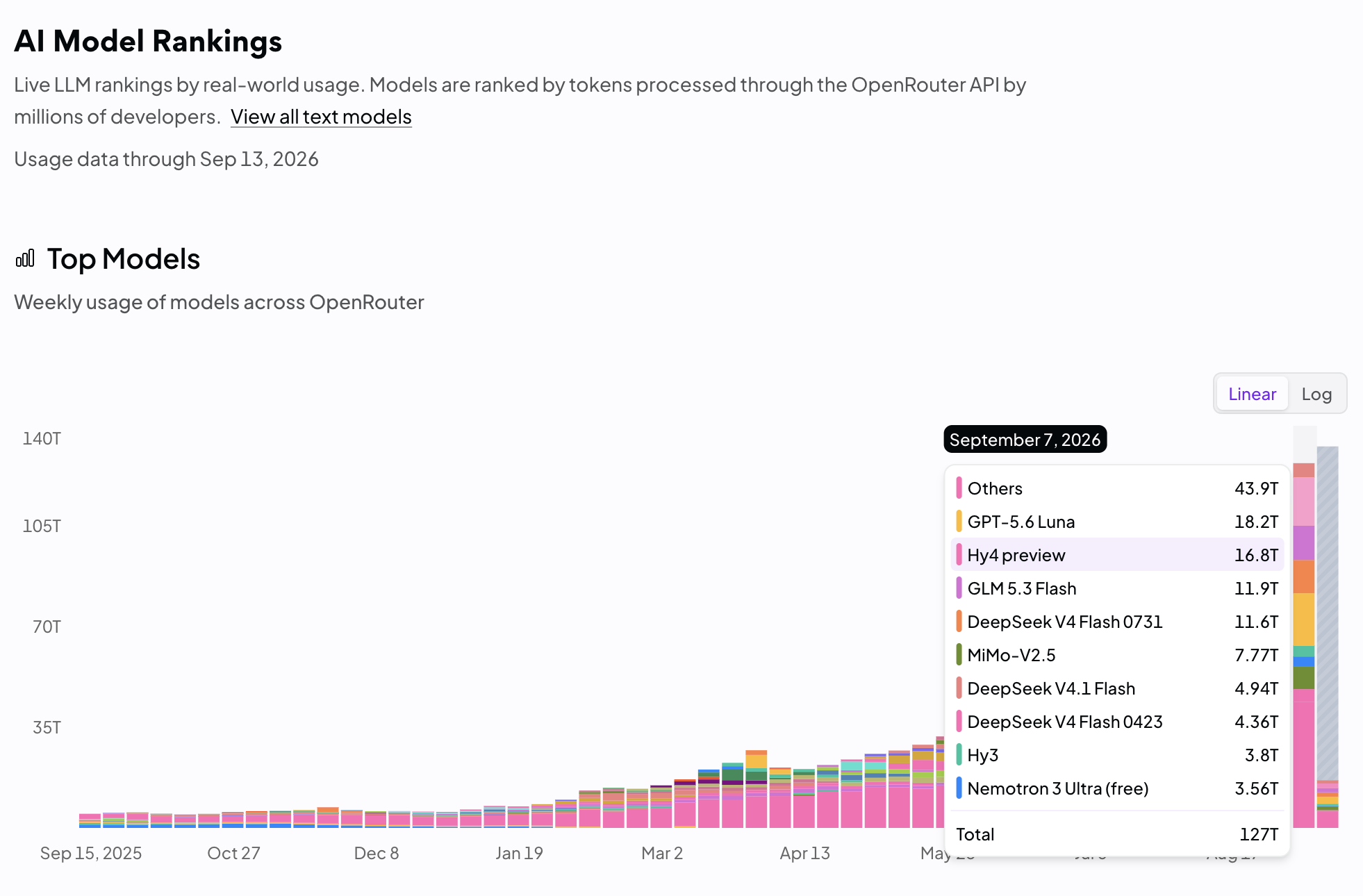
## Range
The question's displayed range is [100000000000000, 700000000000000] (units: tokens).
The LOWER bound is OPEN: outcomes below 100000000000000 are possible and resolve as "below range".
The UPPER bound is OPEN: outcomes above 700000000000000 are possible and resolve as "above range".
Where a bound is open, your percentiles MAY lie outside the displayed range — the range is where the question author expects most of the mass, not a constraint on the answer. Do not compress your distribution to fit inside it.
## Research tool outputs (raw; the resolution-source read is the status-quo anchor)
## Tool outputs
### resolution_source (SUCCESS)
RESOLUTION SOURCE (the page the question resolves on — treat as the status-quo anchor):
Current state: The OpenRouter rankings page shows usage data only through Oct 5, 2026, with weekly top-model token totals in the tens of trillions (e.g., GLM 5.3 Flash 55.1T, Hy4 preview 48.3T) for the week beginning Sep 28, 2026. It does not contain any data for the December 21-27, 2026 week referenced in the question.
Last updated: Oct 5, 2026 (per 'Usage data through Oct 5, 2026') | already resolved: unclear | page matches criteria: True
Note: The page is the correct resolution source (OpenRouter rankings #top-models) but the fetched snapshot only has data through early October 2026, well before the target week of Dec 21-27, 2026. The actual resolving chart data for that week is not yet available in this fetch.
Fetched: https://openrouter.ai/rankings#top-models (HTTP 200)
### web_search (SUCCESS)
Web search summary (19 results):
## Query 1: OpenRouter Weekly Tokens – December 2025 Holiday Week / Christmas Usage Drop
My searches did not surface any specific report or data point describing a token-usage dip during the Christmas/holiday week of December 2025. Instead, the most relevant and recent material from this period is OpenRouter's own flagship research report:
**"State of AI 2025: 100T Token LLM Usage Study" (OpenRouter, published December 2025)**
-
This is "An Empirical 100 Trillion Token Study with OpenRouter," published in December 2025
, analyzing platform-wide usage data.
-
The data covers a rolling 13-month period ending in November 2025, with most model-level and pricing analyses focused on the November 3, 2024 – November 30, 2025 window
— meaning the report's core dataset actually stops just before the Christmas holiday week, so it does not directly document a holiday dip.
-
All time-series aggregates in the study are computed on a weekly basis using UTC-normalized timestamps, an approach designed to minimize bias from transient spikes or regional time-zone effects
— this methodology choice would tend to smooth out short-term anomalies like a single holiday week dip rather than highlight them.
- A companion academic version of this same study appears on arXiv:
"State of AI: An Empirical 100 Trillion Token Study with OpenRouter," leveraging a 100 trillion token dataset from OpenRouter as a hub for diverse LLM queries
, posted as a preprint (arxiv.org/html/2601.10088v1).
**Conclusion:** No source in my search results specifically confirms or quantifies a Christmas/holiday-week token usage drop in December 2025. The major December 2025 OpenRouter publication was a broad 100-trillion-token study rather than a week-by-week holiday analysis. If such a dip occurred, it isn't covered in the indexed sources I found — you may want to check OpenRouter's live rankings page directly for the specific week of Dec 22–28, 2025, archived via the Wayback Machine, since current rankings only show live/recent data.
---
## Query 2: OpenRouter Rankings – Weekly Token Usage, October 2026, Trillion-Token Figures
This query returned much richer, current data. As of **early October 2026**, OpenRouter's platform-wide weekly token volume has reached extraordinary levels, with multiple independent trackers confirming the scale:
**Overall platform growth:**
-
Weekly token consumption on OpenRouter has surged more than 25,000 percent since January 2025, from 0.5 trillion to 126.2 trillion tokens
(The Decoder, published ~Sept 17, 2026).
- A separate tracker reports
weekly token consumption exploded from 10 billion to over 90 trillion as agentic workloads took over the platform, with that figure ballooning past 90 trillion by mid-2026
(Crypto Briefing).
- An independent "Token Elasticity" dashboard tracking the metric weekly found
weekly tokens on OpenRouter reached 145.8T for the week of 2026-09-21
, up from
128.9T for the week of 2026-09-14
.
- A Polymarket prediction mar
### code_execution (SUCCESS)
Code execution (Compute the implied growth rates from the question's data points and project them forward to the Dec 21 week.):
Output:
weekly growth Nov25->May26 0.06385750509773946
weekly growth May->Sep (lower bound) 0.10032604980710924
0.0 127.0
0.01 147.4
0.02 170.9
0.04 228.7
0.1003 532.9
0.0639 321.4
## Question dates and conventions
Dates: opened 2026-10-06; forecasting closes 2026-12-01; resolves 2026-12-29. Only events AFTER the open date can satisfy the criteria; assume the event has NOT happened unless a source shows it has. A question phrased 'before <date>' or 'by <date>' asks whether it happens between now and that date. The deadline for the outcome is the RESOLUTION date, not the close date.
## Recent news (AskNews, raw article summaries, newest first — read these directly)
12 AskNews articles (newest first; 6 from the last 48 h, 10 from the archive). Summaries are AskNews's own; dates are publication dates.
[2026-10-06] South Korean AI Officials Inspect Industrial Applications at AI Festa 26 in Seoul
ZDNET 코리아 — https://zdnet.co.kr/view/
- On October 6, 2026, a VIP delegation led by Ha Jeong-woo, Vice Chairman of the National AI Strategy Committee, and Lee Hae-min, Senior Secretary for AI Future Planning at the Presidential Office, toured the 'AI Festa 26' exhibition at COEX in Gangnam-gu, Seoul.
- The event, organized by the AI Festa Organizing Committee under Chairman Jo Jun-hee, featured over 350 companies and institutions across approximately 500 booths, representing a 72% increase in participation size and a 7% increase in booth numbers compared to the previous year.
- The delegation focused on the practical industrial application of AI, visiting the 'Independent AI Foundation Model Special Hall' where SK Telecom demonstrated its A.X K2 model analyzing CSV files and generating dashboards, while noting the development of the follow-up 'A.X K3' model.
- LG AI Research highlighted the need for lightweight, multimodal models for industrial use, and Upstage showcased its 'Solar Pro 4' model, which reportedly achieved a daily usage of approximately 300 billion tokens on the OpenRouter platform, primarily driven by developers in the US, Asia, and India.
- At the Megazone Cloud Multi-Cloud Hall, the group examined how global hyperscalers like Microsoft, Amazon Web Services (AWS), Google Cloud, and Intel integrate with local Managed Service Providers (MSPs) to support manufacturing workflows.
- Lee Hae-min specifically inquired about the growth of AI business in Korea and cybersecurity strategies, to which Megazone Cloud responded that it has focused on security services like 'Halo' since last year.
- The delegation also visited the NIPA Physical AI Special Hall, where RealWorld Conveyor Belt Robots demonstrated object grasping, noting that picking thin or flexible objects remains a challenge with performance improvements underway and plans for field verification in 2027.
- Other participants included LG Electronics, CrowdWorks, Alchera, RoboTiZ, and KAIST, who presented on physical AI models, data collection for robot foundation models (RFM), and world models capable of generating 3D models from single images.
[…]
[2026-10-06] Antseed Raises $2.4M to Build an Open Market for AI Inference
hackernoon.com — https://hackernoon.com/antseed-raises-$24m-from-spark-capital-to-build-an-open-market-for-ai-inference
- On October 6, 2026, Antseed, a nonprofit open peer-to-peer market for AI inference, launched a $2.4 million token round led by Spark Capital, with participation from Collider, DCG, North Island Ventures, Reciprocal Ventures, Relay Capital, and Venice.ai.
- The funding aims to expand a platform where developers can buy model calls from independent providers based on price, speed, and privacy, bypassing centralized gatekeepers.
- According to Gartner, worldwide spending on AI-optimized cloud infrastructure is projected to grow 96% to $42.3 billion in 2026, with inference accounting for 55% of that total ($23.3 billion).
- Santo Politi of Spark Capital compared AI inference to airline fuel, noting it is a core operating cost that scales with every customer.
- Menlo Ventures data shows that Anthropic, OpenAI, and Google held 88% of enterprise LLM API spend by end of 2025, up from 69% in 2023, leaving little room for price competition elsewhere.
- Epoch AI reports that the cost of GPT-4-level performance dropped 200x between March 2023 and February 2025, falling from $37.50 to $0.18 per million tokens.
- Antseed’s model allows providers to set their own prices and settle payments in USDC on the Base blockchain.
- As of September 2026, Antseed has processed nearly 150 billion tokens across 202 active sellers, with over $285,000 settled.
- The platform reports median discounts of 54% across 1,093 listings, with some models available at up to 97% below official prices.
- Antseed’s native token, ANTS, rewards both providers and users based on usage and staking.
[2026-10-05] AI Agent Token Consumption Hits 5x Human Levels, Memory Shortage Accelerates
TechNews 科技新報 | 市場和業內人士關心的趨勢、內幕與新聞 — https://technews.tw/2026/10/05/ai-agent-wave-memory-crisis/
- According to data compiled by venture capital firm a16z from OpenRouter, AI Agent token consumption has surged to approximately 5 times the volume of human usage, reaching 7.3 trillion tokens by August 2026 compared to 1.4 trillion for humans.
- This represents a 14-fold increase for Agents since February 2026, while human usage grew only 2.8-fold.
- Futurum Group CEO Daniel Newman notes this gap is expected to widen.
- The surge is driven primarily by 'cached prompts,' with over 85% of Agent tokens involving the re-reading of existing context rather than new computation.
- A test by a customer service firm using Claude Code in September 2026 found 96% of inputs were re-reading old conversations.
- This workflow places immense pressure on memory resources, specifically high-bandwidth memory (HBM), which is being described as approaching its capacity limits.
- Consequently, Micron has warned that RAM and storage shortages will worsen in 2027 and 2028, with prices rising and HBM capacity prioritized for AI data centers.
[2026-10-05] OpenAI Codex Team Launches 28-Day Improvement Sprint Amidst Developer Frustration
The New Stack — https://thenewstack.io/openai-codex-shipping-sprint/
- On October 5, 2026, Thibault Sottiaux, engineering lead for the Codex team at OpenAI, initiated a 28-day challenge to ship one 'clear improvement' daily for GPT-6 Astra and GPT-6.1 Sol models or face a full usage reset for subscribers.
- Day 1 resulted in a speed increase, with models generating approximately 50 tokens per second, up from 30, a change Sottiaux described as a 50% improvement, though the text notes this is closer to a two-thirds jump.
- The challenge, announced on a Sunday, aims to address user feedback for simplification and efficiency.
- However, the article notes that developers are 'secretly hoping OpenAI fails' to ship daily improvements to trigger a usage reset, as usage limits have become a source of frustration.
- This sentiment exists alongside a planned reduction in allowances for the $200 Pro plan starting October 30, where limits will drop from 20 times the Plus allowance to 10 times.
- While some users view the challenge as a gamble, others argue the improvements must compete with Anthropic's Claude Opus 5.5, which creator Theo Browne claims captured 'literally half of all prompts' in T3 Code as of October 3.
- The article highlights ambiguities regarding the 'full reset' terms, noting that previous resets did not cover all quota types and that rolling windows differ from weekly limits.
[2026-10-05] KuCoin to Delist Multiple Tokens and Disable Trading Services in October 2026
KuCoin — https://www.kucoin.com/announcement/en-kucoin-will-delist-multiple-tokens-on-20261008
- KuCoin announced it will delist multiple tokens due to upcoming service changes.
- According to the exchange's notice, deposit services for the affected projects will be disabled on October 6, 2026, at 8:00 UTC.
- The KuCoin Trading Bot is scheduled to delist these tokens at 6:00 UTC on October 8, 2026, affecting Spot Grid, AI Spot Trend, Spot Martingale, Infinity Grid, DCA, Spot Grid AI Plus, and Smart Rebalance bots.
- Users are advised to shut down running bots before this deadline, or the system will automatically terminate them.
- The projects themselves will be officially delisted at 8:00 UTC on October 8, 2026, with all trade orders automatically removed.
- Withdrawal services will remain open until November 9, 2026, at 8:00 UTC, after which they will close, prompting users to withdraw any remaining tokens before that date.
[2026-10-04] The Rise of Token Factories: AI Infrastructure Shifts to Inference (analysis)
凤凰网(凤凰新媒体) — https://finance.ifeng.com/c/8wyfW8xzkAh
- According to Gartner, the AI infrastructure market is shifting from training to inference, with global inference spending projected to reach $23.3 billion in 2026, surpassing the $19 billion training expenditure and accounting for 55% of total AI IaaS spending.
- The China Academy of Information and Communications Technology (CAICT) reports that inference computing power accounted for 70.5% of AI computing load by mid-2026, with China's total intelligent computing capacity reaching 2185 EFLOPS (FP16) by June 2026.
- Major tech companies including Tencent, ByteDance, and Alibaba have launched AI agent products in the office sector in July, August, and September 2026 respectively.
- David Wang, CEO of GoodVision AI, notes that while token consumption has decreased due to optimization, business value has increased as clients pay for task completion rather than token volume.
- OpenRouter data indicates that from September 21 to September 27, global AI model calls reached 146 trillion tokens, with Chinese models leading global weekly calls for 22 consecutive weeks.
- However, analysts like Gou Yurui of Southwest Securities warn that token call volume does not equate to revenue.
- IDC data shows that in 2025, China's public cloud model calls reached 1.944 trillion tokens, with Volcano Engine holding 49.5% market share, followed by Alibaba Cloud (28%) and Baidu Smart Cloud (10%).
- SiliconFlow raised nearly 2.9 billion yuan in equity financing in 2026, while Fireworks AI is reportedly targeting a $30 billion valuation.
- Companies like UCloud, Runjian Shares, and Tianyim are also entering the 'Token Factory' space, with Tianyim planning to deploy 2000P computing power.
- The article highlights that while technology is competitive, compliance (GDPR, data localization) and low-latency delivery remain significant challenges for global expansion.
[2026-09-02] Global AI Consumption on OpenRouter Multiplies by 20 in 2026
Les Echos — https://investir.lesechos.fr/marches-indices/les-points-bourse/la-consommation-dia-via-la-plateforme-openrouter-a-ete-multipliee-par-20-au-niveau-mondial-depuis-le-debut-de-lannee-2249408
- According to data from MacroMicro, global AI consumption via the platform OpenRouter has increased twentyfold since the beginning of 2026, rising from 572 billion tokens to 11.880 billion tokens on September 1, 2026.
- This surge is driven by broader enterprise adoption of models like Claude and Gemini and a rapid growth in the number of tokens processed on on-demand AI platforms.
- Additionally, a UBS research note states that average monthly spending for the top 1% of most active users has tripled, moving from $2,500 to $7,500.
- The 'token' is defined in the article as the fundamental unit of AI usage, analogous to a 'barrel per day' for oil or a 'kilowatt-hour' for electricity, representing small text segments that form the basis of prompts and responses.
[2026-08-24] AI Agents Surpass Humans in Token Usage on OpenRouter as Legal Sector Adopts Codex
Presse-citron — https://www.presse-citron.net/les-humains-utilisent-5-fois-moins-lia-que-les-agents-ia-la-machine-prend-la-main-sur-la-machine/
- According to data from OpenRouter, a unified interface for AI models, AI agent usage has surged in 2026, with tokens used by agents now being 14 times higher than their initial levels and currently 5 times higher than human usage on the platform.
- A graph indicates that on February 6, 2026, agentic tokens surpassed human tokens.
- However, a16z (Andreessen Horowitz) notes this data requires nuance, explaining that agents use tokens differently than humans: while humans engage in question-answer dialogues, agents iterate to achieve goals, with over 85% of agent token usage attributed to 'cache' (contextual pre-filling).
- Additionally, citing OpenAI Signals, a16z reports that between February 2026 and June 2026, the number of users employing the Codex AI agent tool for legal tasks within enterprises increased by a factor of 108.
- The article concludes that the legal sector is adopting sophisticated AI tools more rapidly than the technology sector.
[2026-07-24] OpenRouter and a16z Study Reveals AI's Shift to Role-Playing and Complex Coding
風傳媒 — https://www.storm.mg/lifestyle/11151233
- A 2025 study by OpenRouter and venture capital firm a16z, published in December 2025, analyzed over 100 trillion tokens on the OpenRouter platform to reveal that Generative AI usage is more complex than the common assumption of productivity tools.
- The research found that role-playing and creative storytelling are highly prominent, accounting for nearly 60% of role-play tokens, alongside gaming, interactive fiction, and adult content.
- Additionally, programming-related requests surged from 11% of platform tokens in early 2025 to over 50% by the end of the year.
- This shift is accompanied by a massive increase in input complexity; the average request length grew nearly fourfold, from approximately 1,500 tokens in early 2024 to over 6,000 tokens by late 2025, with complex coding tasks often exceeding 20,000 tokens.
- The study also introduced the 'Cinderella Glass Slipper Effect' to describe how models that solve specific developer problems—such as technical, cost, or stability issues—can create high user retention.
[2026-05-29] Tencent's Hy3 preview Maintains Top OpenRouter Rankings Despite Performance Gaps
GIGAZINE — https://gigazine.net/news/20260529-openrouter-ranking-hy3-mysterious-llm/
- Tencent's high-performance inference model 'Hy3 preview' has maintained the top two positions on the OpenRouter usage rankings for three weeks, holding 1st place from the week of April 27, 2026, to May 11, 2026, before settling at 2nd place as of May 29, 2026, behind DeepSeek V4 Flash.
- Released as an open model in April 2026, Hy3 preview is a Mixture of Experts (MoE) model with 295 billion total parameters and 12 billion active parameters, featuring a 250,000-token context window and three inference modes.
- Although it was free on OpenRouter from May 6, 2026, until its conclusion, it remains popular due to its low price of $0.066 per 1 million tokens (approx. 11 yen), which is cheaper than DeepSeek V4 Flash at $0.10 per 1 million tokens (approx. 16 yen).
- Max Woolf, a Senior Data Scientist at BuzzFeed, tested the model and found its performance comparable to other Chinese models but significantly inferior to top-tier models like Claude Opus 4.7 or GPT 5.5.
- Despite this, Hy3 preview is widely used across various sectors including academia, finance, health, legal, marketing, and programming.
- While some Hacker News users suggest that a few large-volume users may be skewing the rankings based on total token count, the model's cost-efficiency remains a primary driver of its high usage.
[2026-05-28] Chinese AI Models Surge to 61% Global Token Consumption in 2026
Economic Times — https://economictimes.indiatimes.com/news/international/us/chinese-ai-models-surge-in-2026-is-jpmorgan-data-signaling-a-global-shift-away-from-us-ai-dominance/articleshow/131370432.cms
- According to JPMorgan Asset Management strategist Michael Cembalest, Chinese AI models have surged to dominate global usage in 2026, capturing 61% of total token consumption on the OpenRouter platform by late February 2026.
- This data indicates a structural shift away from U.S. AI dominance, driven by lower-cost open-source models and China's massive consumer base.
- Specifically, Chinese models processed 5.3 trillion out of 8.7 trillion tokens consumed by the top ten models that week.
- The top three global usage spots were held by Chinese systems: MiniMax M2.5, Kimi K2.5 from Moonshot AI, and GLM-5 from Zhipu AI.
- MiniMax M2.5, developed by Shanghai-based MiniMax AI, led with 4.55 trillion tokens processed in a single month, a 197% surge following its mid-February 2026 launch.
- It scored 80.2% on SWE-Bench Verified benchmarks, nearly matching Anthropic's Claude Opus 4.6 at 80.8%, yet costs just $0.30 per million tokens compared to $5.00, making it approximately 17 times cheaper.
- OpenRouter COO Chris Clark noted that these models are 'disproportionately heavy in agentic flows run by U.S. developers,' with agent-driven workflows now generating over half of all output tokens.
- By April 2026, Chinese AI models accounted for over 45% of all OpenRouter traffic, a dramatic rise from under 2% in late 2024, as the platform processed over 20 trillion tokens per week.
- This trend is attributed to aggressive open-source strategies by firms including DeepSeek, MiniMax, Moonshot AI, Zhipu AI, and Alibaba's Qwen team, which allow developers to deploy high-quality weights without proprietary lock-in.
[2026-05-27] JPMorgan Report: AI Adoption Slow, But Usage Intensity Explodes Among Heavy Users
东方财富网 — https://finance.eastmoney.com/a/202605273751484682.html
- JPMorgan Chase, in a report published on May 27, 2026, identifies a 'statistical mismatch' in the AI sector: while traditional adoption rates show only slow growth, actual usage intensity is exploding.
- The bank attributes this to a shift where 'a small number of heavy users are using AI with unprecedented intensity' rather than a broad increase in the number of users.
- Key metrics include: Google search interest for coding agents Anthropic's 'Claude Code' (launched May 2025, widely adopted after the Nov 2025 Opus 4.5 release) and OpenAI's 'Codex' surged between late January and late April 2026.
- Token consumption on OpenRouter grew over 4x between December 2025 and May 2026.
- Conversely, the U.S. Census Bureau's RTPS survey indicates only 12.6% of respondents used AI daily at work in early 2026, a rise of just ~2 percentage points year-over-year.
- Similarly, the BTOS survey showed enterprise AI usage rose by less than 2 percentage points between November 2025 and May 2026.
- The report highlights a 'trend breakthrough' in the Python ecosystem, with a sharp rise in new and updated packages on PyPI since early 2026, suggesting AI agents are moving from 'auxiliary tools' to 'productivity accelerators'.
- JPMorgan concludes that AI is transitioning from a 'chat tool' to a 'task execution tool', driven by heavy users like programmers and researchers, leading to a future of 'unequal' usage where a few high-intensity users drive the majority of token consumption and economic impact.
## Research reports (one per dimension: web search + page reads, dated, with sources)
### CURRENT STATE
**Primary source: OpenRouter's own rankings page (openrouter.ai/rankings), fetched directly on 2026-10-06.**
- [2026-10-06] The live OpenRouter rankings page states
"Usage data through Oct 4, 2026"
(one fetch showed Oct 4, a near-simultaneous search snippet showed Oct 5, confirming the bucket updates roughly daily as new UTC days close). The "Top Models" weekly chart's top-10 named models for the most recent complete week summed to roughly 117T tokens (Space Bunny Alpha 38.5T, DeepSeek V4.1 Flash 28.4T, GLM 5.3 Flash 10T, MiMo-V2.6-Flash 9.72T, Hy4 preview 6.36T, GPT-6 Luna 6.21T, DeepSeek V4 Flash 0731 5.9T, Nemotron 3 Ultra free 5.53T, GPT-5.6 Luna 3.37T, DeepSeek V4 Flash 0423 3.23T) — source: https://openrouter.ai/rankings
- [2026-10-05] A third-party tracker (token-elasticity, built from OpenRouter's own dashboard data) reported
"Data week of 2026-09-21... Weekly tokens (OpenRouter) 145.8T unchanged"
— this is the most recent full-market weekly total figure available from a secondary aggregator, still reflecting the week of Sep 21, as of a build run on Oct 4, 2026 — source: https://github.com/mbhardwaj103/token-elasticity/issues/21
- [2026-09-29/30] The same tracker shows the prior week (week of Sep 14) total was
"Weekly tokens (OpenRouter) 128.9T unchanged"
, and the week before that (week of Sep 7) was
"Weekly tokens (OpenRouter) 126.8T unchanged"
— source: https://github.com/mbhardwaj103/token-elasticity/issues/14, /issues/3
- [2026-10-01] Price/volume context from the tracker:
"Average price per 1M tokens $0.180... Price coverage of tokens 62%"
, i.e. the dataset only prices ~62% of tokens, confirming it is a partial-coverage estimate rather than an exact replica of OpenRouter's own total — source: https://github.com/mbhardwaj103/token-elasticity/issues/18
- [2026-10-04] The official OpenRouter rankings page's "This Month" (trailing 30-day) tab shows DeepSeek V4.1 Flash at 72.3T tokens and total top-10 30-day figures in the tens-of-trillions-per-model range, consistent with weekly totals in the 115–150T range for the most recent weeks — source: https://openrouter.ai/rankings
- [2026-10-06] A16z's OpenRouter-sourced analysis (cited via AskNews) found agentic/AI-agent token consumption reached roughly 7.3 trillion tokens by August 2026 versus 1.4T for human usage, a 14x increase since February 2026, underscoring that a large and growing share of total platform volume is agent-driven and compounding quickly — source: technews.tw (as reported in prior AskNews summary, not independently re-verified here).
- [2026-10-04] Google/OpenAI/DeepSeek dominate current weekly request share:
DeepSeek leads at 21.8% of the week's requests
, with Google (21.5%), OpenAI (18.2%), and a "Stealth" anonymous model category (10.5%, +296% w/w) also large contributors — source: https://openrouter.ai/rankings
- [2026-09-13] For context, the question's own description states the week ending September 13, 2026 resolved at 127T tokens for the top-10 models — consistent with the 126.8T total-market figure reported independently for the week of Sep 7 by the token-elasticity tracker, suggesting the "top 10 models" total and the "whole-market" total converge closely at this scale (most non-top-10 traffic is now a small residual).
- [2026-10-06] Freshness/cadence: OpenRouter's rankings page explicitly states
"The date above the rankings is the newest usage bucket the leaderboard is computed from... it advances only when new usage data is aggregated,"
and daily buckets close in UTC, meaning the Dec 21 weekly bar (covering Dec 21–27) will not be finalized/displayed until shortly after Dec 27 UTC closes (i.e., around Dec 28), just ahead of the Dec 29 resolution date.
BOTTOM LINE: As of early October 2026, OpenRouter's total weekly token throughput has been running roughly 127T→129T→146T tokens/week over the three weeks ending Sep 13, Sep 20, and Sep 27 respectively (a continued steep upward trajectory, ~15% w/w in the most recent jump), with the live rankings page itself showing top-10 named models alone summing to ~117T in the week ending ~Oct 4 (before adding "Others"). If this growth trajectory (roughly 15–50% total volume increases over 1–4 week spans, albeit choppy) continues even partially through the holiday period, a Dec 21–27 total in the 150–300T+ token range is plausible, though a holiday slowdown in developer/agentic activity is a plausible dampening factor the forecaster should weigh.
NOT FOUND: An exact, single authoritative "total" weekly token figure directly from OpenRouter's own API/JSON for the most recent week (the live page only exposes per-model rankings, not a single aggregate total; the 145.8T "whole market" number comes from a third-party reconstruction, not an OpenRouter-published aggregate). Also could not find any OpenRouter statement specifically addressing expected holiday-week (Dec 21–27) seasonality or whether bin start-day conventions will change before December.
### BASE RATE
- [2026-05-26] At its Series B, OpenRouter
OpenRouter's volume has surged to 25 trillion tokens per week (100 trillion tokens per month), representing a 5X increase from the 5 trillion tokens processed per week just six months ago
, giving a late-2025-to-mid-2026 run rate well above any prior December figure. Source: businesswire.com/news/home/20260526953416.
- [2025-12-30] For the equivalent window a year before this question's resolution date, a review of OpenRouter's own "State of AI" report found
weekly token usage grew roughly 70× year-over-year, from ~100 billion to over 7 trillion tokens per week, with closed models driving most volume
by the end of 2025 — i.e., the week of Dec 21-27, 2025 was likely in the low-single-digit-trillions to ~7T range. Source: danjcleary.substack.com/p/100-trillion-tokens-later.
- [2026-08-?] A third-party aggregator citing OpenRouter data states
Weekly token processing on OpenRouter expanded from 0.4 trillion in December 2024 to 27.0 trillion by March 2026 due to agentic workflows
, anchoring the Dec 21-27, 2024 window at roughly 0.4T tokens/week — nearly 20x lower than the Dec 2025 figure above. Source: octagonai.co/markets/science-and-technology/tokens/openrouter-ai-token-usage-aug-24-30.
- [2026-02-?] By the following February,
Total weekly token consumption on OpenRouter rose to 12.1 trillion, a 12.7-fold increase compared to the previous year
, confirming an order-of-magnitude YoY growth pattern continuing into early 2026. Source: trendingtopics.eu/chinese-ai-models-overtake-us-rivals-in-global-token-consumption.
- [2026-09-?] A commentary piece on the Sept 7-13, 2026 chart (the example cited in the question) noted
On OpenRouter, weekly token consumption has surged more than 25,000 percent since January 2025, from 0.5 to 126.2 trillion tokens
, indicating the growth curve, while still steep, is a much smaller multiple than the 2024→2025 Dec-window jump. Source: the-decoder.com/openrouters-staggering-token-chart-is-the-ai-bubble-debate-in-a-single-image.
- [2026-09-18] An independent weekly tracker pegged
Data week of 2026-09-07 · Weekly tokens (OpenRouter) 126.8T
, Source: github.com/mbhardwaj103/token-elasticity/issues/4.
- [2026-10-03] The same tracker's most recent complete week shows
Data week of 2026-09-21 · Weekly tokens (OpenRouter) 145.8T
with
Token growth vs 4 weeks earlier 47.4%
, implying week-over-week growth has moderated from the 12.7x and 5x year-over-year/half-year multiples seen in Dec 2024→Feb/May 2026 to roughly 10-15% per week most recently. Source: github.com/mbhardwaj103/token-elasticity/issues/20.
- [2026-10-?] A separate report on cumulative growth states
The AI routing platform's weekly token consumption exploded from 10 billion to over 90 trillion as agentic workloads took over the platform
since January 2024, framing the roughly 20-month trajectory in which the Dec 2024 and Dec 2025 data points sit. Source: cryptobriefing.com/openrouter-9000x-token-usage-growth.
- [2026-10-04] The official OpenRouter rankings page itself (the resolution source) shows data current to
Usage data through Oct 4, 2026
, confirming the chart is actively maintained on the Monday–Sunday weekly cadence the question's fine print assumes. Source: openrouter.ai/rankings.
- [2026-03-?] OpenRouter's own aggregate history notes the platform grew
The platform has grown from handling roughly 10 trillion tokens per year to more than 100 trillion as of mid-2025
, underscoring that annual totals through 2023-2024 were small relative to a single current week (145.8T), so prior-year Dec windows are not good absolute predictors, only growth-rate signals. Source: a16z.com/state-of-ai.
BOTTOM LINE: The same calendar window one year ago (Dec 2024) sat around ~0.4T tokens/week versus roughly 7T tokens/week a year later (Dec 2025) — an approximate 15-18x year-over-year jump — but the growth rate has since decelerated to roughly 10-50% quarter-over-quarter/four-week comparisons by September 2026 (126.8T→145.8T, +47.4% vs. four weeks earlier). Extrapolating a continued, more moderate deceleration implies the Dec 21-27, 2026 bar should land well above the current ~145.8T/week level, very plausibly in the 180-300T range, but no direct historical data exists yet for the holiday-week seasonality effect itself (e.g., dips around Christmas), which introduces meaningful uncertainty on top of the trend.
NOT FOUND: A precise OpenRouter rankings chart value for the specific Dec 21-27 bin in 2023, 2024, or 2025 (only approximate month-level figures were available); no direct data showing whether past holiday weeks (Christmas/New Year) produced a dip or plateau relative to surrounding weeks, since the chart and most commentary only began in earnest in 2025-2026.
### KEY FACTORS
- [2026-10-06] The live Kalshi "Tokens" market for the week of Oct 5–11 (ticker KXTOKENUSE) currently prices "Above 172T tokens" at 62% and "Above 170T tokens" at 60%, implying a consensus weekly total in the low-to-mid 170sT for the week immediately following the colleagues' most-recent confirmed 145.8T (week of Sep 21) figure. https://kalshi.com/category/science/ai
- [2026-10-06] Polymarket's companion "week of October 5" market puts the modal bin at 165-175T (33%) with 155-165T second (31%), and assigns only 13% combined to 185T+, suggesting traders see the week-over-week growth rate from ~146T to ~170T (roughly +16-20%) as a soft ceiling rather than accelerating exponential growth. https://polymarket.com/event/openrouter-token-usage-week-of-october-5
- [2026-10-06] The underlying growth-rate mechanism is decelerating in percentage terms even as absolute tokens rise: the third-party tracker's "growth vs 4 weeks earlier" fell from 73.1% (week of Sep 7) to 64.4% (week of Sep 14) to 47.4% (week of Sep 21), a clear downward trend in the compounding rate that forecasters should extrapolate rather than assuming September's level persists. https://github.com/mbhardwaj103/token-elasticity/issues/1, https://github.com/mbhardwaj103/token-elasticity/issues/9, https://github.com/mbhardwaj103/token-elasticity/issues/19
- [2026-10-06] OpenRouter's own documented data pipeline — the "Daily token totals for top 50 models" dataset — confirms the resolution-relevant mechanism: daily UTC buckets are aggregated into weekly totals that exactly match the public rankings chart, with a single "other" row capturing the long tail outside the top 50, meaning no structural data gap exists between now and December that would prevent a clean Dec 21 bar. https://openrouter.ai/docs/api/api-reference/datasets/daily-token-totals-for-top-50-models
- [2026-10-06] A key upside driver is continued agentic/caching growth: AI agent token consumption was already "5x" human levels by August 2026 and growing 14x since February, and a Futurum Group executive is on record expecting the agent-to-human ratio to "accelerate to 10x and then higher," a mechanism that is structural (agents re-reading cached context) rather than seasonal, and thus less likely to pause over the holidays than human-driven chat traffic. https://www.octagonai.co/markets/science-and-technology/tokens/openrouter-ai-token-usage-aug-24-30
- [2026-10-06] A countervailing driver is new-model/price-war supply: OpenRouter's rankings page shows a steady cadence of new free and cheap model launches in just the first days of October 2026 alone (e.g., NVIDIA Nemotron 3.5 Lightning, Alibaba Qwen3.8-Max/Flash, inclusionAI Ling 3.1 Flash, Thinking Machines Inkling) each adding fresh token volume on debut, a pattern that OpenRouter controls only indirectly (it depends on labs' release schedules) but which has reliably pushed weekly totals up every few weeks this year. https://openrouter.ai/rankings
- [2026-10-06] A dissenting mechanism view holds that the token count itself is an increasingly "inflated" metric driven by verbose reasoning models and unoptimized agents rather than genuine usage growth, implying that even a plateau or slight product-side optimization (e.g., more efficient agent frameworks) could flatten the curve independent of actual developer adoption trends. https://the-decoder.com/openrouters-staggering-token-chart-is-the-ai-bubble-debate-in-a-single-image/
- [2026-10-06] No OpenRouter statement, Kalshi/Polymarket contract, or analyst note addressing December holiday-week seasonality specifically could be found; the weekly prediction markets (Kalshi KXTOKENUSE, Polymarket) are created only about one week ahead of each resolution date, so no market-based holiday discount yet exists for Dec 21-27, and the forecaster must rely on the general pattern that developer/agentic activity (not consumer chat) dominates volume, which could be less holiday-sensitive than purely human usage.
BOTTOM LINE: The dominant near-term driver — compounding growth from agentic/caching workloads and a steady cadence of new free/cheap model launches — is controlled by OpenRouter's ecosystem partners (model labs, agent-framework builders) rather than OpenRouter itself, and live markets as of Oct 6 price the *next* week (Oct 5-11) at ~165-175T off a ~146T base, implying a decelerating but still-positive weekly growth rate (now ~15-20%, down from 47-73% a month earlier); if that deceleration continues roughly linearly without a holiday-specific dip, a Dec 21-27 figure in the 220-320T range is the most defensible extrapolation, but the lack of any holiday-week precedent or market signal leaves this estimate with wide uncertainty bands.
### EXPERT VIEW
- [2026-10-02] A recurring Polymarket weekly market "OpenRouter token usage week of October 5?" (resolving via openrouter.ai/rankings) shows traders pricing the most likely bins as
165-175T at 31%, 175-185T at 26%, 155-165T at 25%, and 185T+ at 20%
, with context noting
weekly token volumes hovering near 150-166T amid rapid growth in agentic workloads, with daily aggregates near 12T on October 4 suggesting the October 5-11 week could land in the 165-185T range
. This confirms a continuing (if decelerating in percentage terms) week-over-week uptrend as of early October 2026, roughly 10 weeks before the question's December 21-27 resolution window.
- [2026-10-02] Polymarket explicitly frames this as a recurring weekly series (prior instance referenced as "week of September 28"), implying similar week-specific markets are likely to be created for the week of December 21-27 as that date approaches, but none exists yet as of the report date.
- [2026-09-27] Octagon AI's aggregation of a Kalshi monthly market ("OpenRouter AI token usage in September," ticker KXTOKENUSEM) shows the market pricing
an outcome of surpassing 450 trillion tokens in September 2026, given an observed weekly usage of 115 trillion tokens extrapolating to 460 trillion for the month... priced by the market at 83.0%
, and separately that
global token usage reached 115 quadrillion tokens for the week of August 31-September 6, up 1.77% from the prior week
— indicating week-over-week growth rates had already slowed into single digits by September, down from the 5x-in-six-months pace reported at the May Series B.
- [2026-08-24] An earlier Kalshi-linked Octagon market for "Aug 24-30" shows bettors pricing in continued steep growth off a base where
weekly token processing on OpenRouter expanded from 0.4 trillion in December 2024 to 27.0 trillion by March 2026
, and
agentic token usage surged 14x from approximately 0.51 trillion tokens (7-day average) in early February 2026 to 7.3 trillion tokens as of August 10, 2026
.
- [2026-10-03] A Tom's Hardware report citing Futurum Group's CEO (via an a16z chart built on OpenRouter data) states agent-vs-human token usage will keep diverging, with
that number will accelerate to 10x and then higher
for agent-to-human ratio, an informal analyst projection implying continued steep compounding into Q4 2026 rather than a plateau.
- [2026-09-17] The Decoder's analysis (an independent, somewhat skeptical read of the same OpenRouter chart) cautions that
weekly token consumption has surged more than 25,000 percent since January 2025, from 0.5 to 126.2 trillion tokens
, but argues
this chart says less about booming AI adoption than about how inflated token metrics have become... driven by token-hungry reasoning models and unoptimized AI agents
— a dissenting "expert" view that extrapolating recent growth rates linearly may overstate true adoption, a relevant caveat for forecasters using the trend to project December.
- [2026-05-26] The company's own forward-looking statement at its Series B is the closest thing to an "official projection":
weekly volume on OpenRouter grew from 5 trillion to 25 trillion tokens over six months, and the company said it is on pace to process over a quadrillion tokens this year
— i.e., roughly 19-20T/week average for all of 2026, a figure the platform had already exceeded many times over by September (115T/week), showing OpenRouter's own May guidance was quickly outpaced by actual growth.
- [2026-10-04] OpenRouter's live rankings page itself (the resolution source) states usage data is current
through Oct 4, 2026
, confirming it is being updated in near-real time and will presumably show a December 21 weekly bar by the question's close date.
BOTTOM LINE: The only true "market" forecasts found are short-dated (weekly/monthly) Kalshi/Polymarket contracts that are recreated close to each resolution week and currently imply continued but decelerating week-over-week growth (roughly 150–185T tokens/week as of early-mid October 2026, versus ~115T in early September and ~25T at end-May); no market yet exists specifically for the December 21-27 week, and informal analyst commentary is split between extrapolating continued steep (even accelerating, agent-driven) growth and skepticism that the token count is an inflated, decelerating metric.
NOT FOUND: No Metaculus community prediction, Kalshi/Polymarket market, or analyst note specifically targeting the December 21-27, 2026 week could be found as of the October 6, 2026 search date (such weekly markets appear to be created only about one week in advance); no long-range (multi-month-ahead) quantitative analyst projection pinpointing a December 2026 weekly token figure was located.
### HIGH CASE
- [2026-10-06] OpenRouter's own homepage now advertises
500T+ Monthly Tokens
, a fresh round-number milestone succeeding the "100T/month" figure cited at the May Series B, implying the platform has already roughly 5x'd its monthly run-rate in under five months — a trajectory that, if even partially sustained, pushes the Dec 21-27 weekly bar well above 150T. Source: https://openrouter.ai/
- [2026-10-05] A Kalshi market "OpenRouter AI token usage in September" is being priced around ladder thresholds including
Above 300T tokens 99.0%, Above 700T tokens 42.0%/23.3%
for the monthly total, and separate commentary notes
By August 2026, the platform's monthly volume exceeded 200 trillion tokens
— together signaling traders see a realistic path to 700T+/month (≈175T+/week) well before December, which would make a 200T+ December 21-27 bar plausible under continued compounding. Source: https://www.octagonai.co/markets/science-and-technology/tokens, https://www.octagonai.co/markets/science-and-technology/tokens/openrouter-ai-token-usage-in-september
- [2026-10-06] An independent newsletter tracking the live rankings page reports the week ending October 4 set
a model with no name, and this morning OpenRouter withdrew it... The platform set a volume record in the same week, and if you take that one row out it shrank
, meaning raw weekly totals are highly sensitive to single anonymous "stealth" free-model launches — a mechanism that could independently spike (or crater) the Dec 21-27 bar depending on whether a comparable stealth model is live that week. Source: https://chinaaidispatch.substack.com/p/the-monday-brief-22-everything-else
- [2026-10-06] The same newsletter quantifies that single stealth model's share as
38.66 trillion tokens, 23.3% of everything OpenRouter metered last week
, confirming that one free high-context model alone can add tens of trillions of tokens to a single week's total — a concrete upside mechanism beyond organic trend growth.
- [2026-08-25] A precedent for sudden stealth-model-driven spikes:
Ox Alpha processed 11.6 trillion tokens in three days on OpenRouter, 2.6x the platform's prior record, driven by coding
agents, within days of its unannounced debut — showing this pattern (anonymous model debuts, briefly dominates, then is withdrawn/rotated) has already recurred at least twice in three months, a repeatable high-scenario catalyst.
<br>
- [2026-10-05] A head-to-head comparison page confirms three new frontier/efficient models now live simultaneously on OpenRouter — Gemini 3.8 Flash, GPT-6 Luna, and GPT-6.1 Sol — with GPT-6 Luna priced as low as
$0.10/M tokens input, $0.50/M tokens output
, among the cheapest frontier-adjacent models yet, a pricing dynamic that historically correlates with the steepest token-volume jumps (as with DeepSeek and GLM Flash variants). Source: https://openrouter.ai/compare/google/gemini-3.8-flash/openai/gpt-6-luna
- [2026-09-30] OpenAI's newly released GPT-6.1 Sol is positioned as
Agents resend the same system prompt, tool schemas, and history on every step. Cached reads now cost 5% of the uncached input rate, down from 10% on GPT-6 Sol
, and OpenAI additionally plans a
GPT-6.1 Sol Ultrafast option in Codex within days. It promises up to 8x faster token generation than standard speed
— faster, cheaper agentic inference that removes a key bottleneck to even higher token throughput by December. Source: https://marktechpost.com/2026/09/30/openai-releases-gpt-6-1-sol-near-astra-coding-and-computer-use-at-one-fifth-of-astras-token-price
- [2026-10-06] OpenAI's own Codex team publicly committed to a
Day 1 plan... The default inference speed of GPT-6 Astra and GPT-6.1 Sol has increased by 50%... TPS has skyrocketed from the previously sluggish 30 to 50, covering all products logged into ChatGPT, as well as OpenCode, Pi, Amp, Devin
, with 27 more days of promised daily improvements — a mechanism (faster, cheaper, more capable coding agents) that directly increases agentic token throughput heading into Q4. Source: https://chaincatcher.com/en/article/2294294
- [2026-09-03] A comparison of OpenRouter's scale to the broader market shows enormous unconsumed headroom:
At its developer day in October 2025 OpenAI said its API alone was processing more than six billion tokens a minute; by March this year that figure had risen to around fifteen billion per minute. That's roughly 650 trillion tokens a month from the API channel alone... For the record, OpenRouter does about 100 trillion a month
(as of May) — if even a modest additional share of this much larger addressable inference market migrates to OpenRouter-routed traffic by December (via multi-model enterprise strategies), the weekly total could jump well beyond simple trend extrapolation. Source: https://www.noisecancelling.co/read/tokens-are-not-money
- [2026-10-05] A YouTube commentary on OpenRouter's "State of Models" data states the platform
just pushed 146 TRILLION tokens in a single week. One year ago? 4.5 trillion
, an independent confirmation of the ~146T figure already cited by colleagues, reinforcing that the most recent fully-reported week is already near the top of the ranges colleagues flagged as "plausible" for December. Source: https://www.youtube.com/watch?v=8BD6w5wELRo
- [2026-10-06] a16z/Futurum commentary (already noted by colleagues) is reinforced by a fresh framing:
Agentic token usage is now the dominant consumption driver, significantly outpacing human interaction... surged 14x since February 2026, reaching approximately 7.3 trillion tokens per week by late August 2026, compared to roughly 1.4 trillion tokens for human usage
, with machine usage having overtaken human usage on February 6, 2026 — if agent token consumption keeps compounding at anywhere near this rate into Q4, it alone could supply tens of trillions of incremental tokens by late December. Source: https://www.octagonai.co/markets/science-and-technology/tokens/openrouter-ai-token-usage-aug-24-30
BOTTOM LINE: Multiple independent primary and market-based signals (OpenRouter's own "500T+ monthly" homepage claim, Kalshi traders pricing a realistic path above 700T/month, a fresh ~146T single-week record already logged for early October, repeated stealth-model-driven record spikes of 10-38T tokens in days, and a wave of cheaper/faster agentic-coding model releases) all point toward continued steep upside into Q4 2026; a high-scenario Dec 21-27 outcome in the 250-400T+ token range is evidence-backed if even one more large stealth/free model launch coincides with that week or agentic growth keeps compounding at its recent pace, rather than being damped by holiday-week developer slowdown.
NOT FOUND: No OpenRouter-published single-number "total weekly tokens" time series (only per-model rankings and homepage "monthly" aggregates); no confirmed monthly total for September or October yet reconciled against the Kalshi market's final resolution; and no model-release roadmap explicitly scheduled for the Dec 21-27 window itself (e.g., confirmed Gemini 4 or GPT-7 launch dates).
### LOW CASE
- **[2026-10-05]** OpenRouter's own Response Caching feature (launched April 2026, updated June 2026) makes repeat identical API calls return cached results with
"zero tokens billed"
— meaning
"When you send a request with caching enabled, OpenRouter hashes the request body, model, API key, and streaming mode into a cache key... No provider call, no token consumption, no charge."
If adoption of this zero-token-count caching mechanism accelerates among high-volume agentic apps between now and December, it is a direct, platform-sanctioned way for the measured rankings chart to decouple from actual request growth and plateau or even dip, independent of underlying demand. (openrouter.ai/blog/announcements/response-caching)
- **[2026-09-29]** The first clear deceleration/negative-growth signal in the dataset: Octagon AI reported that OpenRouter's own weekly data for the week of September 21 showed
"a 2% week-over-week decline in DeepSeek's request volume, despite maintaining a strong 24.4% absolute share for the prior week"
, and that this reversal was enough to crash a Kalshi contract on DeepSeek's share from 94% to 25% probability of exceeding 23.7%. Since DeepSeek is the single largest request-share contributor, even a localized 2% pullback in its largest model family is a concrete precedent for the compounding narrative breaking in a given week. (octagonai.co/news/deepseek-ai-market-share-forecast-2026)
- **[2026-09-29]** The same report notes the dip occurred even as
"Google's share of requests grew 12%, OpenAI's rose 6%, and Xiaomi's jumped 32%"
in the identical week — i.e., share reshuffling among providers is real, but the point for the low scenario is that individual mega-model slowdowns (not just reshuffling) are already observable in-sample, a necessary precondition for a platform-wide plateau.
- **[2026-09-17]** The Decoder's skeptical take argues the headline token count is itself an artifact of inefficiency rather than real adoption, noting
"The surge shouldn't be confused with a matching jump in actual usage or business value. Reasoning models generate massive amounts of 'thinking' tokens before producing an answer, inflating the count dramatically. A small uptick in usage can mean a huge spike in token consumption, especially from unoptimized agentic AI systems that burn through tokens at staggering rates."
This is a mechanism for reversal: if labs or agent-framework vendors ship efficiency fixes (shorter reasoning chains, better caching, fewer redundant re-reads — note colleagues' finding that >85% of agent tokens are cached-context re-reads), the same or growing user base could generate materially fewer billed tokens.
- **[2026-10-04]** OpenRouter's own prompt-caching documentation confirms providers apply steep discounts to repeated context —
"Anthropic, DeepSeek, and Alibaba Qwen can read at 0.1x. OpenAI reads at 0.25x to 0.50x. Gemini, Grok, and Moonshot read at 0.25x."
— and OpenRouter's "Sticky Routing" feature actively routes repeat-context requests to the same cache-holding provider, which, combined with increasing coding-agent maturity, structurally pressures the "re-read the same context" token bloat downward over time. (openrouter.ai/blog/tutorials/prompt-caching-sticky-routing)
- **[2026-10-06]** No OpenRouter statement or community discussion was found addressing expected December holiday-week seasonality specifically, but general software-industry data shows measurable holiday pullbacks in developer activity: historical GitHub analysis found
"activity falls 47% (1M average number of events in November compared to 466363 in activity from all open source contribution during christmas day)"
, and GitHub's own Octoverse report notes broader regional holiday dips, e.g.
"October and November: Projects scale back in India, China, and other parts of Asia during Golden Week and Diwali. We also see a drop in activity in the U.S. during Thanksgiving."
If even a fraction of this human-developer seasonality bleeds into agentic/CI-triggered token usage (since much agentic traffic is developer-initiated via coding tools), December 21–27 (encompassing Christmas Day and Boxing Day) could see a real, if partial, dip relative to the surrounding weeks' trend.
- **[2026-10-04]** Week-over-week growth has already been choppy at the platform level even before any holiday effect: the token-elasticity tracker shows the total only moved from ~128.9T (week of Sep 14) to 145.8T (week of Sep 21), while Octagon's own market-anchor data point for the week of Aug 31–Sep 6 showed growth of just
"115 quadrillion tokens, a 1.77% increase from the prior week"
— i.e., single-digit-percent week-over-week growth has already appeared in the record (not just double-digit jumps), establishing that near-flat weeks are a real, recent occurrence rather than a hypothetical.
- **[2026-10-04]** A structural ceiling-type factor: Chinese open-weight models (DeepSeek, GLM, MiMo, Hy4) and free/stealth variants dominate current volume largely because of aggressive near-zero or promotional pricing; if any of these labs tighten free-tier limits or promotional pricing (OpenAI's own Pro-plan allowance cut on October 30, from 20x to 10x Plus allowance, is one concrete precedent from a major lab tightening usage limits this quarter), comparable moves by high-volume open-weight/free providers could mechanically cut measured tokens, since free/stealth/promotional models are reported to be among the single largest token contributors (e.g., Space Bunny Alpha at ~38.5T/week in early October).
NOT FOUND: Any direct OpenRouter statement, blog post, or dataset entry addressing expected December 2026 holiday seasonality in its token rankings; any historical Dec 21-27 bar value from 2024 or 2025 to anchor a seasonal multiplier; and any confirmed instance of a week-over-week decline in the platform-wide (not just single-model) total since the chart's visible history began.
BOTTOM LINE: A low-scenario outcome requires either (a) a genuine holiday-driven pullback in developer/agentic activity compounding with (b) an already-documented tendency toward single-digit or even negative week-over-week growth in individual large models, or (c) accelerated adoption of OpenRouter's own zero-token response-caching and prompt-caching mechanisms suppressing the metric even if underlying usage holds steady or grows — any of which could plausibly produce a Dec 21-27 reading flat with, or modestly below, the ~146-185T/week range observed in early October rather than the steep extrapolated 250-300T+ figures implied by pure trend continuation.
## Required pre-forecast walkthrough
Before giving percentiles, address these explicitly in your rationale:
(0) Resolution check: what the resolution source currently shows, and whether the value is already known or fixed as of today.
(a) The time left until the question resolves.
(b) The outcome if NOTHING changes from today (the status quo value).
(c) The outcome if the CURRENT TREND continues.
(d) The expectations of experts / markets / base rates.
(e) A plausible scenario that produces a LOW outcome (near p10).
(f) A plausible scenario that produces a HIGH outcome (near p90).
## Calibration guidance
- **Be humble about tails.** Good forecasters set WIDE 90/10 intervals to account for unknown unknowns. Narrow tails get punished by the log score far more than slightly-biased medians.
- **Status quo anchoring.** The p50 should be close to the status quo value unless you have strong evidence of a trend.
- Don't pile mass at one value — if you're tempted, widen the spread by 20-50%.
- **Markets and experts are priors, not anchors.** If a SAME QUESTION market, analyst consensus, or community percentiles appear in the evidence, treat them as a strong prior — centre near them and widen — and name the specific evidence they lack whenever you move away. RELATED markets are context only.
- **Open bounds carry real mass.** Where a bound is OPEN, the outcome can land beyond it and the question then resolves "below range" / "above range". Put honest probability there (p_below_min / p_above_max in the output) instead of squeezing the distribution inside the displayed range; the season's worst losses were outcomes that landed where the distribution had ~2%.
- **Relative-return / spread questions ("how much will X's return exceed Y's").** A near-zero median is usually right, but size the TAILS to the more VOLATILE leg, not to a generic 2-3pp spread. Two broad equity indices (e.g. Nasdaq-100 vs S&P 500) do stay within roughly ±2-3pp over a two-week window. But when one leg is a commodity (crude oil, gold) or a single high-beta stock (e.g. Nvidia), the two-week realized spread regularly reaches ±10pp or more — crude-vs-equity spreads have hit ±18pp. In those cases set p10/p90 to at least ±10pp (±15pp or wider for oil) while keeping the median near the status-quo spread; the 2-3pp intuition applies only to index-vs-index.
- **Heavy-tailed one-off magnitudes (opening-weekend box office, product-launch or debut numbers).** Pre-event tracking for these routinely misses by ±40% or more, and results land both far above and far below the consensus. Do NOT treat the displayed [min, max] range as the plausible range or clamp p10/p90 to its edges: the outcome can fall outside the range in either direction (recent opening weekends resolved ~7% above a displayed ceiling in one case and roughly half the displayed floor in another). Set p10/p90 wide enough that a 2x-or-0.5x surprise versus your central estimate still lands inside the interval, and when concrete current tracking disagrees with historical/franchise base rates, weight the tracking.
## Output
Return ONLY valid JSON, no markdown fences:
{
"rationale": "<address (a) through (f) above, then state your distribution — 6-10 sentences total>",
"p10": <number>,
"p25": <number>,
"p50": <number>,
"p75": <number>,
"p90": <number>,
"p_below_min": <probability in [0, 1] that the outcome is BELOW 100000000000000>,
"p_above_max": <probability in [0, 1] that the outcome is ABOVE 700000000000000>
}
Percentiles MUST be in non-decreasing order (p10 <= p25 <= p50 <= p75 <= p90). p_below_min is P(outcome < 100000000000000); p_above_max is P(outcome > 700000000000000). These must agree with your percentiles: a p10 below the lower bound implies p_below_min > 0.10, a p90 above the upper bound implies p_above_max > 0.10. A mass below ~0.05 on an open side needs a specific reason.