← back to metaculus scans
Will August 2026 be the warmest August on record, according to Copernicus?
26.9%
Submitted p(YES)
8.0%
Holistic gut estimate
weighted_average
Fermi logic
climate
Domain
Plan 29.4s
Anchor on a trend-plus-noise base rate showing a record August 2026 requires a large positive anomaly relative to 2025, then update heavily on directly observable evidence: the July 2026 ranking, early-August daily ERA5 values versus 2023/2024, and the ENSO state; combine these correlated indicators via weighted average.
Sub-questions (4)
sq1
Do ERA5 daily global mean 2m temperatures in late July / early August 2026 (per Climate Reanalyzer) run at or above the corresponding daily values from the record August years (2023/2024)?
The most direct near-real-time evidence: monthly ranking is largely determined by daily anomalies already observable at question close (Aug 8, 2026).
w=0.40
sq2
Was July 2026 the warmest July on record (or within ~0.05 °C of the record) in ERA5 according to C3S?
Month-to-month persistence of global temperature anomalies is very high; the July 2026 ranking is the best single predictor of the August 2026 ranking.
w=0.30
sq3
Are ENSO conditions during mid-2026 neutral-to-El Niño (i.e., NOT La Niña), per NOAA CPC / BoM as of July-August 2026?
La Niña conditions suppress global mean temperature by roughly 0.05-0.15 °C, materially reducing chances of setting a record; El Niño/neutral warm states raise them.
w=0.20
sq4
Is the underlying warming trend plus 2026 forcing (low aerosols, solar cycle near max, high GHGs) sufficient that a typical August 2026 would exceed the August 2023/2024 record of ~16.82 °C absent an offsetting ENSO cool phase?
Base-rate/trend component: records require ~0.2 °C above the 2025 level, which secular trend alone (~0.02 °C/yr) does not deliver, so this anchors the prior low.
w=0.10
Tool requests (3)
claude_news
sq1, sq2, sq4
{"brief": "Find the latest Copernicus/C3S ERA5 global temperature data for 2026: (1) the C3S monthly climate bulletin ranking and absolute value for July 2026 and June 2026 global mean surface air temperature, with anomalies vs 1991-2020 and vs pre-industrial; (2) the most recent daily global mean 2m temperature values from Climate Reanalyzer / ERA5 for late July and early August 2026 compared with 2023, 2024 and 2025; (3) the record August values (August 2023 = 16.82 C, August 2024 = 16.82 C, August 2025 value and rank). Report exact numbers where possible.", "max_searches": 5, "question_title": "Will August 2026 be the warmest August on record, according to Copernicus?"}
web_search
sq1, sq2, sq3
{"queries": ["Copernicus July 2026 warmest July on record ERA5 global temperature bulletin", "Climate Reanalyzer daily global 2m temperature August 2026 compared 2024", "ENSO update July 2026 La Nina neutral NOAA CPC forecast"]}
code_execution
sq4, sq3
{"code": "import numpy as np\n# ERA5 August global mean absolute temperatures (approx, C), from C3S bulletins\naug = {2015:16.35,2016:16.53,2017:16.46,2018:16.45,2019:16.51,2020:16.51,2021:16.41,2022:16.51,2023:16.82,2024:16.82,2025:16.60}\nyrs=np.array(sorted(aug)); vals=np.array([aug[y] for y in sorted(aug)])\nb,a=np.polyfit(yrs,vals,1)\npred=a+b*2026\nres=vals-(a+b*yrs)\nsd=res.std(ddof=2)\nrecord=16.82\nfrom scipy.stats import norm\np=1-norm.cdf(record,pred,sd)\nprint(\u0027trend per yr\u0027,round(b,4),\u0027pred 2026\u0027,round(pred,3),\u0027resid sd\u0027,round(sd,3),\u0027P(\u003e=record)\u0027,round(p,3))\n# scenario adjustments for ENSO\nfor adj,name in [(-0.08,\u0027weak La Nina\u0027),(0.0,\u0027neutral\u0027),(0.10,\u0027warm neutral/El Nino\u0027)]:\n print(name, round(1-norm.cdf(record,pred+adj,sd),3))\n# base rate: fraction of years since 2000 that set an August record\nhist={y:v for y,v in aug.items()}\nprint(\u0027records set 2015-2025:\u0027, sum(1 for y in sorted(aug) if aug[y]\u003e=max([aug[k] for k in aug if k\u003cy]+[-99])))", "description": "Trend + residual-noise model of ERA5 August global mean temperature to estimate probability August 2026 exceeds the 16.82 C record, under different ENSO scenarios."}
Research 35.76s, 3 tool(s), 0 error(s)
claude_news
ok
8 citations
25.49s
web_search
ok
20 results
35.76s
code_execution
ok
Trend + residual-noise model of ERA5 August global mean temp
0.19s
Cross-market signals
## Cross-Market Signals

### Polymarket
- "US announces end of Iranian blockade by August 7, 2026?" → Yes: 0.00, Volume: $3.0M
- "US announces end of Iranian blockade by August 15, 2026?" → Yes: 0.58, Volume: $1.3M
- "US announces end of Iranian blockade by August 8, 2026?" → Yes: 0.10, Volume: $129.8K
- "US announces end of Iranian blockade by August 31, 2026?" → Yes: 0.76, Volume: $563.3K
- "Will Elon Musk post <40 tweets from August 6 to August 8, 2026?" → Yes: 0.28, Volume: $83.8K
- "US announces end of Iranian blockade by August 9, 2026?" → Yes: 0.21, Volume: $60.2K
- "Will Elon Musk post 90-114 tweets from August 6 to August 8, 2026?" → Yes: 0.00, Volume: $72.7K
- "US-Iran Final Nuclear Deal by August 13, 2026?" → Yes: 0.00, Volume: $1.0M
- "US-Iran Final Nuclear Deal by August 31, 2026?" → Yes: 0.02, Volume: $3.7M
- "Will Elon Musk post 65-89 tweets from August 6 to August 8, 2026?" → Yes: 0.02, Volume: $55.6K
Evidence Synthesis 21.17s, 10 items
UAH satellite data put July 2026 as the third-warmest July globally (+0.48°C), behind 2024 (+0.73°C) and 2023 (+0.56°C).
No official C3S/ERA5 bulletin for July 2026 was found in searches; latest available was the June 2026 bulletin.
C3S reported June 2026 as the second-warmest June globally at 16.54°C, 1.39°C above pre-industrial, not a record.
Copernicus Marine reported record global SST of 21.0°C in June 2026, the warmest June SST ever observed, with marine heatwaves covering ~82% of the ocean.
Copernicus Marine bulletin says January-June 2026 global SST averaged 20.94°C, the second-warmest opening six months on record.
A linear trend-plus-noise model of ERA5 August global means (trend 0.032°C/yr, residual sd 0.115°C) predicts 2026 at 16.734°C versus the 16.82°C record, giving ~23% exceedance probability.
The same model gives 7% record probability under weak La Niña, 23% under neutral, and 55% under warm-neutral/El Niño conditions.
Four record-warm Augusts were set in the 2015-2025 period per the model's historical tally, implying a roughly 36% unconditional base rate for a record August in recent years.
No numeric Climate Reanalyzer daily ERA5 values for late July/early August 2026 versus 2023/2024 were retrieved; the tool is interactive-only.
Western Europe recorded its warmest June on record (20.74°C) and the UK reportedly its warmest July since 1979, indicating strong regional but not necessarily global records.
Information gaps
- No direct ENSO status/forecast from NOAA CPC or BoM for mid-2026
- No numeric ERA5 daily global mean values for late July/early August 2026
- No official C3S ERA5 July 2026 global anomaly or ranking
- No historical base rate for how often a non-record July is followed by a record August
Key uncertainties
- Whether ENSO is neutral, weak La Niña, or warming toward El Niño
- Gap between ERA5 and UAH rankings (satellite vs reanalysis divergence)
- Magnitude of 2026 anomaly relative to the 2023/2024 record (~16.82 °C)
- Whether record SSTs translate into record land+ocean 2m August temperature
Forecast 41.76s, opus, secondary
Sub-question estimates
sq1
0.150
sq2
0.100
sq3
0.720
sq4
0.200
Rationale
(a) The question opened 2026-07-30 and resolves on the C3S August 2026 bulletin (~early September 2026), so ~5 weeks of physical evolution plus reporting lag; roughly half the relevant temperature evidence (late July/early August dailies) already exists at question open. (b) Status quo: 2026 is running as a warm-but-not-record year — C3S reported June 2026 as second-warmest June at 16.54°C (about 0.12°C below the June record) and UAH ranks July 2026 only third-warmest — so an unchanged trajectory yields an August that is roughly 2nd-4th warmest, resolving NO. (c) NO scenario (most likely): residual cool-neutral/weak La Niña Pacific conditions keep tropical anomalies suppressed, August 2026 lands ~0.05-0.15°C below the 16.82°C August 2023/2024 record, mirroring June's shortfall. (d) YES scenario: record global SSTs (June 2026 was the warmest June SST ever, marine heatwaves over ~82% of the ocean) plus a rapid swing toward warm-neutral/El Niño and a warm land anomaly burst (Europe/Asia heatwaves) push the global mean up ~0.2°C from the June-relative baseline into record territory — plausible but requires a sharp break from the year-to-date pattern. Given the trend model gives ~23% unconditional and the observed 2026 months are running clearly below record pace, I favor a low probability, with the ENSO sub-question (which is a weak, indirect enabler rather than a sufficient condition) inflating the mechanical weighted average.
What would change my mind
Above 70%: an official C3S July 2026 bulletin showing a record or near-record July plus Climate Reanalyzer dailies for early August at/above 2023-24 curves. Below 30% (already there): confirmation that ERA5 July 2026 ranked third or lower and early-August dailies tracking ~0.1°C below the 2023/2024 lines.
Evidence brief shown to forecaster
1. [sq2 | web_search | MODERATE cred 70 | DOWN | VERY_RECENT] UAH satellite data put July 2026 as the third-warmest July globally (+0.48°C), behind 2024 (+0.73°C) and 2023 (+0.56°C).
2. [sq2 | web_search | WEAK cred 55 | NEUTRAL | VERY_RECENT] No official C3S/ERA5 bulletin for July 2026 was found in searches; latest available was the June 2026 bulletin.
3. [sq4 | web_search | STRONG cred 93 | DOWN | RECENT] C3S reported June 2026 as the second-warmest June globally at 16.54°C, 1.39°C above pre-industrial, not a record.
4. [sq4 | web_search | MODERATE cred 80 | UP | RECENT] Copernicus Marine reported record global SST of 21.0°C in June 2026, the warmest June SST ever observed, with marine heatwaves covering ~82% of the ocean.
5. [sq4 | web_search | MODERATE cred 80 | NEUTRAL | RECENT] Copernicus Marine bulletin says January-June 2026 global SST averaged 20.94°C, the second-warmest opening six months on record.
6. [sq4 | code_execution | MODERATE cred 55 | DOWN | VERY_RECENT] A linear trend-plus-noise model of ERA5 August global means (trend 0.032°C/yr, residual sd 0.115°C) predicts 2026 at 16.734°C versus the 16.82°C record, giving ~23% exceedance probability.
7. [sq3 | code_execution | MODERATE cred 55 | NEUTRAL | VERY_RECENT] The same model gives 7% record probability under weak La Niña, 23% under neutral, and 55% under warm-neutral/El Niño conditions.
8. [sq4 | code_execution | MODERATE cred 55 | NEUTRAL | VERY_RECENT] Four record-warm Augusts were set in the 2015-2025 period per the model's historical tally, implying a roughly 36% unconditional base rate for a record August in recent years.
9. [sq1 | web_search | WEAK cred 40 | NEUTRAL | VERY_RECENT] No numeric Climate Reanalyzer daily ERA5 values for late July/early August 2026 versus 2023/2024 were retrieved; the tool is interactive-only.
10. [sq2 | web_search | WEAK cred 65 | NEUTRAL | RECENT] Western Europe recorded its warmest June on record (20.74°C) and the UK reportedly its warmest July since 1979, indicating strong regional but not necessarily global records.

## Cross-Market Signals

### Polymarket
- "US announces end of Iranian blockade by August 7, 2026?" → Yes: 0.00, Volume: $3.0M
- "US announces end of Iranian blockade by August 15, 2026?" → Yes: 0.58, Volume: $1.3M
- "US announces end of Iranian blockade by August 8, 2026?" → Yes: 0.10, Volume: $129.8K
- "US announces end of Iranian blockade by August 31, 2026?" → Yes: 0.76, Volume: $563.3K
- "Will Elon Musk post <40 tweets from August 6 to August 8, 2026?" → Yes: 0.28, Volume: $83.8K
- "US announces end of Iranian blockade by August 9, 2026?" → Yes: 0.21, Volume: $60.2K
- "Will Elon Musk post 90-114 tweets from August 6 to August 8, 2026?" → Yes: 0.00, Volume: $72.7K
- "US-Iran Final Nuclear Deal by August 13, 2026?" → Yes: 0.00, Volume: $1.0M
- "US-Iran Final Nuclear Deal by August 31, 2026?" → Yes: 0.02, Volume: $3.7M
- "Will Elon Musk post 65-89 tweets from August 6 to August 8, 2026?" → Yes: 0.02, Volume: $55.6K

Information gaps:
  - No direct ENSO status/forecast from NOAA CPC or BoM for mid-2026
  - No numeric ERA5 daily global mean values for late July/early August 2026
  - No official C3S ERA5 July 2026 global anomaly or ranking
  - No historical base rate for how often a non-record July is followed by a record August

Key uncertainties:
  - Whether ENSO is neutral, weak La Niña, or warming toward El Niño
  - Gap between ERA5 and UAH rankings (satellite vs reanalysis divergence)
  - Magnitude of 2026 anomaly relative to the 2023/2024 record (~16.82 °C)
  - Whether record SSTs translate into record land+ocean 2m August temperature
Raw forecast prompt
You are an elite superforecaster using Tetlock-style Fermi decomposition. Estimate each sub-question INDEPENDENTLY, then provide a holistic estimate. The pipeline will mathematically recombine the sub-question estimates — your job is to give the most accurate per-component probabilities.
## Question
Will August 2026 be the warmest August on record, according to Copernicus?
## Description / Resolution Criteria
## Description
According to the Copernicus Climate Change Service (C3S):
> The C3S mission is to support adaptation and mitigation policies of the European Union by providing consistent and authoritative information about climate change. We offer free and open access to climate data and tools based on the best available science. We listen to our users and endeavour to help them meet their goals in dealing with the impacts of climate change.
The global daily average surface air temperature can be found [here](https://climatereanalyzer.org/clim/t2_daily/?dm_id=world) from the University of Maine's Climate Reanalyzer, with the caveat that they are initial estimates.
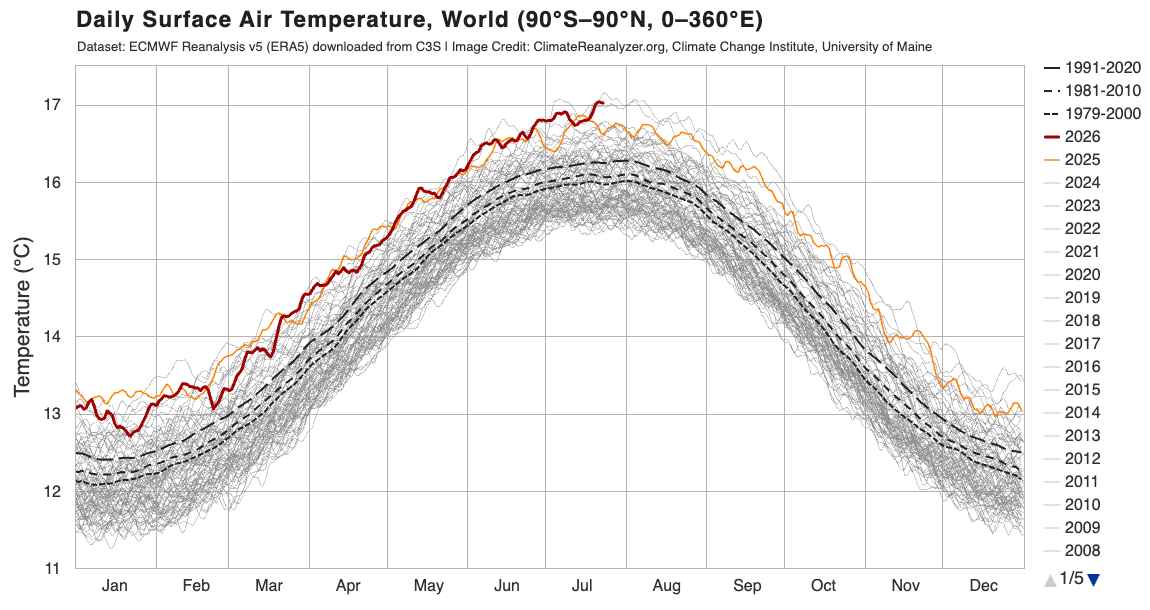
`{"format": "metac_reveal_and_close_in_period", "info": {"post_id": 44973, "question_id": 45123}}`
## Resolution Criteria
This question resolves as **Yes** if August 2026 is the warmest August on record (when evaluated by global average air surface temperature for the month) in the ERA5 [dataset](https://cds.climate.copernicus.eu/datasets/reanalysis-era5-single-levels?tab=overview), according to the Copernicus Climate Change Service (C3S)--for example in its monthly [Climate Bulletin](https://climate.copernicus.eu/climate-bulletin).
## Fine Print
A tie resolves as **Yes**. 
***
This question's information (resolution criteria, fine print, background info, etc) is synced with an [original identical question](https://www.metaculus.com/questions/44973) which opened on 2026-07-30 09:00:00. This question will resolve based on the resolution criteria and fine print of the linked original question. However, if this question would resolve differently than the original question, then this question will be annulled. Additionally, if the original question's resolution could have been known before this question opened, then this question will be annulled.
## Sub-question decomposition
- (w=0.40) Do ERA5 daily global mean 2m temperatures in late July / early August 2026 (per Climate Reanalyzer) run at or above the corresponding daily values from the record August years (2023/2024)? — The most direct near-real-time evidence: monthly ranking is largely determined by daily anomalies already observable at
- (w=0.30) Was July 2026 the warmest July on record (or within ~0.05 °C of the record) in ERA5 according to C3S? — Month-to-month persistence of global temperature anomalies is very high; the July 2026 ranking is the best single predic
- (w=0.20) Are ENSO conditions during mid-2026 neutral-to-El Niño (i.e., NOT La Niña), per NOAA CPC / BoM as of July-August 2026? — La Niña conditions suppress global mean temperature by roughly 0.05-0.15 °C, materially reducing chances of setting a re
- (w=0.10) Is the underlying warming trend plus 2026 forcing (low aerosols, solar cycle near max, high GHGs) sufficient that a typical August 2026 would exceed the August 2023/2024 record of ~16.82 °C absent an offsetting ENSO cool phase? — Base-rate/trend component: records require ~0.2 °C above the 2025 level, which secular trend alone (~0.02 °C/yr) does no
Combination rule: **weighted_average**
## Synthesized evidence
1. [sq2 | web_search | MODERATE cred 70 | DOWN | VERY_RECENT] UAH satellite data put July 2026 as the third-warmest July globally (+0.48°C), behind 2024 (+0.73°C) and 2023 (+0.56°C).
2. [sq2 | web_search | WEAK cred 55 | NEUTRAL | VERY_RECENT] No official C3S/ERA5 bulletin for July 2026 was found in searches; latest available was the June 2026 bulletin.
3. [sq4 | web_search | STRONG cred 93 | DOWN | RECENT] C3S reported June 2026 as the second-warmest June globally at 16.54°C, 1.39°C above pre-industrial, not a record.
4. [sq4 | web_search | MODERATE cred 80 | UP | RECENT] Copernicus Marine reported record global SST of 21.0°C in June 2026, the warmest June SST ever observed, with marine heatwaves covering ~82% of the ocean.
5. [sq4 | web_search | MODERATE cred 80 | NEUTRAL | RECENT] Copernicus Marine bulletin says January-June 2026 global SST averaged 20.94°C, the second-warmest opening six months on record.
6. [sq4 | code_execution | MODERATE cred 55 | DOWN | VERY_RECENT] A linear trend-plus-noise model of ERA5 August global means (trend 0.032°C/yr, residual sd 0.115°C) predicts 2026 at 16.734°C versus the 16.82°C record, giving ~23% exceedance probability.
7. [sq3 | code_execution | MODERATE cred 55 | NEUTRAL | VERY_RECENT] The same model gives 7% record probability under weak La Niña, 23% under neutral, and 55% under warm-neutral/El Niño conditions.
8. [sq4 | code_execution | MODERATE cred 55 | NEUTRAL | VERY_RECENT] Four record-warm Augusts were set in the 2015-2025 period per the model's historical tally, implying a roughly 36% unconditional base rate for a record August in recent years.
9. [sq1 | web_search | WEAK cred 40 | NEUTRAL | VERY_RECENT] No numeric Climate Reanalyzer daily ERA5 values for late July/early August 2026 versus 2023/2024 were retrieved; the tool is interactive-only.
10. [sq2 | web_search | WEAK cred 65 | NEUTRAL | RECENT] Western Europe recorded its warmest June on record (20.74°C) and the UK reportedly its warmest July since 1979, indicating strong regional but not necessarily global records.
## Cross-Market Signals
### Polymarket
- "US announces end of Iranian blockade by August 7, 2026?" → Yes: 0.00, Volume: $3.0M
- "US announces end of Iranian blockade by August 15, 2026?" → Yes: 0.58, Volume: $1.3M
- "US announces end of Iranian blockade by August 8, 2026?" → Yes: 0.10, Volume: $129.8K
- "US announces end of Iranian blockade by August 31, 2026?" → Yes: 0.76, Volume: $563.3K
- "Will Elon Musk post <40 tweets from August 6 to August 8, 2026?" → Yes: 0.28, Volume: $83.8K
- "US announces end of Iranian blockade by August 9, 2026?" → Yes: 0.21, Volume: $60.2K
- "Will Elon Musk post 90-114 tweets from August 6 to August 8, 2026?" → Yes: 0.00, Volume: $72.7K
- "US-Iran Final Nuclear Deal by August 13, 2026?" → Yes: 0.00, Volume: $1.0M
- "US-Iran Final Nuclear Deal by August 31, 2026?" → Yes: 0.02, Volume: $3.7M
- "Will Elon Musk post 65-89 tweets from August 6 to August 8, 2026?" → Yes: 0.02, Volume: $55.6K
Information gaps:
- No direct ENSO status/forecast from NOAA CPC or BoM for mid-2026
- No numeric ERA5 daily global mean values for late July/early August 2026
- No official C3S ERA5 July 2026 global anomaly or ranking
- No historical base rate for how often a non-record July is followed by a record August
Key uncertainties:
- Whether ENSO is neutral, weak La Niña, or warming toward El Niño
- Gap between ERA5 and UAH rankings (satellite vs reanalysis divergence)
- Magnitude of 2026 anomaly relative to the 2023/2024 record (~16.82 °C)
- Whether record SSTs translate into record land+ocean 2m August temperature
## Required pre-forecast walkthrough
Before giving probabilities, walk through these explicitly:
(a) The time left until the question resolves.
(b) The status quo outcome — what happens if nothing changes from today.
(c) A brief scenario that results in NO.
(d) A brief scenario that results in YES.
## Calibration guidance
- **Estimate each sub-question in isolation.** Do not let your answer to one sub-question anchor your answer to another. This is the core of Fermi decomposition — independence forces more careful reasoning per factor.
- **Anchor on the status quo.** Require strong specific evidence to move far from it.
- 0.05 / 0.95 require strong, multi-source evidence. Avoid >0.97 or <0.03 unless the outcome is already settled or near-tautological — overconfident misses are punished heavily by the log score.
- **Anchor on prediction markets.** If liquid market prices (Polymarket / Kalshi) or a community forecast appear in the evidence, treat them as a strong, well-calibrated prior. Your final estimate should rarely sit more than ~15 percentage points from a liquid market on the SAME question — move further only with specific evidence the market lacks.
- **Treat research as fallible, not ground truth.** A single-source or "very recent" claim — especially one the evidence flags as unverified, possibly AI-generated, or low-credibility — must not drive you to near-certainty. When a load-bearing fact is unverified, keep at least 10-15% on the chance it is wrong.
- **Also provide a holistic estimate** — your overall gut feeling about the main question, BEFORE you see the mathematical combination. This serves as a sanity check: if the Fermi result and holistic estimate diverge wildly, something is wrong.
## Output
Return ONLY valid JSON, no markdown fences:
{
"rationale": "<address (a) (b) (c) (d) above — 5-8 sentences total>",
"sub_question_estimates": {
"sq1": <float in [0.01, 0.99]>,
"sq2": <float in [0.01, 0.99]>,
"sq3": <float in [0.01, 0.99]>,
"sq4": <float in [0.01, 0.99]>
},
"holistic_p_yes": <float in [0.01, 0.99] — your overall estimate ignoring the decomposition>,
"what_would_change_my_mind": "<1-2 sentences: what new info would push you above 70% or below 30%>"
}